Magnetic nanoparticles with chirality were developed domestically by imparting chirality to medical nanomaterials using chiral nano paint technology. Chirality refers to the property of an object that does not overlap with its mirror image. When utilized, the anticancer hyperthermia treatment effect showed results more than four times higher than before. Above all, the developed technology is expected to contribute to maximizing the efficiency of mRNA therapeutics such as COVID-19 vaccines by being applicable to drug delivery systems.
KAIST announced on the 19th that Professor Yeom Ji-hyun's research team from the Department of Materials Science and Engineering developed the 'chiral nano paint' technology that can impart chirality to the surface of bio-nanomaterials.
Following the development of the chiral nano paint technology, the research team succeeded in introducing it to the surface of lipid carriers that deliver mRNA (nanoparticles that safely encapsulate and deliver biomaterials such as mRNA, genes, and drugs into cells) through follow-up research with Professor Jung Hyun-jung's team from the Department of Life Sciences.
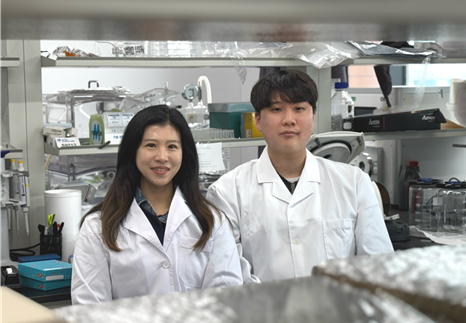 Professor Yeom Ji-hyun and Jeong Uk-jin, integrated master's and doctoral course students in the Department of Materials Science and Engineering. Provided by KAIST
First, Professor Yeom's research team focused on chiral selectivity, where molecules with left-handed (L-type) and right-handed (D-type) structures act differently, and developed a technology that imparts chirality by applying chiral nano paint to the surface of nanomaterials.
Through this, they succeeded in imparting chirality to materials of various sizes, ranging from nanometer (nm)-scale nanoparticles to micrometer (μm)-scale microstructures.
In particular, they synthesized chiral magnetic nanoparticles using the chiral nano paint technology and demonstrated anticancer hyperthermia treatment by injecting these into tumors and inducing heat through magnetic field treatment to necrotize tumor tissues. In this process, it was proven that magnetic nanoparticles with D-chirality were absorbed by cancer cells more than those with L-chirality, achieving an anticancer treatment effect improved by more than four times.
In the follow-up study conducted with Professor Jung's team, the chiral paint technology was introduced to the surface of lipid carriers delivering mRNA. mRNA-based therapeutics deliver genetic information to directly synthesize proteins inside cells, but their therapeutic effect has been limited due to the instability of the carriers.
The chiral nano paint technology presents a new paradigm that can maximize the efficiency of mRNA therapeutics by solving these problems. In fact, when using lipid carriers introduced with D-chiral paint, intracellular expression of mRNA increased stably by more than twice.
Based on this, the research team anticipates that chiral nano paint technology will be widely applied in the future in fields such as next-generation drug delivery systems including medical bio-materials, biosensors, catalysts, and nanoenzymes.
Professor Yeom said, “This research is meaningful in that it enhances the performance of bio-nanomaterials and presents a methodology for synthesizing innovative nanomaterials with various sizes and shapes,” adding, “The research team plans to continue research on next-generation bio-platforms for vaccine development to prevent diseases such as cancer and COVID-19, as well as diagnosis and treatment using chiral nanomaterials.”
Meanwhile, this research was conducted with support from the Ministry of Science and ICT, the Pan-Government Full-Cycle Medical Device R&D Project Group, and the Research Foundation’s Excellent Young Researchers Project.
© The Asia Business Daily(www.asiae.co.kr). All rights reserved.
![Clutching a Stolen Dior Bag, Saying "I Hate Being Poor but Real"... The Grotesque Con of a "Human Knockoff" [Slate]](https://cwcontent.asiae.co.kr/asiaresize/183/2026021902243444107_1771435474.jpg)















