Amid ongoing trade risks originating from the United States, such as tariff increases, the South Korean government has devised a comprehensive response plan including amendments to the Enforcement Decrees of the Customs Act and the Foreign Trade Act, as well as strengthening trade cooperation with major countries. The core measures involve pursuing legal revisions to prevent circumvention dumping and block illegal distribution, while enhancing negotiations with the US, EU, and India. Additionally, the government aims to bolster long-term industrial competitiveness by fostering low-carbon, high value-added steel products.
On the 19th, the Ministry of Trade, Industry and Energy announced that it had established the "Steel and Aluminum Trade Risk and Unfair Import Response Plan" and discussed it at the National Agenda Ministers’ Meeting, Economic Ministers’ Meeting, and Industrial Competitiveness Enhancement Ministers’ Meeting.
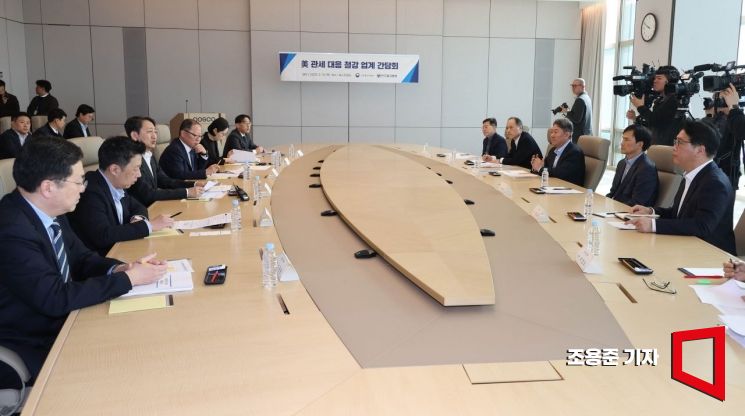 Minister Ahn Deok-geun of the Ministry of Trade, Industry and Energy attended and spoke at an industry meeting on U.S. steel tariffs held on the 13th at the POSCO Center in Gangnam-gu, Seoul. The meeting was attended by steel industry officials, including Lee Hee-geun, President of POSCO. 2025.3.13 Photo by Jo Yong-jun
Amendments to Enforcement Decrees of Customs Act and Foreign Trade Act... Strengthening Response to Unfair Imports
The government will first amend relevant laws to block the domestic inflow of imported steel products through unfair trade practices. It plans to revise the Customs Act to prevent “circumvention dumping,” where exports are routed through third countries to evade anti-dumping duties. Previously, only minor product modifications within the supplying country were considered circumvention dumping, but going forward, circumvention dumping via third countries will also be regulated to block a wider range of unfair imports.
Additionally, the government will amend the Enforcement Decree of the Foreign Trade Act to mandate the submission of a “Material Test Certificate (MTC)” at the import declaration stage to enable early detection of unfair imports. By utilizing the MTC, which contains more detailed information than the existing Certificate of Origin, the plan is to block the domestic inflow of low-quality steel or circumvention dumping products.
Intensified crackdowns on illegally distributed imported materials will also be strengthened. The Korea Customs Service will focus on cracking down on cases where imported steel products are disguised as domestic products, add high-risk items to the distribution tracking system, and increase inspection frequency from twice to four times a year.
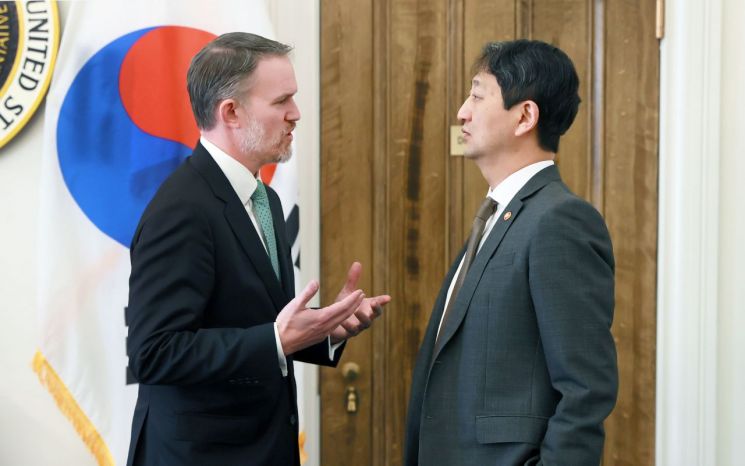
Close Consultations with the US, EU, and India... Dedicated Window for Tariff Response
The government will engage in close consultations with major countries such as the United States, the European Union (EU), and India to reduce tariff burdens on Korean steel. The Ministry of Trade, Industry and Energy held high-level discussions last month during the minister’s visit to the US and this month during the visit of the Chief Trade Negotiator to the US to seek tariff exemptions on steel. Going forward, the government plans to actively propose tariff exemptions and measures to minimize damage to Korean companies through working-level talks.
Furthermore, the government will respond closely through bilateral Free Trade Agreement (FTA) implementation channels to India’s safeguard investigations on flat products, the EU’s implementation of the Carbon Border Adjustment Mechanism (CBAM), and its review of safeguard enhancements.
To support companies, KOTRA will operate an integrated window called “Tariff Response 119.” This channel will receive trade-related difficulties from companies and provide consulting support from trade and tariff experts. Starting in April, a “Tariff Response Voucher” will be introduced to help affected companies receive overseas tariff and legal consulting.
Moreover, the Ministry of Trade, Industry and Energy plans to designate a “Steel Hub Trade Office” in April to minimize damage to exporters to the US and establish a “Technical Barriers to Trade (TBT) Response Hub” by the third quarter. The Ministry of SMEs and Startups will also create a tailored consulting program for small and medium enterprises.
Preparing for the Future... Fostering Low-Carbon, High Value-Added Steel Products
The government is preparing not only short-term responses but also strategies to strengthen the medium- to long-term competitiveness of the steel industry. Through the “Public-Private Joint Task Force for Strengthening Steel Industry Competitiveness,” launched in January this year, the government plans to pioneer the market for low-carbon, high value-added steel products.
It will also work on establishing an industrial foundation suited for the low-carbon steel era, including support for research and development (R&D) and stabilizing the supply of raw materials such as steel scrap.
An official from the Ministry of Trade, Industry and Energy stated, "We will swiftly implement these measures to promptly respond to the crisis in the steel industry," adding, "We will prepare a ‘Steel Industry Advancement Plan’ within this year to present a future blueprint for the Korean steel industry."
© The Asia Business Daily(www.asiae.co.kr). All rights reserved.
![Clutching a Stolen Dior Bag, Saying "I Hate Being Poor but Real"... The Grotesque Con of a "Human Knockoff" [Slate]](https://cwcontent.asiae.co.kr/asiaresize/183/2026021902243444107_1771435474.jpg)
















