Mom's Touch to Open Second Direct Store in Tokyo This Year
Hollys Launches with Opening Rush in Osaka
Franchise Expansion Accelerates on the Back of the "K-Food Craze"
Korean Market Already Saturated
Domestic franchise companies are turning their attention to Japan. Although Japan has long been considered a "graveyard for foreign brands" due to its closed consumer market, the threshold has lowered as the "K-food" craze sweeps mainly among the 2030 generation. The number of companies aiming to enter Japan, a country with a large population and diverse food culture, is expected to increase. However, unlike the domestic franchise market, which competed quantitatively, Japan has many self-employed business owners who emphasize craftsmanship, so companies need to devise strategies keeping competition with them in mind.
According to the industry on the 18th, burger and chicken franchise brand Mom's Touch plans to open its second directly operated store in Harajuku, Tokyo, in the first half of this year. This location, the largest scale among all Mom's Touch stores domestically and abroad, is expected to attract local MZ generation and foreign tourists.
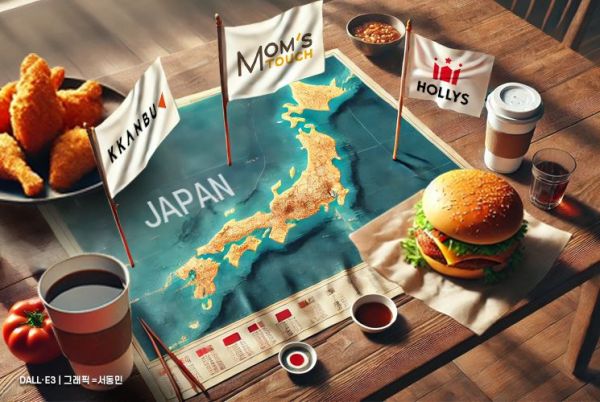
Mom's Touch is expected to actively expand its franchise business in Japan by consecutively opening stores in Tokyo's prime commercial areas following last year's Shibuya store. The first directly operated store opened in April last year in Tokyo's Shibuya core commercial district surpassed 100,000 cumulative visitors and 100 million yen in cumulative sales within 40 days of opening. By December last year, it exceeded 500,000 cumulative visitors and continues to attract about 2,000 customers daily, maintaining steady popularity.
Sales are also growing smoothly. As of July last year, monthly sales were about 64 million yen (620 million KRW), which is three times and 5.5 times higher than the average monthly sales per store of major local quick service restaurant (QSR) brands McDonald's (21.73 million yen) and KFC (11.47 million yen), respectively.
A Mom's Touch representative said, "We have confirmed the opening of a franchise store early next year at the Odaiba complex shopping mall, a famous tourist spot in Tokyo," adding, "Our local franchise business is implementing a customized store opening strategy considering the business culture and entry speed of Japanese companies."
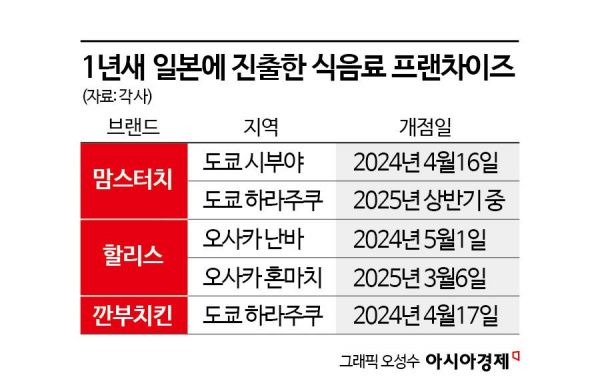
Coffee franchise Hollys is also continuing its success in Japan. Following the opening of its first Japanese store at Namba Marui last year, Hollys opened its second store on the 6th in Honmachi, Osaka’s business district. On the first day, there was a waiting line of over 30 minutes, and a gift event for the first customers ended within about two hours. It is believed that providing conveniences such as power outlets and Wi-Fi, which competing Japanese franchise brands do not offer, captivated local customers.
Kkanbu Chicken also chose Japan for its second overseas store. After opening its first store in the Philippines in 2023, it opened its first Japanese store, "Harakado Tokyo Main Store," in Harajuku, Tokyo, in April last year.
The reason domestic franchise companies have chosen Japan as their overseas expansion country in the past year is due to the changed local atmosphere. Japan has traditionally been known for high preference and loyalty to domestic brands, making it difficult for foreign brands to gain traction. Especially, it was considered risky for food franchises lacking overseas business know-how to choose Japan as their first entry country.
However, riding the newly emerging "K-culture boom" in Japan, the favorability toward Korean culture has greatly increased. This trend is driven mainly by the 2030 generation, spreading across various age groups who share Korean lifestyle elements such as content, fashion, and food. In particular, recognition of Korean food culture has risen as people eat samgyeopsal, chicken, tteokbokki, and drink soju featured in Korean dramas and share their experiences.
An industry insider explained, "With the Korean Wave in Japan frequently exposing Korean cuisine, more companies are targeting the local market with 'Korean flavors,'" adding, "Since Japan is considered an advanced country in the food service industry, success there makes global expansion easier."
Since the domestic franchise market has already reached saturation due to low birth rates and high inflation, more franchises are expected to seek new opportunities through expansion into Japan. According to Statistics Korea, as of 2022, the number of domestic franchise stores increased by 25,000 from the previous year to about 286,000.
However, unlike Korea, where large and small brands aggressively compete to open stores, there are calls to develop strategies suited to the local market in Japan. Since Japan has many restaurants emphasizing craftsmanship and is an advanced franchise industry country, more thorough preparation is advised.
Another industry insider said, "Although the local atmosphere has changed a lot now, Kyochon Chicken also quietly withdrew after entering Japan in the past," adding, "In the franchise industry, Japan is considered a more difficult market to enter than the U.S., so companies should carefully understand Japanese consumer needs before considering entry."
© The Asia Business Daily(www.asiae.co.kr). All rights reserved.


















