Later Than Predictions by Musk and Altman
Demis Hassabis, CEO of Google DeepMind, predicted on the 17th (local time) that human-level Artificial General Intelligence (AGI) will emerge within the next 5 to 10 years.
According to CNBC and others, CEO Hassabis stated at a media briefing held at Google DeepMind headquarters in London that "many AI capabilities will come to the forefront within the next 5 to 10 years, and we will move toward the stage we call AGI."
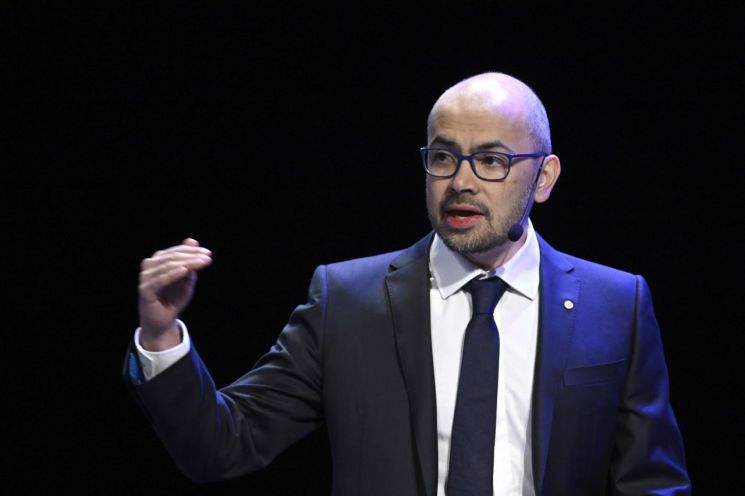
CEO Hassabis defined AGI as "a system capable of demonstrating all the complex abilities that humans can perform." Regarding the current level of artificial intelligence (AI), he said, "It is very impressive in specific fields, but there are many things it cannot do," adding, "considerable research is needed to reach the goal (AGI)." He also said, "Within the next 5 to 10 years, a significant portion of these capabilities will begin to emerge, and we will start moving toward what we call AGI."
He referred to AI that surpasses humans as Artificial Superintelligence (ASI), stating, "ASI will appear after AGI and is expected to exceed human intelligence," but also noted, "No one knows when such a groundbreaking event will occur."
The timeline predicted by CEO Hassabis is later than those anticipated by other tech company executives. Last year, Elon Musk, CEO of Tesla, forecasted the emergence of AGI by 2026, and Sam Altman, CEO of OpenAI, the developer of ChatGPT, predicted it would be developed in the relatively near future. Dario Amodei, CEO of Anthropic, an AI startup known as an 'OpenAI rival,' said in January that "within the next 2 to 3 years, AI that outperforms most humans in almost all tasks will emerge." Additionally, Gitu Patel, Cisco's Chief Product Officer, said last month, "By 2025, we will see meaningful evidence of AGI functioning," and "ASI will come at best a few years later."
CEO Hassabis identified the greatest challenge in achieving AGI as enabling current "AI systems to reach a level of understanding of real-world context." For example, while it has been possible to develop systems that analyze problems and autonomously complete tasks in games like Go, it is not easy to transfer this to the real world.
He explained, "The problem is how quickly we can generalize planning ideas and the behavior, planning, and reasoning of AI agents," adding, "and then whether that can be generalized to work in the real world." He also said, "Interaction among Multi-Agents (systems where multiple independent AI agents cooperate or compete to perform tasks) is essential for AGI development," mentioning that DeepMind has trained AI agents to compete or cooperate in the popular game StarCraft in the past.
CEO Hassabis is the AI developer who created AlphaGo, which played the historic Go match against Lee Sedol 9-dan in 2016. He also developed the 'AlphaFold' series of AI models that analyze protein structures and predict drug interactions, which won the Nobel Prize in Chemistry last year.
© The Asia Business Daily(www.asiae.co.kr). All rights reserved.
![Clutching a Stolen Dior Bag, Saying "I Hate Being Poor but Real"... The Grotesque Con of a "Human Knockoff" [Slate]](https://cwcontent.asiae.co.kr/asiaresize/183/2026021902243444107_1771435474.jpg)















