NPS Publicly Opposes MBK's Hostile M&A Investments
Policy to Be Applied to Future Contracts with Other PEFs
Other Pension Funds Also Strengthening Evaluations, Industry On Edge
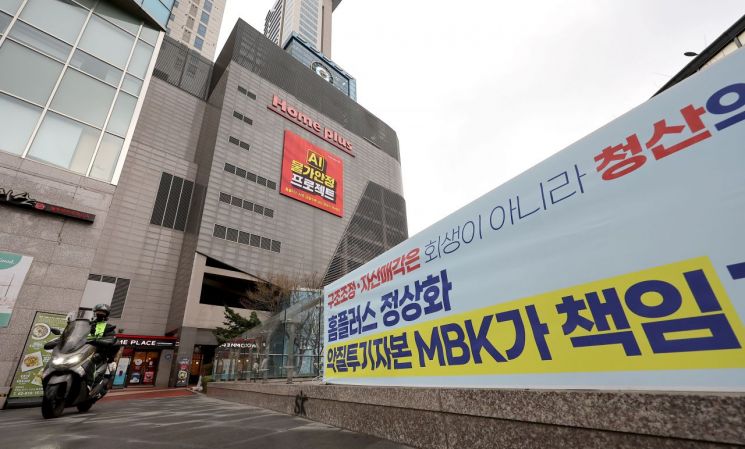
The National Pension Service (NPS) has also publicly signaled a 'distancing' from the private equity fund (PEF) management company MBK Partners. Following the management rights dispute at Korea Zinc and the sudden corporate rehabilitation filing by Homeplus, suspicions and criticisms toward PEFs appear to be intensifying.
According to the investment banking (IB) industry on the 18th, the NPS established a policy the previous day not to invest in hostile mergers and acquisitions (M&A) when investing in MBK Partners. This policy will also be reflected when signing management contracts with other private equity funds in the future.
The NPS stated that when it finalized the contract to invest in MBK Partners' blind fund last February, it included such a clause. While committing approximately 300 billion KRW, the contract stipulated that it would not participate (capital call) in hostile M&A investments. Earlier, in July last year, the NPS selected the top four firms, including MBK Partners, among 15 applicants through a comprehensive domestic private investment management company selection process. Although contracts are typically signed within two to three months after final selection, the NPS closely monitored MBK Partners' ongoing management rights dispute with Choi Yoon-beom, chairman of Korea Zinc. This was due to concerns that funding hostile M&A would not align with the NPS fund's management direction. Consequently, the contract signing was delayed by seven months.
The NPS explained, "We conducted case reviews and consultations regarding hostile M&A investments, and based on the results, negotiations with MBK Partners were adjusted, which delayed the final contract." It added, "During this process, we gathered opinions from the domestic private investment industry and others, and are considering reflecting these in future private equity fund contracts and articles of incorporation for funds to be invested."
As the NPS has taken a public distancing stance, the private equity fund industry is tense. Other major contributors, such as other pension funds, are also monitoring the situation and showing signs of strengthening investment requirements. The Government Employees Pension Service, considered one of the three major pension funds alongside the NPS and the Teachers' Pension, is reviewing ways to incorporate qualitative factors such as management stability into the evaluation of fund managers. The Teachers' Pension is also planning to examine whether fund managers can grow their portfolio companies without issues. In particular, they plan to evaluate whether PEFs operate separate corporate management organizations properly. The intention is to assess not only investment scale and capability but also the management ability of the invested companies.
Since the political sphere views this incident not as an investment failure but as 'moral hazard' and is applying comprehensive pressure, the private equity fund industry is concerned that the reputation built since its inception may be negatively altered in an instant. The National Assembly's Political Affairs Committee held a plenary session that day to conduct urgent inquiries related to Homeplus. Witnesses included Kim Byung-joo, chairman of MBK Partners; Kim Kwang-il, vice chairman of MBK Partners and co-CEO of Homeplus; Cho Joo-yeon, co-CEO of Homeplus; Geum Jeong-ho, president of Shin Young Securities; and Kang Kyung-mo, vice chairman of the Homeplus Store Association. However, Chairman Kim submitted a letter of absence to the Political Affairs Committee on the 14th citing an overseas business trip and ultimately did not attend the session.
An industry insider from the private equity fund sector said, "Since MBK made significant profits from other portfolios within the fund, they seemed to think it was acceptable to write off losses by filing for corporate rehabilitation for Homeplus, which appears to be an overly numerical approach to the matter." He added, "They probably did not expect public opinion to turn this negative, and it is regrettable because the overall industry is likely to face harsher scrutiny going forward."
© The Asia Business Daily(www.asiae.co.kr). All rights reserved.

















