Attempting Rebound After Last Week's Correction
February Retail Sales Up 0.2% Month-on-Month, Below Expectations
Tariff Policy Uncertainties Persist
Focus on FOMC Meeting on the 19th... Interest Rate Projections in the 'Dot Plot' Are Key
The three major indices of the U.S. New York Stock Exchange showed mixed movements near the flat line in early trading on the 17th (local time), St. Patrick's Day. The market on this day, which honors Saint Patrick who spread Christianity in Ireland, is attempting a rebound after last week's plunge caused by concerns over a tariff-induced recession. Retail sales last month fell short of expectations, igniting worries about consumer contraction.
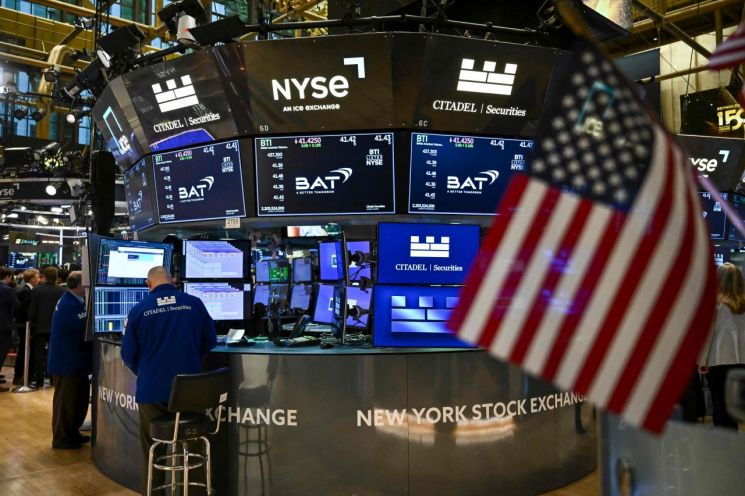
As of 11:29 a.m. in New York's stock market, the Dow Jones Industrial Average (Dow) focused on blue-chip stocks was up 239.29 points (0.58%) from the previous trading day, standing at 41,727.48. The large-cap S&P 500 index rose 13.57 points (0.25%) to 5,652.51, while the tech-heavy Nasdaq index fell 48.96 points (0.28%) to 17,705.13.
By individual stocks, AI leader Nvidia was down 1.9%. Apple declined by 1.1%. U.S. electric vehicle maker Tesla plunged 5.68%. Financial stocks were on the rise. JP Morgan increased by 0.52%, Bank of America (BoA) and Citigroup gained 0.84% and 1.29%, respectively.
The retail sales data released this morning showed figures below market expectations. According to the U.S. Department of Commerce, retail sales in February this year totaled $722.7 billion, up 0.2% from the previous month. The market had initially expected a 0.6% increase in retail sales last month, but the actual figure fell significantly short of this forecast. January retail sales were also revised from an initial 0.9% decrease to a 1.2% decrease, marking the largest decline in 3 years and 7 months since July 2021. However, retail sales excluding automobiles rose 0.3% month-over-month, meeting market expectations, which led to a relatively calm investor reaction without significant contraction in sentiment. Core retail sales (control group), which exclude volatile sectors, also recorded a 1% increase, far exceeding the forecast of 0.2%, partially alleviating concerns. Core retail sales exclude food services, automobiles, building materials, and gas station sales, and are reflected in the calculation of Gross Domestic Product (GDP), drawing attention from experts.
Jennifer Timmer, investment strategy analyst at Wells Fargo Investment Institute, analyzed, "The February retail sales report released this morning (17th) provides evidence of a limited and gradual economic slowdown rather than a signal that a recession is imminent."
The stock market experienced a sharp decline last week due to recession fears stemming from President Donald Trump's tariff policies. Although the market rose on the last trading day of last week, the Dow recorded its largest weekly drop since 2023. The Nasdaq index, as of the closing price on the 14th, remains about 12% below its previous peak, indicating it is still in a technical correction phase. Investors are attempting to rebound by buying stocks after the correction, but tariff uncertainties continue to be a source of market instability.
The second Trump administration has expressed its determination to enforce tariff policies, stating that short-term market declines must be endured. U.S. Treasury Secretary Scott Vestent appeared on NBC's "Meet the Press" yesterday and commented on the recent sharp drop in the New York Stock Exchange due to tariff concerns, saying, "Having worked in investment for 35 years, I can say this adjustment is healthy and normal," adding, "An unhealthy market is one that is overly euphoric, which leads to a financial crisis." He also stated that a "detox" is necessary to shift from government spending-driven growth to private spending-driven growth, but there is "no guarantee" that a recession can be avoided.
Derek Harris, portfolio strategist at Bank of America (BoA) Securities, analyzed, "The 'detox' of U.S. efficiency, deregulation, and trade could cause more pain in the market before visible GDP growth appears."
The big event this week is the Federal Open Market Committee (FOMC) regular meeting scheduled for the 18th-19th. The U.S. Federal Reserve (Fed) is widely expected to keep the benchmark interest rate steady at 4.25-4.5% on the 19th, with attention focused on the Fed's dot plot reflecting interest rate projections. Previously, in December last year, the Fed significantly reduced its forecast for the number of rate cuts in 2025 from four times (total 1.0 percentage point) to two times (total 0.5 percentage point), each by 0.25 percentage points. The key question is whether the Fed will emphasize inflation concerns and adopt a hawkish stance by reducing the number of rate cuts this year to one, or focus on recession fears and take a dovish stance by increasing the number to three in the dot plot to be released this time. However, Wall Street largely expects the Fed to maintain its forecast of two rate cuts this year.
On the 20th, weekly initial jobless claims, which indicate the labor market status, will be announced.
Due to concerns over reduced consumption, U.S. Treasury yields are falling, mainly in long-term bonds. The 10-year U.S. Treasury yield, a global bond yield benchmark, is down 4 basis points (1 bp = 0.01 percentage point) from the previous trading day, standing at 4.26%. The 2-year U.S. Treasury yield, sensitive to monetary policy, is trading around 4.02%, unchanged from the previous trading day.
© The Asia Business Daily(www.asiae.co.kr). All rights reserved.
![Clutching a Stolen Dior Bag, Saying "I Hate Being Poor but Real"... The Grotesque Con of a "Human Knockoff" [Slate]](https://cwcontent.asiae.co.kr/asiaresize/183/2026021902243444107_1771435474.jpg)















