"Gwangju Must Transform into a Plastic-Safe City"
Discussion on Implementing On-Site Voices for Waste Management
"Establishing the Foundation for Ordinance Enactment and Revision, and Formation of Consultative Bodies"
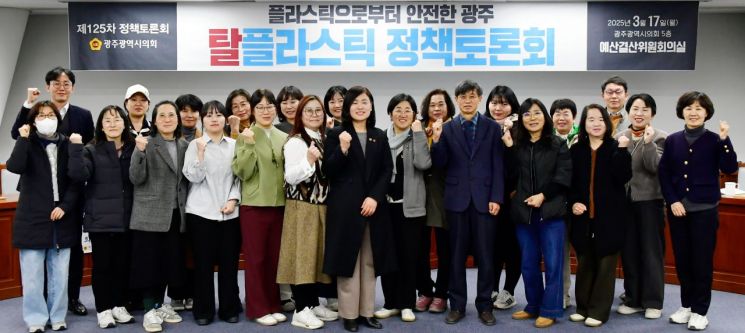 Jihyun Choi, a member of the Gwangju Metropolitan Council, held a policy forum on the 17th in the Budget and Settlement Special Committee Room on the 5th floor of the City Council building to review the current status of plastic reduction policies in the Gwangju area and to explore policy directions for citizen participation-based 'plastic-free' initiatives. Photo by Gwangju Metropolitan Council
Choi Jihyun, a member of the Gwangju City Council (Democratic Party of Korea, Gwangsan 1), held a policy forum on "A Plastic-Free and Safe Gwangju" at the Special Budget and Accounts Committee Room on the 5th floor of the City Council on the 17th.
The forum was organized to address escalating environmental issues such as waste problems caused by increased plastic use, rising greenhouse gas emissions, and the spread of microplastics. In particular, the event reviewed the current status of plastic reduction policies in the Gwangju area and explored directions for "plastic-free" policies based on citizen participation.
For the keynote presentations, Moon Gapsaeng, Director of the Household Waste Division at Korea Environment Corporation, presented on "K-Resource Circulation Policy for Transition to a Circular Economy," while Lee Kyunghee, Deputy Director of the Gwangju Citizens’ Environmental Research Institute, gave suggestions for "A Plastic-Free Gwangju."
Director Moon introduced the following through his presentation: ▲ Introduction of a grading evaluation system for improving packaging material and structure ▲ Strengthening reduction of waste plastics at the production stage ▲ Revising standards for separate collection to improve recycling rates. He stated, "The government aims to reduce plastic usage by 60% and achieve a 70% recycling rate by 2030," emphasizing, "It is important to reduce factors that lower plastic quality, such as multilayer structures, composite materials, and color usage, and to design products with structures that are easy to recycle from the design stage. An integrated approach throughout the entire cycle of production, consumption, and separate collection is necessary."
Deputy Director Lee proposed ▲ Realizing reduction of single-use products in the public sector ▲ Expanding rental and return systems for reusable containers ▲ Regulations and incentives for the transition to plastic-free ▲ Building public-private governance, and stressed, "The public sector must take the lead so that the private sector can follow," urging public institutions to play a leading role.
In the designated discussion that followed, Oh Jinhee, Secretary General of the Gwangju Resource Circulation Council, Jung Eunjung, Director of the Gwangju Environmental Movement Association, Park Jaemin, CEO of Grico Co., Ltd., and Jung Mikyung, Director of the Resource Circulation Division at Gwangju City, participated. They shared on-site perspectives and various alternatives by presenting practical cases of plastic reduction, institutional challenges, fostering the bioplastics industry, and expanding the use of reusable packaging from administrative and industrial perspectives.
Chairing the session, Councilor Choi emphasized, "The plastic problem is a social cost created by everyday convenience, and now it is necessary to transition to a resource-circulating society in which all citizens participate."
She continued, "According to one study, we ingest about 5g of microplastics per week, equivalent to the weight of a credit card," adding, "As microplastics infiltrate every corner of our daily lives and threaten health and ecosystems, it is essential for the entire local community to participate and make efforts for Gwangju to become a leading plastic-free city."
Councilor Choi also added, "I hope today’s event will serve as a starting point for policies that can be practically implemented on the ground," and "The council will also establish an effective policy foundation for a plastic-free city through the enactment and revision of ordinances and the formation of consultative bodies."
© The Asia Business Daily(www.asiae.co.kr). All rights reserved.
![Clutching a Stolen Dior Bag, Saying "I Hate Being Poor but Real"... The Grotesque Con of a "Human Knockoff" [Slate]](https://cwcontent.asiae.co.kr/asiaresize/183/2026021902243444107_1771435474.jpg)















