Korea Real Estate Board Releases February National Housing Price Trend Survey
Nationwide Housing Sales Price Index Declines for Third Consecutive Month
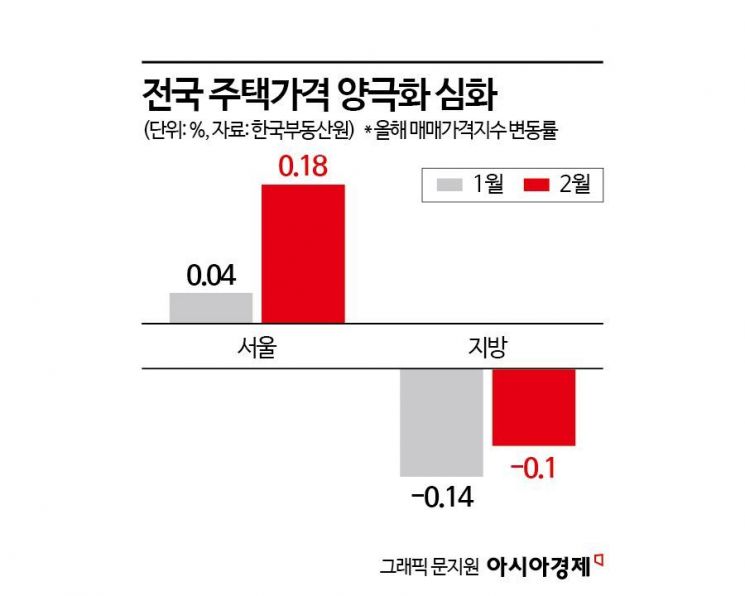
Last month, Seoul's housing prices rose the most in three months. Nationwide, Seoul was also the area where apartment prices increased the most. In contrast, provincial areas continued to experience a decline.
According to the 'National Housing Price Trend Survey' released by the Korea Real Estate Board on the 17th, the housing (including apartments, row houses, and detached houses) sales price index in Seoul last month rose by 0.18% compared to the previous month. This is the largest increase since November last year (0.20%).
The areas driving the rise in Seoul housing prices were the 'Gangnam 3 districts' and regions with good school districts. On the other hand, areas with a large volume of move-ins or located on the outskirts with low preference saw prices fall.
By autonomous district, the 'Gangnam 3 districts'?Songpa (0.94%), Seocho (0.74%), and Gangnam (0.68%)?showed the largest increases. Songpa and Gangnam, where the land transaction permit system was lifted on the 12th of last month, recorded their largest increases in six and four months respectively, while Seocho saw its biggest rise in five months. Yongsan (0.24%), Gangdong (0.16%), Gwangjin (0.15%), and Mapo (0.14%) also rose.
Conversely, Nowon (-0.07%), Dobong (-0.04%), Gangbuk (-0.03%), Guro (-0.03%), and Eunpyeong (-0.02%) experienced declines.
Gyeonggi (-0.10%) and Incheon (-0.20%) continued their downward trends, but due to Seoul's increase, the overall decline in the metropolitan area narrowed from -0.06% to -0.01%.
Provincial areas also saw a reduction in the rate of decline from -0.14% to -0.10%. The five major metropolitan cities (-0.21% to -0.16%), eight provinces (-0.09% to -0.05%), and Sejong (-0.30% to -0.29%) all showed a slowdown in their downward trends.
As a result, nationwide housing prices fell by 0.06%, a smaller decline compared to the previous month (-0.10%). This marks the third consecutive month of decline since the downturn began in December last year.
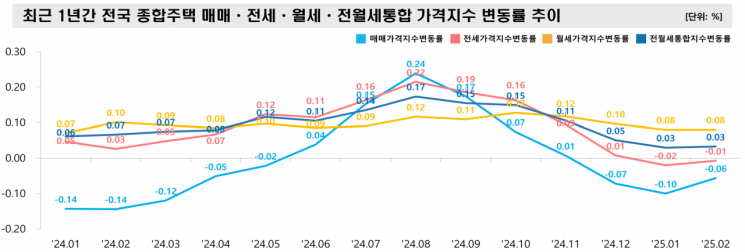 Trends in the nationwide comprehensive housing sale, jeonse, monthly rent, and combined jeonse-monthly rent price index change rates over the past year. Provided by Korea Real Estate Board
Apartment prices in Seoul rose by 0.24%, recording the largest increase nationwide. Ulsan (0.03%), Chungbuk (0.01%), and Jeonbuk (0.05%) also saw slight increases. However, the metropolitan area (-0.03%) and provincial areas (-0.15%) declined, leading to a nationwide apartment price drop of 0.09%. The Korea Real Estate Board analyzed, "In Seoul and the metropolitan area, prices continue to fall in outskirts or areas with many new apartments, while popular complexes like reconstruction apartments attract demand, causing regional differences."
Jeonse (long-term lease) prices fell by 0.01%, a smaller decline compared to the previous month (-0.02%). Seoul (0.00% to 0.06%) saw increases centered around good school districts and areas near subway stations. Provincial areas (-0.02%) remained unchanged, while Sejong (-0.04% to -0.12%) experienced an expanded decline.
Monthly rent rose nationwide by 0.08%, maintaining the same rate of increase as the previous month. Seoul (0.10% to 0.12%) saw an expanded rise, and the metropolitan area (0.13%) increased at the same rate. Sejong (0.07% to -0.13%) shifted to a decline. Including this, provincial monthly rent rose by 0.04%, unchanged from the previous month.
The Korea Real Estate Board stated, "There are areas in Seoul and the metropolitan area where expectations of rising housing prices exist, as well as regions with low popularity where buyers have the advantage. In provincial areas, the situation varies depending on the supply volume in each region, but overall, the rate of decline has lessened nationwide."
They added, "In the jeonse and monthly rent markets, prices are rising in complexes near subway stations or with good school districts, but older apartments and outskirts are losing popularity. Jeonse price declines have narrowed, while monthly rent continues to maintain an upward trend."
© The Asia Business Daily(www.asiae.co.kr). All rights reserved.
![Clutching a Stolen Dior Bag, Saying "I Hate Being Poor but Real"... The Grotesque Con of a "Human Knockoff" [Slate]](https://cwcontent.asiae.co.kr/asiaresize/183/2026021902243444107_1771435474.jpg)

















