Concerns Rise in the Defense Industry Amid Favorable Relations
Anxieties Grow Over Potential Setbacks from the Second Trump Administration
"Government System Did Not Function Properly"
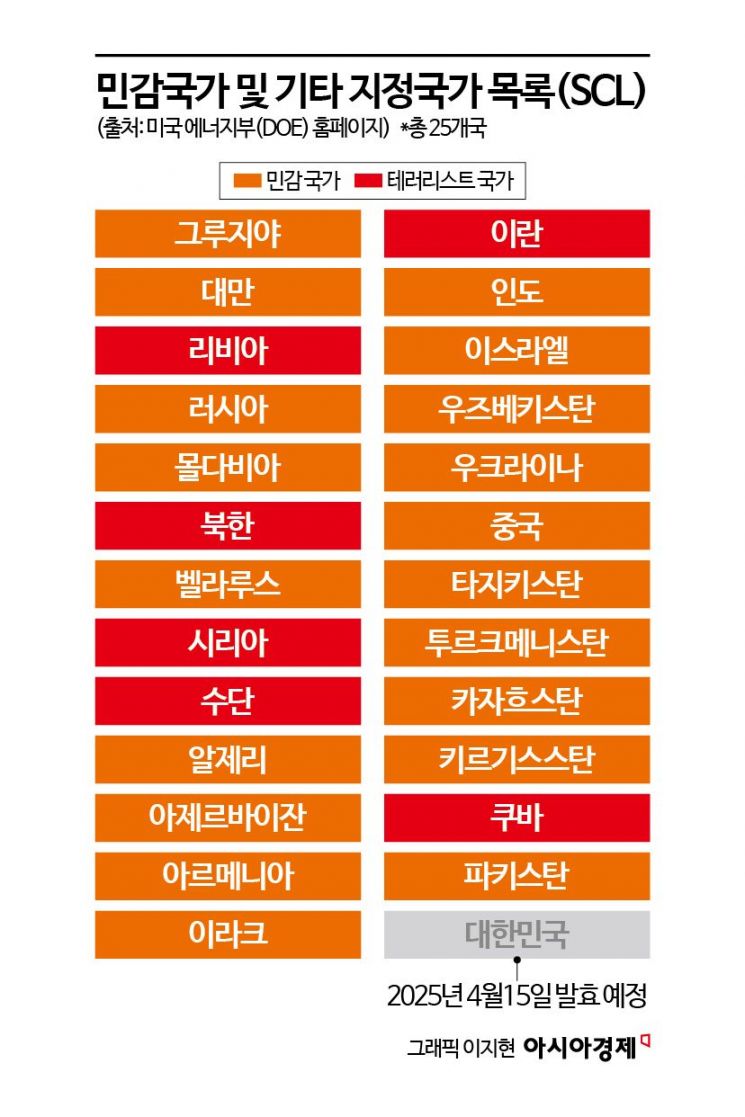
The domestic industry is struggling to hide its embarrassment after it was belatedly revealed that the U.S. government has decided to add South Korea to the 'Sensitive Countries List,' which can restrict cooperation in areas such as nuclear power and artificial intelligence (AI). There is widespread concern that this designation, along with the 'reciprocal tariffs' scheduled to be imposed from the 2nd of next month, will have a negative impact on the industrial environment in South Korea.
According to the business community on the 18th, after it was confirmed that South Korea was newly included in the U.S. government's 'Sensitive and other designated Countries List (SCL),' companies have reportedly held internal meetings to review the potential impact of the sensitive country designation and to consider countermeasures. A business official said, "We held a countermeasure meeting early in the morning regarding the sensitive country designation and discussed related issues," adding, "We are currently at the stage of identifying which sectors and to what extent the impact will be."
The defense industry is the most immediately affected. South Korea is currently preparing the Reciprocal Defense Procurement Agreement (RDP-A), known as an FTA in the defense industry, with the United States. However, if South Korea is designated as a sensitive country, it may face difficulties in concluding the agreement. Furthermore, there are concerns that defense exports will inevitably suffer damage. Shim Soon-hyung, head of the Security Strategy Team at the Korea Institute for Industrial Economics and Trade, said, "Most of our defense export products use U.S.-made components," adding, "For exports containing U.S. components, approval from the U.S. is required, and there is a possibility that objections may be raised citing the sensitive country designation."
Inside and outside the industry, the prevailing view is that this sensitive country measure could also hinder research and development (R&D) cooperation between South Korea and the U.S. in advanced fields such as nuclear power, AI, and semiconductors. Park Joo-heon, a professor of economics at Dongduk Women's University, said, "There will be many negative impacts on R&D," adding, "It is expected that there will be various restrictions, especially in sharing U.S. technology." A semiconductor industry official also said, "Due to restrictions on cooperation with research institutions under the U.S. Department of Energy, indirect effects may occur in advanced technology fields, so it is necessary to keep monitoring the situation."
Once listed as a sensitive country, South Korean researchers must undergo stricter certification procedures when participating in cooperative projects with institutions under the U.S. Department of Energy (DOE). Even visits without participation in research require prior review, and approval must be requested at least 45 days in advance. In contrast, for non-sensitive countries, submissions are required five days prior. However, within the industry, there is also a view that since the sensitive country designation is a regulation limiting cooperation with the DOE or its affiliated institutions, its impact on most projects and businesses involving private sector collaboration will be limited.
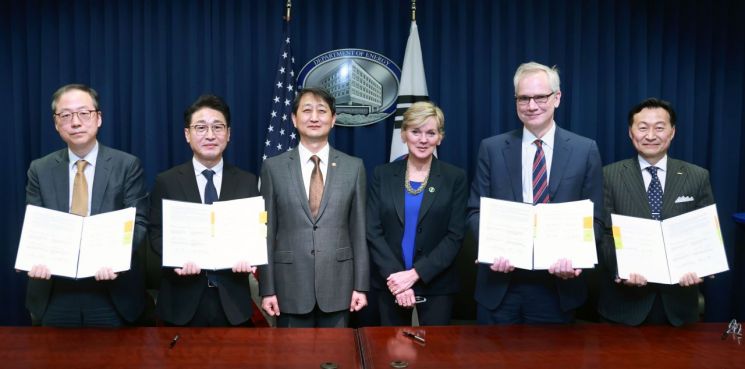 Minister Anduk Geun of the Ministry of Trade, Industry and Energy (third from the left) is posing for a commemorative photo after signing an inter-agency agreement on the "Principles of Korea-U.S. Nuclear Export and Cooperation" with former U.S. Secretary of Energy Jennifer Granholm (fourth from the left) and officials at the U.S. Department of Energy conference room in Washington D.C. on January 8 (local time). Around this time, the U.S. Department of Energy decided to include Korea in the sensitive countries list. Photo by Yonhap News
Industry concerns are particularly high regarding the increasing uncertainty caused by unexpected variables following the emergence of the second Trump administration. Including the recent sensitive country designation and prior reciprocal tariffs, problems beyond the capacity of individual companies continue to strike the industry. An industry official said, "Even though the inclusion on the sensitive country list happened two months ago, the government has not provided any guidelines to us so far," adding, "The same goes for reciprocal tariffs, and under these circumstances, it is indeed difficult for our companies to come up with individual countermeasures."
Yang Seung-ham, a former professor of political science and diplomacy at Yonsei University, said, "This sensitive country designation can be seen as evidence that the government system did not function properly," pointing out, "When the tariff issue arose, all the government did was have the Minister of Trade, Industry and Energy visit the U.S. once, without any concrete negotiation results." Previously, Minister Ahn Deok-geun of the Ministry of Trade, Industry and Energy visited the U.S. last month and held initial sequential contacts with senior officials in the Trump administration's trade and energy sectors. Minister Ahn is scheduled to visit the U.S. again this week to meet Chris Wright, U.S. Secretary of Energy, to discuss Korea-U.S. energy cooperation as the main agenda.
© The Asia Business Daily(www.asiae.co.kr). All rights reserved.


















