41 Improvement Tasks Selected and Proposed for Revision to the Fair Trade Commission
The Korea Economic Association stated that the Fair Trade Commission's disclosure system is increasing the burden on companies and needs improvement. They decided to gather opinions from major companies and propose a total of 41 improvement tasks.
On the 18th, the Korea Economic Association announced that it had delivered these disclosure system improvement proposals to the Fair Trade Commission. Disclosure refers to companies revealing key information to investors and the market. The disclosure system overseen by the Fair Trade Commission includes ▲Disclosure of Corporate Group Status ▲Board Resolution and Disclosure of Large Internal Transactions ▲Disclosure of Important Matters of Unlisted Companies. The Korea Economic Association pointed out that companies feel a significant administrative burden due to excessive disclosures.
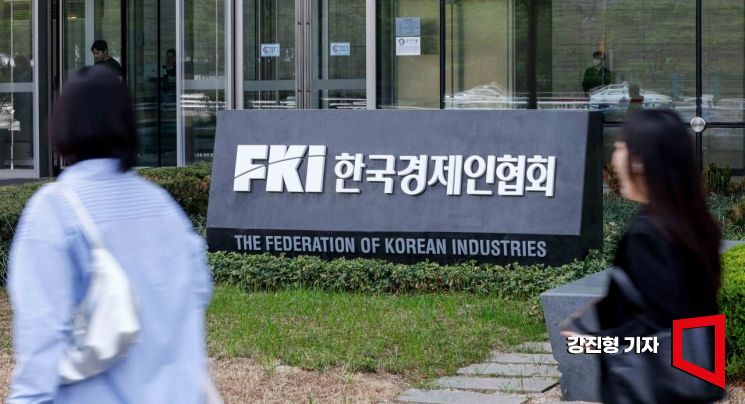 Employees of tenant companies are moving at the Korea Economic Association in Yeouido, Seoul. Photo by Kang Jin-hyung
First, they highlighted the tight disclosure schedule despite the requirement for vast amounts of data. The Fair Trade Commission's disclosure of corporate group status involves announcing the manual between April and May every year, holding explanatory meetings in mid-May, and completing data entry by the end of May. Most companies complained that the volume of disclosure data is so large that it is difficult to meet the tight schedule. Among the 135 violations of Fair Trade Commission disclosures last year, delayed disclosures accounted for 96 cases (71.1%), the highest number.
Another issue is that some items in the Fair Trade Commission disclosures overlap with those of the Financial Supervisory Service disclosures. Under the Fair Trade Act, corporate groups subject to disclosure must reveal the status of affiliated companies through the 'Disclosure of Corporate Group Status.' Among the disclosure contents, status items such as general information, executives, board operations, and stock ownership overlap with the Financial Supervisory Service's disclosure in the 'Business Report.' The Korea Economic Association proposed deleting overlapping items and instead including links to the Financial Supervisory Service disclosures.
In the 'Executive Status' section of the corporate group status disclosure, companies must enter 11 pieces of information per executive. In particular, the 'Term Expiration (Scheduled) Date' must be recorded down to the exact date, but since accurate prediction is difficult, companies argue that there is a risk of false disclosure from the moment it is recorded. Also, the 'Major Career' of executives is difficult for companies to find individually for current and former careers, while users rarely search for personal information through disclosure data. The Korea Economic Association proposed reducing items that impose excessive administrative burdens on companies relative to their informational value.
They also requested simplification of board resolutions and prior disclosure systems when public interest corporations receive donations of affiliate stocks or donation funds. Currently, when a public interest corporation receives 'stocks' from an affiliate, regardless of the transaction counterparty or amount, board resolution and disclosure obligations arise. If a general person donates even one share of an affiliate stock belonging to the corporate group of the public interest corporation, the public interest corporation must hold a board meeting and disclose it. This means that every time a public interest corporation receives affiliate stocks as donations, it must convene non-executive unpaid directors each time.
Lee Sang-ho, head of the Economic and Industrial Headquarters at the Korea Economic Association, said, "Since the end of last year, the Korea Economic Association has formed a practical consultative body with corporate disclosure practitioners to identify improvement tasks. If these improvements are reflected in policy, the burden on companies will be greatly reduced without hindering information users' access to data."
© The Asia Business Daily(www.asiae.co.kr). All rights reserved.
![Clutching a Stolen Dior Bag, Saying "I Hate Being Poor but Real"... The Grotesque Con of a "Human Knockoff" [Slate]](https://cwcontent.asiae.co.kr/asiaresize/183/2026021902243444107_1771435474.jpg)















