Ruling Party Cautious After Raising Nuclear Armament Theory
Party Leadership: "Opposition Responsible for the Situation"
Democratic Party: "Yoon Was the Initial Cause"
Strong Criticism of Nuclear Armament Theory
The U.S. designation of South Korea as a 'Sensitive and Other Designated Countries List (SCL)' has exposed cracks in the South Korea-U.S. alliance. While both the government and ruling and opposition parties are on high alert about the seriousness of the situation, they are showing differences in views regarding the causes and solutions.
The People Power Party (PPP) has drawn a line against views that point to the 'nuclear armament theory' as the cause, while closely monitoring the situation. Kim Geon, the ruling party's secretary on the National Assembly's Foreign Affairs and Unification Committee, said in a phone interview with Asia Economy on the 17th, "It is desirable to give the government time to identify the cause of the designation as a sensitive country and for the National Assembly to observe and then respond." This implies that the opposition's call for a full Foreign Affairs and Unification Committee meeting is inappropriate.
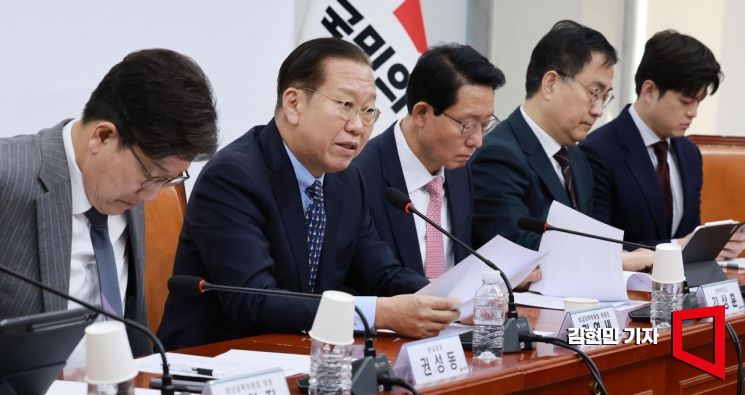 Kwon Seong-dong, Emergency Response Committee Chairman of the People Power Party, is speaking at the Emergency Response Committee meeting held at the National Assembly on the 17th. 2025.3.17 Photo by Kim Hyun-min
The PPP believes that depending on the government's diplomatic response, it is possible to revoke the designation as a sensitive country before it takes effect. Kim Dae-sik, the PPP's chief floor spokesperson, said on YTN radio that day, "If we provide a defense against what the U.S. demands, there is definitely a possibility of negotiation."
They also warned against the nuclear armament theory losing momentum. A PPP member of the Foreign Affairs and Unification Committee said, "Personally, I find it hard to believe that the nuclear armament theory is the reason," adding, "I think the U.S. took action because of concerns or dissatisfaction in practical and administrative aspects of bilateral science and technology cooperation." On the other hand, they ignited the opposition's responsibility theory. Kwon Seong-dong, the PPP floor leader, claimed at an emergency meeting that "the political chaos caused by the major opposition party has led to a diplomatic and security crisis."
The opposition party is advancing the logic that President Yoon is the initial cause of this situation. They argue that President Yoon's remarks around the January 2023 New Year's work report, such as "deploying tactical nuclear weapons in South Korea or possibly possessing our own nuclear weapons," mark the starting point of the problem.
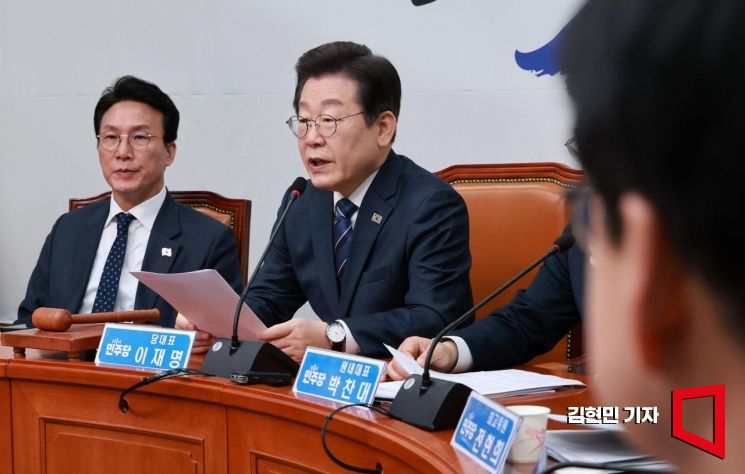 Lee Jae-myung, leader of the Democratic Party of Korea, is speaking at the Supreme Council meeting held at the National Assembly on the 17th. 2025.3.17 Photo by Kim Hyun-min
Lee Jae-myung, leader of the Democratic Party, said at the Supreme Council meeting that day, "On April 27, 2023, President Yoon reaffirmed South Korea's obligations and commitments under the Nuclear Non-Proliferation Treaty (NPT) and compliance with the Korea-China Atomic Energy Peace Cooperation Agreement during the so-called Washington Declaration with U.S. President Biden."
Lee claimed, "(The U.S.) strictly adheres to the Korea-U.S. Atomic Energy Agreement. It was reiterated. From then on, the U.S. thought there might be a possibility that South Korea would violate the NPT. Therefore, the official declaration included clauses stating that South Korea will comply with the NPT and the Korea-U.S. Atomic Energy Agreement."
The Justice Innovation Party is also supporting this claim. Kim Jun-hyung, a Justice Innovation Party lawmaker, said on CBS radio that day, "I think the cause of this designation as a sensitive country is almost entirely due to the nuclear armament theory circulating in our country," adding, "It is necessary to properly identify the cause of the designation and confirm to the U.S. that the nuclear armament theory is not true."
The problem arises if suspicions are not dispelled by the 15th of next month. Some fear that South Korea may suffer disadvantages in matters requiring U.S. cooperation, such as nuclear power. Regarding this, a Foreign Ministry official said, "We will actively negotiate to ensure that energy and science and technology cooperation between South Korea and the U.S. is not negatively affected."
© The Asia Business Daily(www.asiae.co.kr). All rights reserved.
![Clutching a Stolen Dior Bag, Saying "I Hate Being Poor but Real"... The Grotesque Con of a "Human Knockoff" [Slate]](https://cwcontent.asiae.co.kr/asiaresize/183/2026021902243444107_1771435474.jpg)
















