Seoul City and Jongno-gu Issue Two Removal Warnings
Discussing Administrative Actions Including Fines and Restoration Orders
Oh: "All Measures Will Be Considered Against Illegal Tents"
Democratic Party: "Regretful to Raise Such a Minor Issue"
The Seoul Metropolitan Government is considering administrative measures such as fines against the tents installed near Gwanghwamun and the Constitutional Court. These tents were set up by the Democratic Party of Korea and some civic groups for rallies urging the impeachment of President Yoon Seok-yeol, and they seem to be becoming another point of conflict between the ruling and opposition parties ahead of the Constitutional Court's ruling.
According to the Seoul city government on the 17th, Jongno-gu, which manages the sidewalks around Gwanghwamun, has issued two removal warnings to the rally organizers, and now the city intends to discuss enforcement of administrative measures.
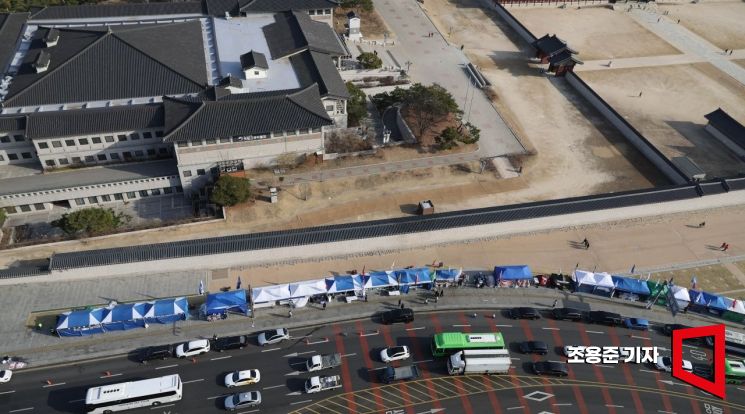 Along the roadside next to the National Museum in Jongno-gu, Seoul, tent protest sites calling for the impeachment of President Yoon Seok-yeol have been set up by the Democratic Party, the Party for Justice and Innovation, and the two major labor unions. Photo by Jo Yong-jun
The five opposition parties including the Democratic Party and the Korean Confederation of Trade Unions have been holding a "Presidential Impeachment Rally" since last week, setting up about 40 tents on the road from Seosipjagak to Dongsipjagak in front of Gwanghwamun. Jongno-gu conducted two rounds of administrative guidance for each group in the presence of police officers, but some tents are causing pedestrian and traffic obstructions.
Under current law, tents installed on roads without local government permission are illegal. Moreover, the area in front of Gwanghwamun is a cultural heritage protection zone, so this could also violate the Cultural Heritage Protection Act. Installing facilities in a cultural heritage protection zone also requires local government approval.
The Seoul Metropolitan Government and Jongno-gu are reviewing related measures such as imposing compensation fees, fines, and orders to restore the original state. According to the Administrative Enforcement Act, if an obligated party fails to fulfill administrative duties, the administrative agency may carry out administrative enforcement. The costs of administrative enforcement can also be collected from the obligated party.
The issue is that the tents in Gwanghwamun are being used as a battleground ahead of the Constitutional Court's impeachment trial of President Yoon. Seoul Mayor Oh Se-hoon criticized the opposition party's outdoor political struggle, stating, "Seoul will strictly hold accountable the illegal and unlawful acts of the imperial majority party," asserting his presence as a presidential candidate. Mayor Oh said, "At some point, it became routine to set up tents and stage sit-ins whenever disputes arise, but if the lawmakers who make the laws are the ones doing this, the story changes," adding, "If a ruling party with an absolute majority in the National Assembly reigns over public authority and commits illegal acts in the heart of the city, the result will be a decline in national dignity."
The opposition criticized whether it was appropriate for the Seoul mayor to intervene. Kim Seong-hoe, spokesperson for the Democratic Party of Korea, said, "It is true that we installed tents as auxiliary structures for our rally, but it is somewhat regrettable that a metropolitan city mayor is raising such a minor and peripheral issue."
Political activities around Gwanghwamun are also increasing. Not only the Democratic Party but also the Party for Justice and Innovation, the Progressive Party, the extraparliamentary Justice Party, and the Labor Party have set up protest tents and are holding supreme council meetings and party caucuses inside them. The People Power Party, centered on pro-Yoon lawmakers such as Na Kyung-won, has launched relay protests around the Constitutional Court area.
© The Asia Business Daily(www.asiae.co.kr). All rights reserved.
![Clutching a Stolen Dior Bag, Saying "I Hate Being Poor but Real"... The Grotesque Con of a "Human Knockoff" [Slate]](https://cwcontent.asiae.co.kr/asiaresize/183/2026021902243444107_1771435474.jpg)















