Average Broad Money (M2) Balance in January Reaches 4,203.8 Trillion Won
Up 0.5% from Previous Month... 20 Consecutive Months of Growth
The money supply in circulation has increased for 20 consecutive months. Due to the decline in fixed deposit interest rates and other factors, investment standby funds have increased, leading to a rise in demand deposits and other accounts.
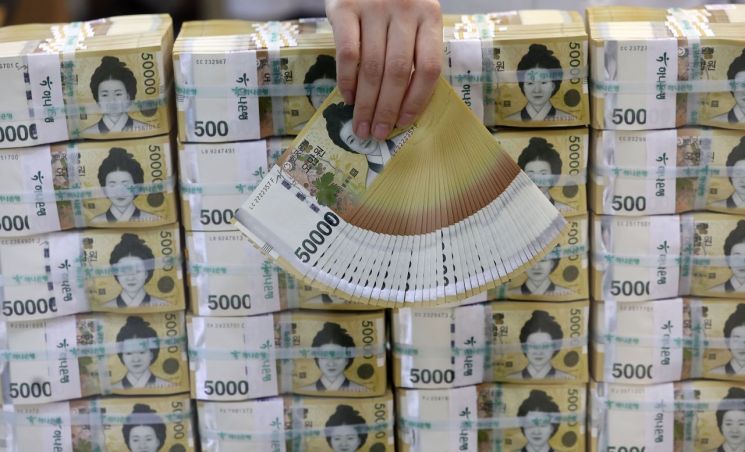
According to the Bank of Korea on the 17th, the seasonally adjusted broad money (M2) average balance in January was 4,203.8 trillion won, an increase of 20.1 trillion won (0.5%) compared to the previous month. M2 has been on an upward trend for 20 consecutive months since June 2023. M2 is a broad monetary indicator that includes cash, demand deposits, and savings deposits with frequent withdrawals (narrow money, M1), as well as money market funds (MMF), fixed deposits and savings deposits under two years, beneficiary certificates, and repurchase agreements (RP).
By financial product, demand deposits and money trusts increased by 5.5 trillion won and 4.7 trillion won respectively compared to the previous month. Demand deposits rose due to an increase in investment standby funds caused by the decline in fixed deposit interest rates, while money trusts increased due to a rise in short-term financial product management demand by companies at the beginning of the year.
On the other hand, fixed deposits and savings deposits decreased by 5.9 trillion won, marking a decline for the second consecutive month. A Bank of Korea official explained, "The decrease in fixed deposits and savings deposits was influenced by weakened incentives for banks to raise funds due to a slowdown in loan growth, as well as withdrawals of funds for fiscal execution by local governments."
By sector, the money supply for households and non-profit organizations increased by 3.9 trillion won, mainly in savings deposits with frequent withdrawals and other beneficiary certificates. Corporations increased by 21.2 trillion won, centered on demand deposits, other monetary products, and money trusts. Other financial institutions increased by 7.8 trillion won, mainly in other beneficiary certificates, fixed deposits and savings deposits, and MMFs. Conversely, the money supply in other sectors decreased by 1.8 trillion won, mainly in fixed deposits and savings deposits.
The average balance of narrow money (M1) was 1,277.5 trillion won, increasing by 7.4 trillion won (0.6%) compared to the previous month, mainly due to demand deposits and others.
© The Asia Business Daily(www.asiae.co.kr). All rights reserved.
![Clutching a Stolen Dior Bag, Saying "I Hate Being Poor but Real"... The Grotesque Con of a "Human Knockoff" [Slate]](https://cwcontent.asiae.co.kr/asiaresize/183/2026021902243444107_1771435474.jpg)
















