Fewer Top-Ranked Students in Smaller Schools
"May Become a Key Factor in Future School District Selection"
As the school-age population declines, the gap in the number of students per high school between regions is widening. It is analyzed that smaller schools may be at a disadvantage in admissions, such as internal school grades.
According to Jongro Academy on the 17th, the gap in the average number of students per grade in high schools among the 17 metropolitan cities and provinces is expanding every year. In the 2025 academic year, the gap between the region with the highest and lowest average number of students per high school was 136.7 students, but it will increase to 150.4 students in 2026 and 160.0 students in 2027.
 Students are preparing for the exam ahead of the 'September Mock Test for the 2025 College Scholastic Ability Test' held at Yeouido Girls' High School in Yeongdeungpo-gu, Seoul. Photo by Kang Jin-hyung
Last year, Gyeonggi had the highest average number of 3rd-year high school students per school at 249.1, while Gangwon had the lowest at 112.4. This year, the gap widened to 150.4 students with Gyeonggi at 278.7 and Gangwon at 129.3. The regions with the highest average number of students per high school this year are Gyeonggi, followed by Sejong at 262.1 and Seoul at 251.7.
Among the 25 autonomous districts in Seoul, the maximum gap in the number of students per district is also gradually increasing: 159.8 students in 2025, 174.8 in 2026, and 195.8 in 2027.
In the current 9-grade system applied to 2nd and 3rd-year high school students, it is more difficult to secure top internal grades when there are fewer students. Since the percentages are fixed?4% for 1st grade, 11% for 2nd grade, etc.?the larger the number of students taking a course, the larger the number of students in the 1st grade. For example, if the number of students taking a subject is between 1 and 4, no one receives 1st grade; if between 5 and 37, one student receives 1st grade; and if between 38 and 62, two students receive 1st grade, and so on.
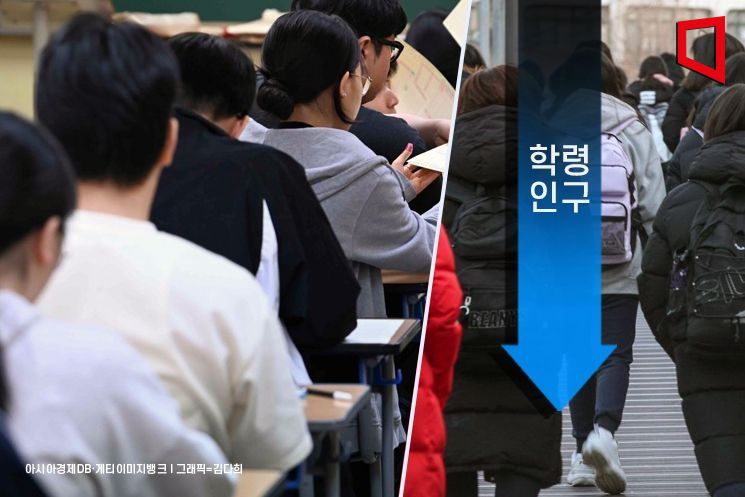
Lim Seong-ho, CEO of Jongro Academy, said, "In the 2026 and 2027 academic years, as the gap in the number of students per high school and region widens significantly, it is expected that schools and regions with larger student populations will also have an advantage in college admission results for students in the top internal grade ranks." He added, "In the admissions process where internal school grades are critically important, regions with relatively larger student populations can be considered advantageous. In the future, the number of students is likely to become a significant factor in choosing high schools and school districts."
© The Asia Business Daily(www.asiae.co.kr). All rights reserved.
![Clutching a Stolen Dior Bag, Saying "I Hate Being Poor but Real"... The Grotesque Con of a "Human Knockoff" [Slate]](https://cwcontent.asiae.co.kr/asiaresize/183/2026021902243444107_1771435474.jpg)
















