Competition Begins in Early Childhood for Top Universities and Corporations
Rising Private Education Costs Fueling Vicious Cycle of Record-Low Birth Rate
As South Korea's early childhood private education market overheats, giving rise to terms like '4-year-old exam' and '7-year-old exam,' foreign media have also begun to shed light on the issue. On the 16th, Yonhap News cited an article from the British daily Financial Times (FT) reporting on the state of South Korea's early childhood private education market. The FT pointed out that nearly half, 47.6%, of children under six in South Korea participate in private education in an article titled "South Korea's academic competition pushes nearly half of children under six into cram schools."
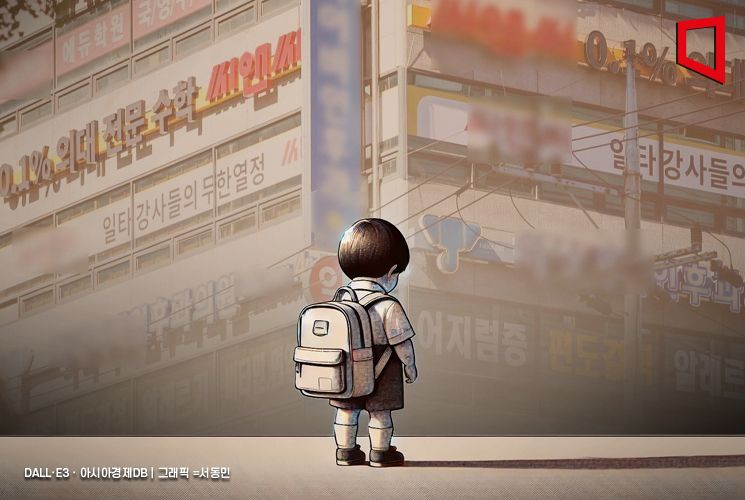
The FT introduced South Korea's 'hagwon' as "institutions that provide classes in subjects such as English, mathematics, science, and writing," noting that it has become a very large industry in South Korea. It further analyzed that Korean parents rely on these hagwon "to ensure their children get ahead in the intense competition for admission to top universities and a few large corporations with high-income jobs." The article pointed out that the newly released statistics show that this private education frenzy has extended even to young children before entering school.
Moreover, the FT diagnosed that the increasing burden of private education costs is one of the reasons why young people avoid childbirth, affecting South Korea's birth rate, which is among the lowest in the world. The FT reported, "South Korea's total fertility rate last year was 0.75, and the pressure from the academic system contributes to South Korea's population structure," adding, "Korean parents are also highly dissatisfied with the burden of private education but simultaneously choose private education out of fear that their children will fall behind."
Growing Early Childhood Private Education Market, but Effectiveness is 'Questionable'
Meanwhile, in recent times in South Korea, the early childhood private education market has grown so much that terms like '4-year-old exam' and '7-year-old exam' have become popular, referring to preparing for level tests to enter English hagwon (English kindergartens) beyond just preparing for prestigious university entrance exams. As the target age for private education gradually lowers, parents' financial burden for private education is increasing day by day.
 Meanwhile, recently in Korea, the private education market for infants and toddlers is growing so much that the terms "4-year-old exam" and "7-year-old exam" have become popular, referring to preparing level tests to enter English academies (English kindergartens) beyond just preparing for prestigious university entrance exams. As the age group for private education gradually lowers, parents' financial burden for private education expenses is also increasing day by day. Asia Economy
Among these trends, research results have shown that early childhood private education does not have a clear effect on academic achievement or emotional development. On the 16th, the National Institute of Child Care and Education, a government research institute, released a report titled "A Study on Early Childhood Private Education Experience and Development," focusing on this issue. The research team analyzed the long-term effects of private education experience at ages 3 to 5 on later academic performance during elementary and middle school using data from the Korea Child Panel Survey, which annually tracks 2,150 children born between April and August 2008. This study controlled for other variables such as children's intelligence, parents' income level, and birth order, verifying only the independent effect of private education.
The results showed that early childhood private education experience had some positive effects on initial academic performance, but the differences were minimal. Additionally, there were no significant effects of private education on socio-emotional aspects such as self-esteem and life satisfaction. In fact, children who did not receive private education showed a faster improvement in life satisfaction over time. Regarding the results, the research team stated, "Private education alone is unlikely to guarantee children's academic achievement or emotional well-being in the long term."
Furthermore, the research team examined the short-term effects of private education experience by testing 72 first-grade elementary school children. The test results showed that children's private education experience did not positively affect language ability, problem-solving skills, or executive function development. Rather, children with more experience participating in learning private education programs showed negative effects on self-esteem.
© The Asia Business Daily(www.asiae.co.kr). All rights reserved.


















