Possible U.S. Demands to Lift Age Restrictions on Beef
and Expand Fruit Imports
As trade pressure from the Donald Trump administration in the United States shows signs of expanding into the livestock and agricultural sectors, related domestic industries are becoming tense. There is an analysis that the Korean quarantine system, which the U.S. has raised issues with so far, could emerge as a key point in Korea-U.S. trade negotiations.
According to the government on the 15th, Jeong In-gyo, head of the Trade Negotiation Office at the Ministry of Trade, Industry and Energy, recently met with Jamieson Greer, U.S. Trade Representative (USTR), and others to discuss trade policies. At this meeting, the U.S. side reportedly pointed out Korea's sanitary and phytosanitary (SPS) issues and demanded improvements related to the import of U.S. livestock products.
The first issue raised by the U.S. is Korea's age restriction on U.S. beef imports. Considering the risk of mad cow disease, Korea has only imported U.S. beef from cattle under 30 months of age since 2008. This measure is based on the relatively lower risk of mad cow disease in cattle under 30 months.
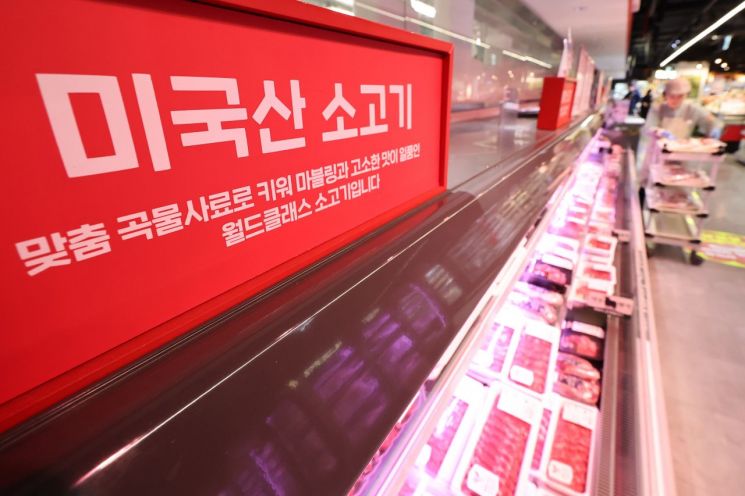
However, the U.S. livestock industry argues that countries such as China, Japan, and Taiwan have already lifted the age restrictions and that Korea should revise its regulations as well. The National Cattlemen's Beef Association (NCBA) officially requested the USTR to abolish the age restriction earlier this month. The USTR has also raised concerns about Korea's beef import restrictions in its annual "National Trade Barriers Report."
Domestic livestock farmers, however, are concerned about the impact of lifting the age restriction on the Korean native beef (Hanwoo) market. They argue that removing the age limit could increase consumer fears about mad cow disease and lead to a decline in Hanwoo consumption. The National Hanwoo Association issued a statement urging, "The National Assembly and government must never accept this for the sake of farmers' livelihoods and public health."
The government stated that it has not yet engaged in related discussions with the U.S. The Ministry of Agriculture, Food and Rural Affairs said, "There has been no official request from the Trump administration regarding the age restriction on U.S. beef, and the U.S. side's specific position has not been confirmed."
Some speculate that the U.S. may also use quarantine issues related to fruits as a trade pressure card.
Korea conducts agricultural quarantine based on scientific evidence. When importing agricultural products, it is essential to assess the risk of invasive pests and diseases and establish preventive measures. The import risk analysis process consists of eight steps, and legally, some procedures cannot be omitted or simplified.
In fact, the average time it takes for Korea to import agricultural products is 8.1 years. Currently, Korea is negotiating quarantine terms for apple imports with 11 countries, including the U.S., but no negotiations have been completed. Japan's quarantine negotiations, accepted in 1992, progressed to the fifth stage, while the U.S. negotiations, which began in 1993, remain at the third stage.
There is also a possibility that demands to ease regulations on genetically modified organism (GMO) agricultural imports may arise. The Korea Rural Economic Institute recently expressed concerns in a report, stating, "Strengthening safety management of imported agricultural products is necessary," and warned that "the proportion of GMO agricultural imports may increase without sufficient safety evaluations." Korea imports GMO crops such as soybeans and corn.
© The Asia Business Daily(www.asiae.co.kr). All rights reserved.
![Clutching a Stolen Dior Bag, Saying "I Hate Being Poor but Real"... The Grotesque Con of a "Human Knockoff" [Slate]](https://cwcontent.asiae.co.kr/asiaresize/183/2026021902243444107_1771435474.jpg)















