Loan Regulations Intensify Perceived Inequality Among Youth
Professor Lee Yoonsoo: Asset Inequality Drives Discrepancy Between Statistics and Sentiment
Criticism of Populist Policies in the Name of Addressing Polarization
There is an argument that the government's loan regulations aimed at curbing the increase in household loans are exacerbating the perception of inequality by intensifying the relative deprivation felt by the younger generation.
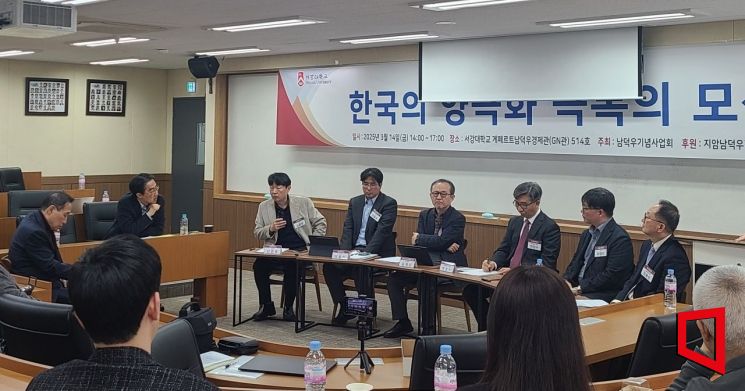 At the 'Seeking Solutions to Overcome Polarization in Korea' seminar held on the 14th at the Geppert Namdeokwoo Economics Hall of Sogang University, participants are engaged in discussion. (From left) Shin Kwan-ho, Professor of Economics at Korea University; Lee Yoon-soo, Professor of Economics at Sogang University; Kim Jae-jin, former President of the Korea Institute of Public Finance; Park Jung-soo, Dean of the Economics Department at Sogang University; Lee Jung-min, Professor of Economics at Seoul National University; Jang Yong-sung, Monetary Policy Committee member of the Bank of Korea.
Professor Lee Yoon-soo of the Department of Economics at Sogang University expressed this view during his keynote presentation at the seminar titled "Exploring Solutions to Korea's Polarization," held on the afternoon of the 14th at the Geppert Namdeokwoo Economics Hall at Sogang University.
Professor Lee stated, "Korea's Gini coefficient has not risen significantly in terms of inequality. However, the level of inequality subjectively perceived by the youth is at a serious level," adding, "About 80% of young people surveyed believe that society is not equal. This means that the actual perception is more severe than the statistics suggest."
He analyzed that the discrepancy between the Gini coefficient statistics and the perception of inequality arises from asset inequality. Professor Lee explained, "When comparing the asset gap between groups who own homes and those who do not, it increased from 5.4 times in 2017 to 6 times in 2021," and added, "There is anxiety that if house prices rise further, they will be unaffordable, and this relative deprivation is even more severe among those living in Seoul and the younger generation."
Professor Lee also pointed out that the loan regulations continued from the previous government are depriving young people of opportunities to build assets. He said, "Even if someone earns an annual salary of 100 million won and works at a large corporation, it is impossible for people in their 30s and 40s to buy a house normally without credit loans," and continued, "So-called 'large corporation dirt spoons' who have income but no accumulated assets could not buy houses even during the real estate boom in 2020 due to loan regulations. Compared to those whose parents have wealth and enjoy investment income from higher-tier areas despite having no income, these individuals feel a relative deprivation that their income does not rise as much as in Gangnam."
Professor Lee argued, "Although household debt among high-income 'young all-in' borrowers has increased, the soundness is actually higher. While household loans are increasing and considered risky, in terms of soundness, the collateral is the best, and it is the young people with high incomes who are buying," adding, "It is a serious problem that bank loans are going only to households and not to companies, but viewing the increase in household debt as if a bomb is about to explode is a mistaken perspective."
Regarding the increase in apartment transactions following Seoul City's lifting of land transaction permit designations in some parts of Gangnam, he added, "In a society where supply is relatively constrained, when demand in limited areas is suppressed, it is natural for such demand to be released and for transactions to increase."
Professor Lee emphasized, "Whether or not one owns a house greatly contributes to asset inequality, and loan regulations centered on the metropolitan area contain the problem of blocking social mobility," adding, "Macroprudential regulations cannot be a means to stabilize housing prices."
At the seminar, there was also criticism that the political sphere is introducing populist policies under the pretext of resolving polarization. Kim Kwang-doo, chairman of the Sogang University Namdeokwoo Memorial Foundation and moderator of the discussion, said, "Both ruling and opposition parties are frequently discussing populist policies that appeal to emotions," and added, "The basic society proposed by the opposition could be the epitome of populism."
Professor Shin Kwan-ho of the Department of Economics at Korea University pointed out, "Eliminating everything and moving to a basic income system is not feasible. On the other hand, implementing basic income while leaving the existing system as is makes securing funding difficult and reduces effectiveness," warning, "There will definitely be side effects."
Professor Lee Jung-min of the Department of Economics at Seoul National University said, "Inequality is a politically sensitive term, so it is necessary to look at the numbers precisely," and added, "It is important to prove with data and conduct transparent debates." He also said, "People would gladly accept cash if the national finances were strong, but that is not the case," and concluded, "The question is whose money will be used to provide it."
© The Asia Business Daily(www.asiae.co.kr). All rights reserved.

















