The Right to Resist Is a Constitutional Safeguard of Last Resort
It Cannot Be Invoked in All Situations
Examining the Necessary Conditions
"If the Constitutional Court messes around, we will invoke the people's right to resist and blow it away." (Jeon Gwang-hoon, Pastor of Sarang Jeil Church, March 9, 2025, Anti-Impeachment Rally)
"Whether to exercise the people's right to resist will depend on the Constitutional Court's decision on the hearing." (Jeon Han-gil, Korea History Top Lecturer, March 12, 2025, National Assembly 'People's Right to Resist Seminar')
"The Constitutional Court's ruling is invalid. We will invoke the people's right to resist." (Jeong Gwang-yong, Chairman of the Group Loving Park Geun-hye, March 10, 2017, Anti-Impeachment Rally)
As concerns grow over the disruption of the scheduled ruling on President Yoon Seok-yeol's impeachment trial, calls to "invoke the people's right to resist" continue to emerge from the anti-impeachment side. The people's right to resist is a fundamental right embedded in the spirit of the constitution, but it is not explicitly stated in the constitution. Eight years ago, during the anti-impeachment rallies against former President Park Geun-hye, remarks about the people's right to resist also appeared.
The phrase in the preamble of the constitution, "inheriting the democratic ideals of the April 19 Revolution against injustice," can be interpreted as constitutional grounds recognizing the sovereign people's right to resist. The right to resist is a concept found in social contract theory, which holds that when the state seriously infringes on the people's rights, they may refuse obedience or resist. However, the right to resist cannot be exercised in all situations. Essentially, it is the right to resist public authority by force, requiring several conditions to be met.
In September 1997, the Constitutional Court dismissed a constitutional review request regarding the strike rights of the Hyundai Precision & Industry Union. There, the Court presented the conditions for the people's right to resist as whether ▲a serious infringement of constitutional fundamental rights by state power has occurred and ▲whether the people cannot protect their rights and freedoms by other lawful remedies.
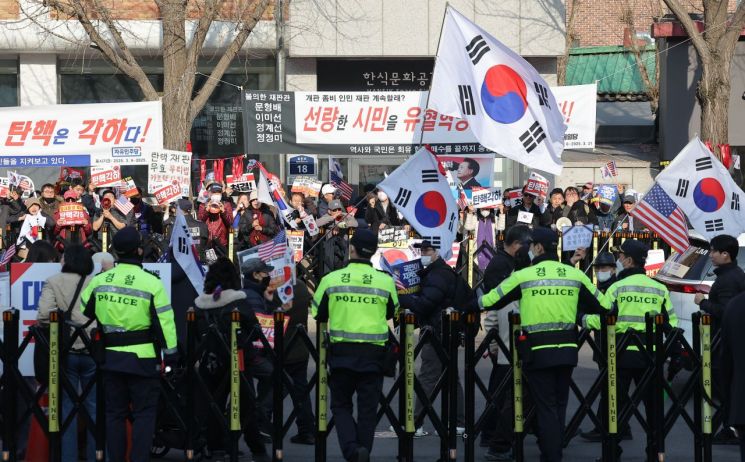 On the 11th, supporters of President Yoon Seok-yeol held an anti-impeachment rally in front of the Constitutional Court in Jongno-gu, Seoul. Photo by Yonhap News
There is also a related precedent in the December 2014 dissolution trial of the Unified Progressive Party. At that time, the Constitutional Court stated that the right to resist is "a right of the people and a constitutional safeguard system," but also "since it is a forceful resistance against the exercise of public authority, it inherently involves the risk of disorder," and presented three conditions.
The conditions for exercising the right to resist were specified as ▲there must be an attempt to seriously infringe or destroy the overall democratic basic order, not just individual constitutional provisions ▲no effective remedies remain ▲the purpose must be passive, aimed at maintaining or restoring the democratic basic order, and it cannot be used as a means to reform political, social, or economic systems.
The People's Right to Resist That Also Appeared Eight Years Ago
Jeong Gwang-yong, chairman of the Group Loving Park Geun-hye, who led the anti-impeachment rallies against former President Park, also mentioned invoking the people's right to resist. On March 10, 2017, when Park's dismissal was decided, Jeong said, "An impossible event has occurred, and we will invoke the people's right to resist." He organized a rally near the Constitutional Court on the day of the impeachment ruling and was indicted for inciting the rally to turn violent. In 2019, he was sentenced to 1 year and 6 months in prison with a 2-year probation. Four participants died and more than 30 were injured during that rally.
At that time, the court examined the responsibility of the rally organizers for failing to manage the rally as it turned violent. The court stated in its sentencing rationale, "The defendants, as rally organizers, did not strive to maintain order but rather intensified the participants with extreme remarks. When the excited participants expressed strong dissatisfaction and became violent, the defendants failed to manage the scene."
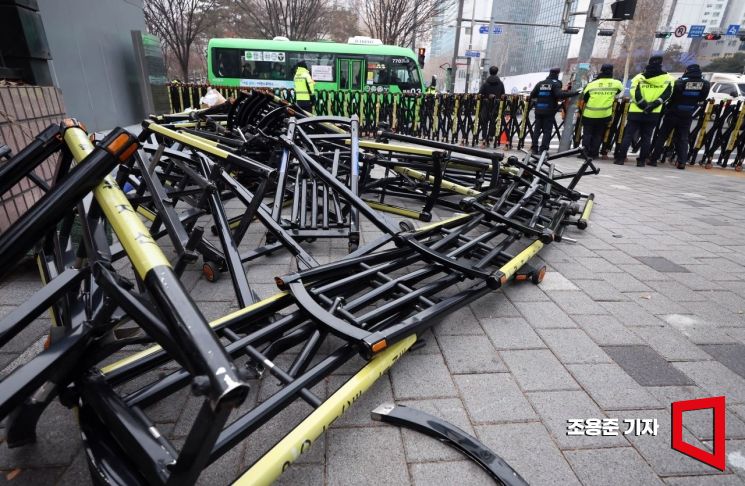 On the morning of January 20th, a police barricade remained damaged in front of the Western District Court in Mapo-gu, Seoul. Photo by Jo Yong-jun
Defendants indicted for the violent incident at the Seoul Western District Court last January have also claimed the people's right to resist. Lee Ha-sang, the lead defense attorney, stated after the trial on the 10th, "The youths resisted illegal acts by state institutions," and argued, "The people's right to resist is guaranteed by the preamble of the Constitution of the Republic of Korea and can be exercised by anyone." However, legal circles point out that acts of destroying courts or using violence cannot be considered exercises of the people's right to resist.
As the ruling date for President Yoon's impeachment trial approaches, concerns are rising that violent incidents and casualties similar to those eight years ago may recur. Recently, rally organizers including Pastor Jeon Gwang-hoon have mentioned the people's right to resist, raising the tone of their remarks by saying they will "blow away the Constitutional Court in one stroke." The police plan to declare Jongno and Jung districts as special crime prevention zones on the day of the ruling and divide the area into eight zones to maintain order and manage crowd safety.
© The Asia Business Daily(www.asiae.co.kr). All rights reserved.


















