People Power Party Welcomes Democratic Party's Shift in Stance
Expectations Grow for Rapid Progress in Discussions
Automatic Adjustment Mechanism and Pension Special Committee Operation Remain Stumbling Blocks
On the 14th, the People Power Party expressed a 'welcoming' stance, stating that "discussions have progressed" regarding the Democratic Party of Korea's renegotiation proposal on pension reform. However, parts related to structural reforms such as the automatic adjustment mechanism are expected to become points of contention in future negotiations between the ruling and opposition parties.
Kim Sang-hoon, the Policy Committee Chairman of the People Power Party, said at a meeting with reporters that day, "The People Power Party positively accepts and welcomes the Democratic Party's acceptance of the National Pension income replacement rate of 43%."
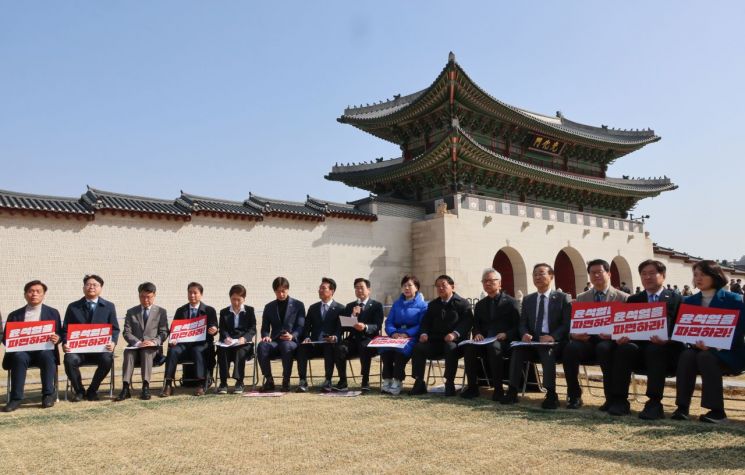 Park Chan-dae, floor leader of the Democratic Party of Korea, is speaking at the on-site Supreme Council meeting held near Gwanghwamun, Seoul on March 14, 2025. Photo by Yonhap News.
Previously, the ruling and opposition parties showed differences over raising the insurance premium rate from 9% to 13% and how much to increase the income replacement rate from 40%. The Democratic Party proposed raising it to 44%, while the People Power Party insisted on 43%.
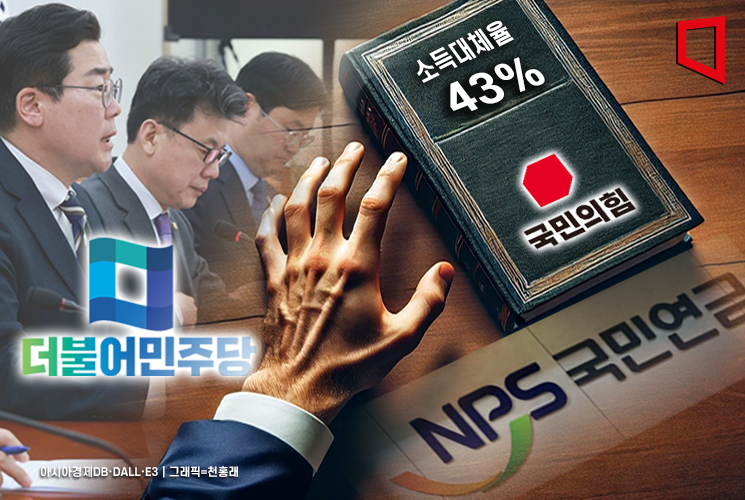
Regarding this, Jin Sung-jun, the Policy Committee Chairman of the Democratic Party, said at a meeting with reporters after the Supreme Council meeting that day, "We will accept the National Pension income replacement rate reform plan of 43% advocated by the People Power Party and the government."
The ruling and opposition parties also confirmed consensus on the expansion of support for low-income earners additionally proposed by Chairman Jin. Jin proposed expanding the childbirth credit, which currently applies from the second child onward, to the first child as well, and extending the military service credit to cover the entire service period as part of measures to expand support for low-income earners. In response, Chairman Kim said regarding the Democratic Party's proposal, "This is not new content," and replied, "We will consult reasonably within the government and the pension law." The outlook for further discussions also brightened. Chairman Kim stated, "From next week, we will enable discussions including supplementary budgets at the working-level consultative body among the ruling party, opposition, and government."
However, additional disagreements are expected to remain. These include how to handle the automatic stabilization mechanism and the operation method of the pension special committee.
Chairman Jin, however, expressed non-acceptance regarding the automatic stabilization mechanism, which was to be discussed later by the ruling and opposition parties. Jin said, "The automatic adjustment mechanism is part of structural reform rather than parameter reform. Depending on the detailed design and timing, very different results can emerge," adding, "At the current stage, even if it requires parliamentary approval, I clearly state that it is difficult to accept the automatic financial adjustment mechanism."
In response, Chairman Kim expressed disagreement, saying, "At the National Policy Council, the Democratic Party suggested forming a special committee next time to discuss this."
The operation method of the pension special committee is also a point of contention. Regarding the failure to launch the pension special committee the previous day, Chairman Kim said, "Until now, pensions including the National Pension have never been handled outside of a special committee, and have never been processed without bipartisan agreement," adding, "The part that the Democratic Party wants to remove from the consensus processing clause is unacceptable to the People Power Party."
© The Asia Business Daily(www.asiae.co.kr). All rights reserved.


















