A new approach is needed for Korea as an advanced nation
Move beyond producer-oriented crisis solutions
Begin considering issues from the consumer's perspective
"In modern society, where complex issues are intertwined, the role of politics is to harmonize each party's interests. Good systems and talented individuals must be brought in."
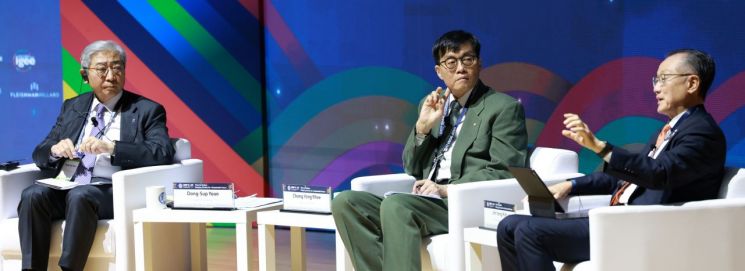 (From left) Yoon Dong-seop, President of Yonsei University; Lee Chang-yong, Governor of the Bank of Korea; and Kim Yong, former President of the World Bank, are having a discussion on key tasks for Korea's sustainable growth at 'GEEF 2025' held at Yonsei University in Seodaemun-gu, Seoul on the 14th. Bank of Korea
Lee Chang-yong, Governor of the Bank of Korea, stated this on the 14th at 'GEEF 2025' held at Yonsei University in Seodaemun-gu, Seoul. The governor said, "In the past, when democracy was less developed, economic development was prioritized above all else, and strong leaders aggressively pushed forward, resulting in rapid growth," adding, "this approach does not work once a country becomes developed." He noted, "Each party has their own interests, making it difficult to coordinate them," and emphasized, "How to coordinate and harmonize these is a major concern." He diagnosed that today's leaders need to have altruistic values and beliefs themselves.
He said, "It would be good if there were political processes to coordinate these, but if politics amplifies conflicts, it becomes more difficult," emphasizing, "Harmonizing these interests is the role of politics." To this end, he argued that a smooth political system must be established and good political talents must be attracted.
Although it is difficult to single out the most urgent issue to solve, he stressed that any issue should be addressed with the consumer at the center. He said, "In the past, when rapid economic development was achieved, there were few producers, so all policies and subsidies were centered on industrial producers," adding, "Now, those producers have become interest groups, and the mode of economic development has changed." He explained that while in the past it might have been possible to solve one problem first, today complex problems coexist. He said, "We must forget the previously successful systems and adopt a framework suitable for the present," and "Everything must be reconsidered from the consumer's perspective."
Governor Lee delivered the keynote speech at the event, emphasizing that "the core issues that our country must solve to achieve sustainable growth are low birthrate and aging population, and climate change." The Bank of Korea recently proposed bold policies such as 'development of hub cities' and 'regional proportional selection system' as solutions to these problems.
Governor Lee emphasized, "Considering our country's land area and population, nurturing two to at most six hub cities is the most effective strategy." He explained that it is important to concentrate key infrastructure and resources such as hospitals, cinemas, and sports centers in a few regional hub cities to create living conditions comparable to the metropolitan area.
Regarding the university admission system, he reiterated that universities should adopt a regional proportional selection system. This method grants universities autonomy in selecting freshmen but requires that the final selection results be proportional to the regional school-age population ratio. He said, "If this system is introduced, it will reduce the impact of parents' economic power and private education environment on admissions, thereby expanding social mobility through education," and added, "As the intense competition for admissions concentrated in Seoul eases, it will help curb population concentration in the metropolitan area and the rise in housing prices in Seoul, which will also aid in reversing the birthrate decline."
On the other key issue of climate change, he viewed it not only as a problem affecting export industries but as a realistic issue that must be addressed immediately. He said, "We need to reorganize Korea's 'green taxonomy' to align with international standards." As of April last year, the global average price of carbon emission permits was about $30 per ton, and the European Union (EU) price reached $60, while Korea's remained at around $6. Governor Lee emphasized, "If the price is excessively low, companies will find it more economical to purchase emission permits rather than reduce carbon emissions," and stressed, "The carbon emissions trading system (K-ETS) must be improved in a more rational direction." He said companies should be encouraged to have incentives to trade emission permits according to market principles.
© The Asia Business Daily(www.asiae.co.kr). All rights reserved.
![Clutching a Stolen Dior Bag, Saying "I Hate Being Poor but Real"... The Grotesque Con of a "Human Knockoff" [Slate]](https://cwcontent.asiae.co.kr/asiaresize/183/2026021902243444107_1771435474.jpg)















