George Glass, Nominee for U.S. Ambassador to Japan
Expresses Intention to Request Increased Defense Cost-Sharing at Senate Confirmation Hearing
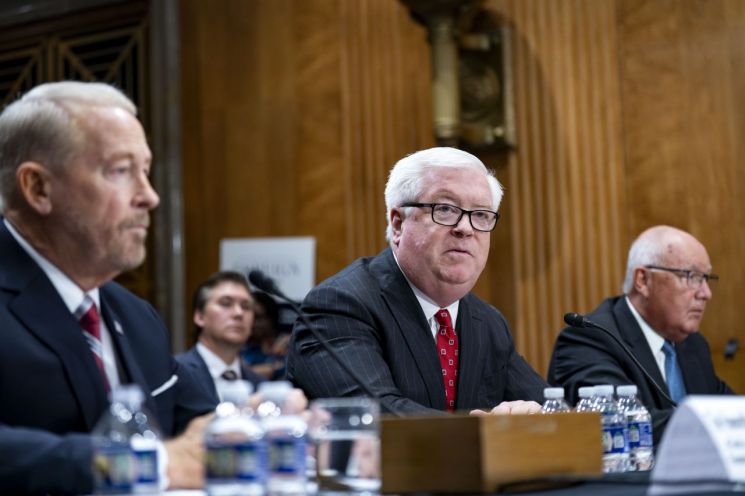 George Glass, nominee for U.S. Ambassador to Japan (center), is speaking at the U.S. Senate confirmation hearing on the 13th (local time). / Photo by UPI and Yonhap News
The 'world police' has turned into a 'mafia' demanding more protection money. As the United States has successfully pushed for increased U.S. military defense cost-sharing in Japan and Taiwan sequentially, concerns are growing that South Korea could be the next target.
George Glass, the nominee for U.S. Ambassador to Japan, stated at a Senate confirmation hearing on the 13th (local time) that, citing the need to counter China, "the Trump administration will ask Japan to bear more of the cost of hosting U.S. troops."
Japan is scheduled to negotiate the Special Measures Agreement (SMA) on defense cost-sharing with the U.S. in 2027. According to Glass, Japan currently pays about $1.4 billion (approximately 2 trillion KRW) annually for the cost of hosting U.S. forces in Japan. He added that the costs for housing U.S. troops in Japan, as well as upgrading weapons and command and control systems, "will be very expensive," and he believes they will "definitely go to the Japanese and discuss an increase in that support."
This is interpreted as an extension of the demand for increased defense costs confirmed at the U.S.-Japan summit in February. After the summit at the White House on the 7th of last month, U.S. President Donald Trump held a joint press conference and announced that Japan had promised to double its defense spending by 2027 compared to the previous term. According to the Nihon Keizai Shimbun (Nikkei), Japan's defense budget in 2024 was 1.6% of GDP, and with the doubling, it is estimated to rise to about 3% of GDP.
Among neighboring countries, Taiwan, which has relied on the U.S. to counter China, is facing increased defense cost burdens. During an interview with The Washington Post (WP) as a presidential candidate last September, Donald Trump stated that "Taiwan should spend one-tenth of its GDP on defense." Ten percent of GDP is the maximum defense spending ratio set by the U.S. during the Cold War. According to the Taiwan United Daily News, former Democratic Progressive Party legislator Guo Zhengliang appeared on a YouTube program on the 7th and said that the U.S. demanded Taiwan increase its defense budget to 5% of GDP next year and extend conscripted soldiers' service from one year to two years.
Concerns continue to arise that South Korea could be next. South Korea signed an SMA agreement for U.S. forces stationed in Korea until 2030 last October. It is known that South Korea plans to pay 1.5192 trillion KRW in 2025, an 8.3% increase from the previous year. At that time, then-Republican presidential candidate Trump publicly stated that "if he were in office, South Korea would have paid $10 billion (approximately 14 trillion KRW) annually for defense costs."
There are several countries where U.S. troops are stationed overseas. In the Asia-Pacific region, besides South Korea, Japan, and Taiwan, there are Guam, the Philippines, and Australia. In Europe, the largest U.S. troop presence is in Germany, with deployments also in Italy, the United Kingdom, and Spain. In the Middle East, major bases are located in Kuwait, with air force, navy, and special forces stationed in Bahrain, Qatar, the United Arab Emirates (UAE), and Syria. In Latin America, the Guantanamo naval base in Cuba is well known.
© The Asia Business Daily(www.asiae.co.kr). All rights reserved.

















