Private Education Expenses for Elementary, Middle, and High School Near 30 Trillion Won
Monthly Spending on English Kindergartens Reaches 1.54 Million Won
"Elementary Medical School Class" Prevention Law Prepared
Ruling and Opposition Parties Also Push for Tax Credit Benefits
Last year, private education expenses for elementary, middle, and high school students reached approximately 30 trillion won, marking the highest level for four consecutive years. Meanwhile, the political sphere is also considering measures to alleviate the burden on parents. Opinions are divided between those who argue that private education should be curbed to prevent future inequality and those who believe that since private education has already become part of childcare, making it difficult to replace, practical measures to reduce household burdens are necessary.
The Era of 30 Trillion Won in Private Education Expenses
According to the '2024 Elementary, Middle, and High School Private Education Expenses Survey' conducted by the Ministry of Education and Statistics Korea, targeting about 74,000 students from approximately 3,000 schools nationwide, the total private education expenses last year amounted to 29.2 trillion won, an increase of 2.1 trillion won (7.7%) compared to the previous year. The total private education expenses have set new records for four consecutive years, with 23.4 trillion won in 2021, 26 trillion won in 2022, and 27.1 trillion won in 2023.
The participation rate in private education among elementary, middle, and high school students rose by 1.5 percentage points from the previous year to 80.0%, marking an all-time high. By school level, the participation rate in elementary schools increased by 1.7 percentage points to 87.7%, the highest among the groups. Middle schools saw a 2.7 percentage point rise to 78.0%, and high schools increased by 0.9 percentage points to 67.3%.
The private education market is gradually shifting to younger ages. According to the Ministry of Education's first-ever survey on private education expenses per child for preschool children under six years old, the average monthly private education expense per child under six in South Korea was 332,000 won. English kindergartens (academies) and play academies had average monthly costs exceeding 1 million won. For children attending English kindergartens, the average monthly expenditure was 1,545,000 won, and for play academies, it reached 1,167,000 won.
The term "7-year-old exam" has emerged, referring to preschool children who flock to the private education market before entering elementary school. The "7-year-old exam" refers to tests taken to enter prestigious math and English academies before elementary school admission. Recently, the age has lowered further, giving rise to the term "4-year-old exam." Children exposed to private education continue with programs such as "elementary medical school class" and "gifted entrance exam class."
Amendment Bills to Regulate Preemptive Education Proposed Mainly by the Opposition
Views on private education within the political sphere are somewhat divided.
Some believe that educational polarization must be resolved. As shown in the recent survey results, the average monthly private education expense per student in households with a monthly income of over 8 million won was 676,000 won, more than three times higher than that of students in households earning less than 3 million won (205,000 won).
According to the National Assembly Bill Information System, three amendment bills to the Special Act on the Promotion of Public Education Normalization and Regulation of Preemptive Education have been proposed. These bills mainly focus on prohibiting preemptive education.
Assemblywoman Kang Kyung-sook of the Joguk Innovation Party, who has experience as a special education teacher, proposed an amendment known as the "Elementary Medical School Class Prevention Act." The main content strengthens the supervision and management by education superintendents if academies operate advanced courses beyond the school curriculum or conduct level tests outside the school curriculum during academy selection processes.
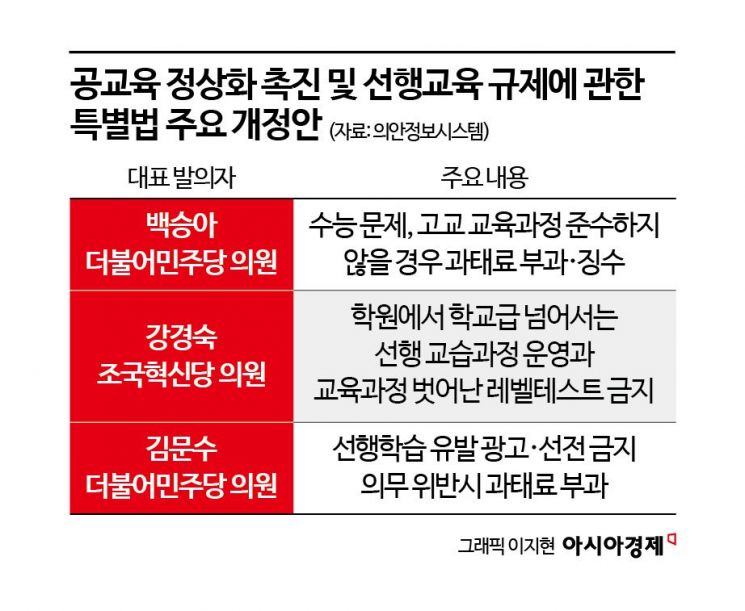
Democratic Party Assemblywoman Baek Seung-ah, a former elementary school teacher, proposed the so-called "Killer Question Prohibition Act." She judged that excessively difficult college entrance exam questions induce preemptive education. Current law stipulates that university-specific exams such as essays and interviews must not include content beyond the scope and level of the high school curriculum, but this regulation does not apply to the College Scholastic Ability Test (CSAT). The amendment allows the Minister of Education or education superintendents to impose and collect fines if such issues arise in CSAT questions.
Another special law amendment, led by Democratic Party Assemblyman Kim Moon-soo, allows fines to be imposed on academies that induce preemptive learning. Schools face administrative and financial measures such as reduced financial support or student quotas if they induce preemptive education or learning. The amendment was proposed on the premise that similar sanctions are necessary for academies.
Ruling and Opposition Parties Agree: Private Education as Part of Childcare... Bills to Expand Tax Credits Submitted
On the other hand, there is also a perspective that private education substitutes for childcare. Both ruling and opposition parties promised a "tax credit for elementary school students' private education expenses" during the last general election. Despite the overheating of private education even before elementary school, the reason for proposing such bills is that for dual-income couples, private education plays a role in substituting childcare for elementary school children. Academies in arts and physical education fields such as Taekwondo, art, and music have become important means for balancing work and family life. In fact, according to the recently released private education expense survey, the average monthly private education expense per student in dual-income households was 502,000 won, a 9.5% increase from the previous year. For households with only the father earning, it was 464,000 won, and for those with only the mother earning, it was 315,000 won.
Assemblyman Yoon Young-seok of the People Power Party proposed a tax law amendment to expand the tax credit target to children under 13 years old and raise the education expense limit for tax credit from the current 3 million won to 5 million won. Assemblyman Kang Dae-sik of the People Power Party proposed an amendment to expand the tax credit target to include academies and sports facilities operated for elementary school students.
Assemblywoman Lee Soo-jin of the Democratic Party also proposed an amendment to raise the education expense limit for tax credit from 3 million won to 5 million won per child for preschool children and elementary, middle, and high school students, and to include academy education expenses for elementary school students as eligible for tax credit. Assemblyman Lee Yong-seon of the Democratic Party proposed a bill to include academy and sports facility expenses paid for elementary school students as tax credit targets. All these bills are currently pending in the National Assembly.
© The Asia Business Daily(www.asiae.co.kr). All rights reserved.
![Clutching a Stolen Dior Bag, Saying "I Hate Being Poor but Real"... The Grotesque Con of a "Human Knockoff" [Slate]](https://cwcontent.asiae.co.kr/asiaresize/183/2026021902243444107_1771435474.jpg)












