Establishment of the "Basic Plan for Visiting Health and Welfare Services"
Yongsan-gu, Seoul (District Mayor Park Hee-young) announced on the 14th that it has established the "2025 Basic Plan for Visiting Health and Welfare Services" to actively identify welfare crisis households and realize field-centered customized integrated welfare through public-private cooperation.
The basic plan encompasses 11 departments and 46 projects centered on promotion strategies such as strengthening the identification and management of poverty and care crisis households, enhancing community social security and local health care, and reinforcing the welfare delivery promotion system through public-private cooperation.
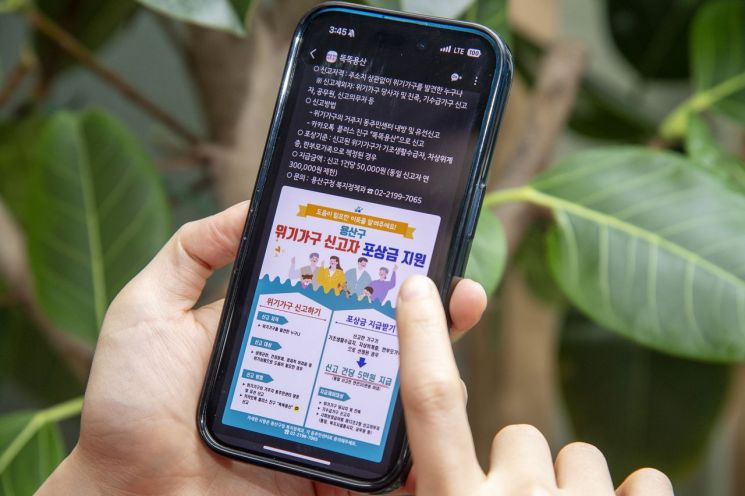
To identify and promptly support poverty and care crisis households, the district operates the "Ddokddok Yongsan" KakaoTalk Plus Friend continuous reporting system and provides rewards for informants reporting crisis households. It also conducts welfare check services using smart technologies such as the Internet of Things (IoT) and Artificial Intelligence (AI).
Additionally, each neighborhood manages crisis households in connection with local characteristics such as jjokbang (small rooms) and gosiwon (boarding houses), with local residents like community leaders actively participating in identifying crisis households.
In response to the diversification of welfare needs, the district provides customized services and expands welfare recipients to create a dense social welfare network. With the increase in single-person and youth households, the age limit for the Care SOS service has been abolished, and new daily care services are being promoted for young and middle-aged adults in need of care as well as family caregiving youth, thereby expanding welfare services.
Furthermore, social isolation prevention projects such as the "Dudream Project," delivering health drinks to young and middle-aged single-person households, and the "Escape Room Supporters" for single-person households are underway to help socially isolated households form social networks.
For the elderly, customized visiting health management, intensive management of high-risk groups, and non-face-to-face health management services (AI-IoT) linked with the "Oneul Health App" and health measuring devices are being promoted to further strengthen local health care services.
To support the mental health of residents, projects such as the elderly mental health support program and the "On-Maum Forest Yongsan" project are being conducted to help all Yongsan-gu residents, including infants, adolescents, and middle-aged adults, contribute to creating a healthy city.
To realize integrated community welfare through public-private cooperation, a memorandum of understanding (MOU) was signed with Yongsan Post Office, enabling mail carriers to directly deliver welfare registered mail, and licensed real estate agents act as administrative welfare helpers to actively identify reclusive individuals and crisis households.
Moreover, the "Happy Neighborhood Making" project by the community social security councils in each neighborhood discovers welfare services tailored to local characteristics, and 43 members of the resident-formed Our Neighborhood Care Group monitor crisis households and provide meticulous care.
District Mayor Park Hee-young said, "As social environments change, service demands and targets are diversifying. In response, we will actively identify crisis households and provide visiting customized services to create a Yongsan-gu where everyone is happy without welfare blind spots."
© The Asia Business Daily(www.asiae.co.kr). All rights reserved.
![Clutching a Stolen Dior Bag, Saying "I Hate Being Poor but Real"... The Grotesque Con of a "Human Knockoff" [Slate]](https://cwcontent.asiae.co.kr/asiaresize/183/2026021902243444107_1771435474.jpg)















