Successive Closures of Jipkkumigi and Mungori.com
Changing Consumer Patterns and Weakened Competitiveness After the Endemic Phase
Small and medium-sized interior platforms that had rushed to declare their entry are disappearing one after another. They experienced rapid growth riding the indoor interior and home furnishing boom during the COVID-19 pandemic, but after the endemic phase, consumer trends changed and their own competitiveness weakened, making it impossible to sustain. The market is seeing a sorting process centered on competitive companies.
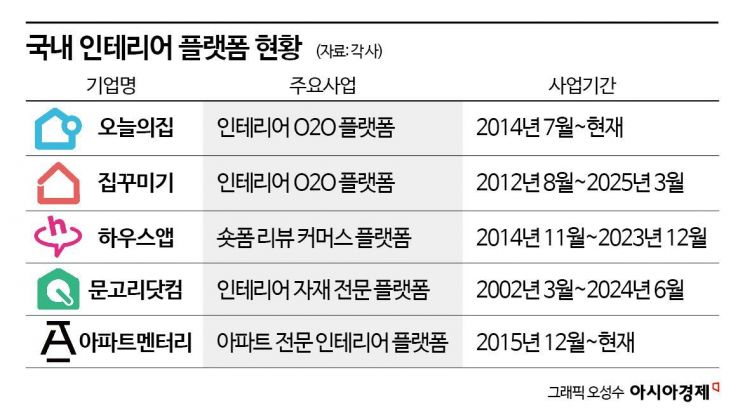
According to the industry on the 14th, the interior platform 'Jipkkumigi' will cease operations at the end of this month. Launched in 2012, it grew to become the second largest in the industry after 'Today’s House' by targeting single-person households with interior tips and sales of furniture and accessories, but it is closing after 12 years due to continuous deficits. Uisikju Company, which acquired Jipkkumigi about a year ago, explained that this decision was made to focus the resources and capabilities secured through it on the growth of 'Lundrigo Commerce.'
The online mall specializing in interior materials, 'Mungori.com,' was declared bankrupt last year. This platform, launched in 2002, was acquired by TY Holdings, the holding company of the Taeyoung Group, in 2019, but could not withstand the increasing deficits of 2 to 4 billion KRW annually. 'House App' also ceased service after its operating company House Media declared inability to pay settlement funds to partners due to worsening liquidity in February 2023.
The crisis of small and medium-sized interior platforms intensified after the COVID-19 endemic phase. Interior platforms, which once sprang up like mushrooms, grew during the COVID-19 period as movement restrictions increased interest in improving indoor spaces. However, with the shift to endemic, consumer focus moved back to dining out and travel, shrinking the market. Professor Kim Min-jung of the Department of Consumer Economics at Sookmyung Women’s University explained, "Besides changes in consumption, rising material costs and losing out to competitors like IKEA accelerated closures."
Some point out that lack of differentiation from large e-commerce platforms caused the crisis. An industry insider said, "The main products such as furniture and accessories offered by these platforms are already sufficiently handled by large online malls like Coupang and 11st," adding, "As consumers had fewer reasons to visit, competitiveness naturally declined."
Ultimately, only a few platforms such as Today’s House and Apartmentmentary survive, and the industry is naturally being consolidated. Today’s House, which solidified its position as the industry leader, recorded sales of 240.2 billion KRW in 2023, growing 31% year-on-year. Operating losses also improved to 17.5 billion KRW, more than halving compared to the previous year (51.6 billion KRW), achieving profitability improvement. In particular, it strengthened its differentiation strategy by launching its own furniture brand 'Layer' in November last year.
© The Asia Business Daily(www.asiae.co.kr). All rights reserved.


















