'Sagyoyuk Geokjeong Eomneun Sesang' urges government to overhaul education policy
Civic group calls for comprehensive measures to address rising private education costs
Last year, the total private education expenses for elementary, middle, and high school students exceeded 29 trillion won, setting a new record. In response, an educational civic organization urged the government to present fundamental measures to curb the rising trend of private education.
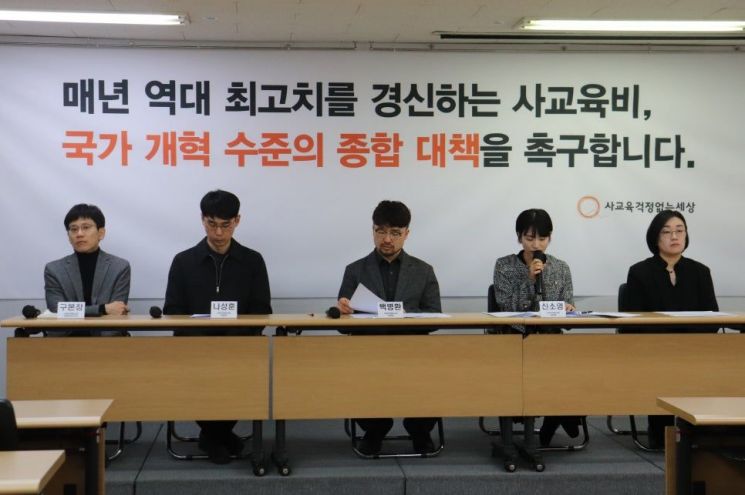 The educational civic group 'Sagyoik Geokjeong Eomneun Sesang' held a press conference on the 13th, following the government's announcement on private education expenses, urging for countermeasures. Photo by Sagyoik Geokjeong Eomneun Sesang
On the 13th, 'Sagyoyuk Geokjeong Eomneun Sesang' (World Without Private Education Worries) held a press conference, stating, "The revealed figures prove that the Ministry of Education's goal and policies to reduce private education expenses are out of sync," and "We demand a comprehensive policy shift and short-, medium-, and long-term measures from the government regarding the overheating of private education."
The Ministry of Education announced that the total private education expenses for 2024 reached approximately 29.2 trillion won, the highest ever recorded since the survey began. This represents about a 7.7% increase from 27.1 trillion won in 2023.
Sagyoyuk Geokjeong Eomneun Sesang identified the sudden increase in medical school admissions and the resulting intensified competition among top-tier students, as well as increased uncertainty in college admissions, as some of the causes for the rise in private education expenses. The organization noted that while private education expenses and participation rates in the highest academic tier decreased by 1.5% in 2023, they increased by 0.5% last year, analyzing that this reflects intensified grade competition among top students.
Furthermore, the organization pointed out that among elementary, middle, and high schools, middle schools showed the highest growth rate in total private education expenses, participation rates, and participation time. They attributed this phenomenon to the maintenance of relative evaluation. Although the proportion of students receiving the top grade increased from 4% to 10%, this intensified competition among the top tiers caused some upper-middle-tier students to also join the competition. Additionally, the burden of having to study Integrated Social Studies and Integrated Science for the College Scholastic Ability Test (CSAT) without distinction between humanities and sciences was seen as another factor increasing private education expenses for elementary and middle school students.
Sagyoyuk Geokjeong Eomneun Sesang also criticized government-provided private education substitutes such as Neulbom School, after-school programs, and EBS textbooks as ineffective. On the same day, the Ministry of Education proposed policy responses to reduce private education expenses, including ▲expanding and strengthening Neulbom School programs and ▲enhancing EBS content and basic academic support. However, Sagyoyuk Geokjeong Eomneun Sesang analyzed, "According to the statistics, participation rates in Neulbom School and after-school programs decreased by 4.3% to 36.8% compared to the previous year, and the use of EBS textbooks for self-study purposes decreased by 1.2% in high schools," adding, "The decline in high school students' purchase of EBS textbooks shows that these substitutes did not provide sufficient efficacy to replace private education."
The organization presented three demands to the government. First, as a short-term task, they urged active legislative and policy efforts to regulate unscrupulous private education that crosses the line, such as the Elementary Medical School Class Prevention Act. They also proposed introducing a Private Education Progress Disclosure System that specifies the target students and courses in the Academy Information Disclosure Service (Hakwon NICE), stating, "This will support consumers' right to know and help them make wise private education choices."
As a medium-term task, they called for reforming college admissions policies and actively reflecting achievement evaluations that clearly indicate what and to what extent students should learn in college admissions. For the long term, they demanded consideration of university system policies such as creating ten Seoul National University-level institutions centered on regional flagship national universities, raising the overall standard of university education, and implementing a university admission guarantee system that combines financial support with joint selection.
© The Asia Business Daily(www.asiae.co.kr). All rights reserved.
![Clutching a Stolen Dior Bag, Saying "I Hate Being Poor but Real"... The Grotesque Con of a "Human Knockoff" [Slate]](https://cwcontent.asiae.co.kr/asiaresize/183/2026021902243444107_1771435474.jpg)
















