Monthly Private Education Cost for Young Children: 332,000 KRW
English Kindergartens Cost Up to Five Times More
Total Expenses Including Additional Fees Can Exceed 3 Million KRW per Month
"Figures Do Not Reflect Individual Circumstances, Creating a Gap with Reality"
No Hyun-seo (44), who is raising three elementary and middle school children in Songpa-gu, Seoul, has been contemplating whether to transfer her second child’s English academy, which she has been sending to for several months. She registered knowing the tuition was 350,000 KRW per month for classes twice a week, three hours each, but she is separately paying 160,000 KRW monthly for online pad classes, textbooks, and transportation fees. No said, "My middle school child preparing for school exams only pays 350,000 KRW for tuition, but my fifth grader is spending 500,000 KRW just on English. If I add math, it’s almost 1,000,000 KRW, so the reported average private education cost of 470,000 KRW per person doesn’t resonate with me."
Although the Ministry of Education recently announced the results of the 'Early Childhood Private Education Cost Pilot Survey' and the 'Elementary to High School Private Education Cost Survey,' the amounts parents feel they spend are much higher.
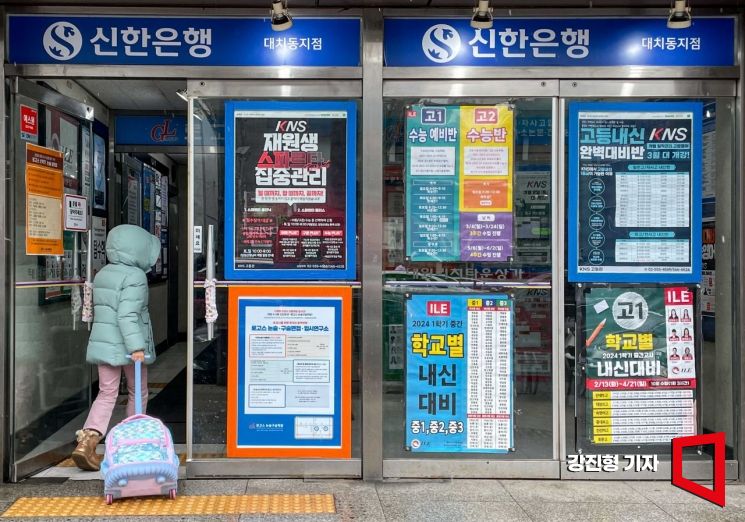 In Daechi-dong, Gangnam-gu, Seoul, there are children who pull their suitcases and go on trips every day. Photo by Jinhyung Kang aymsdream@
According to the Ministry of Education on the 14th, the average private education cost per participating young child is 332,000 KRW, and the most expensive type of early childhood private education is English academies for young children, averaging 1,545,000 KRW per month. While it is significant that this is the first survey on early childhood private education costs, parents who send their children to these so-called 'English kindergartens' expressed that the actual costs they feel are different from the reported figures.
Yoon Sung-hee (43), who sent her child to an English kindergarten until entering elementary school this year, spent 1,900,000 to 2,000,000 KRW per month. The regular tuition for the English kindergarten Yoon sent her child to was 1,320,000 KRW, but she paid an additional 80,000 KRW for transportation and 136,400 KRW for meals. Including after-school activities costing around 100,000 KRW per session, online program fees paid every 3 to 6 months, and textbook fees, she incurred an extra 300,000 to 400,000 KRW monthly.
Many parents also agreed that the actual cost of English kindergartens exceeds 2,000,000 KRW. In parent communities of those sending children to English kindergartens, comments included "1,900,000 KRW without after-school," "200,000 KRW per month after applying for two after-school sessions excluding initial entrance supplies (clothing, etc.)," and "3,000,000 KRW including daily after-school classes and textbooks." According to a survey conducted last year by the organization Private Education Concern-Free Society based on Seoul Metropolitan Office of Education’s data on academies and tutoring centers, the most expensive half-day English academy for young children in Seoul charged 3,080,000 KRW per month (Seocho SCE Language Academy). The annual burden was 36,990,000 KRW, which is 5.5 times the average annual tuition fee of a four-year university (6,780,000 KRW).
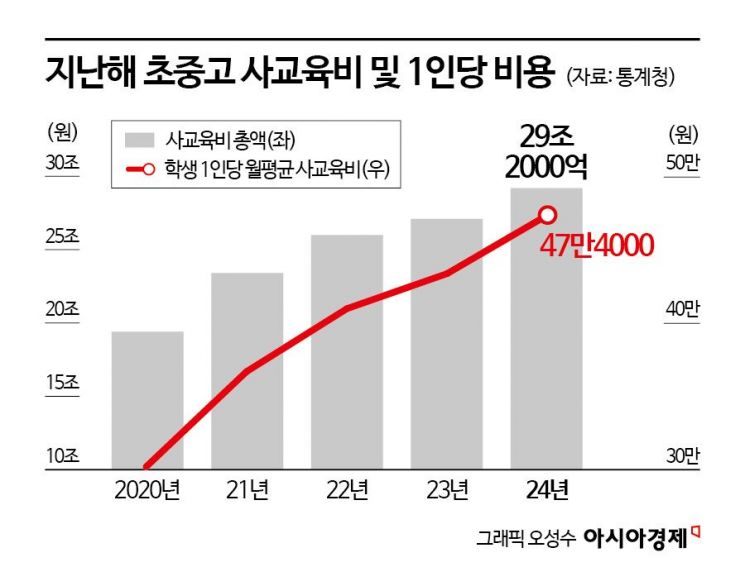
There are also responses that the private education costs for elementary to high school students differ from the perceived expenses. The Ministry of Education announced that last year’s private education expenditure for elementary to high school students was 29.2 trillion KRW, with a participation rate of 80.0%, both record highs. The average monthly private education cost per student was 474,000 KRW, but since elementary school English academy fees alone range from 300,000 to 400,000 KRW, adding subjects like math, Korean, and arts and physical education means actual spending far exceeds the government’s reported figures.
Regarding the discrepancy between this private education cost survey and the costs felt by the public, a government official explained, "The results highlight the overall average monthly private education cost per student without considering individual circumstances."
The government conducts and announces private education cost surveys annually, but each time there are criticisms about the lack of realism. This year’s survey was conducted from March to May and July to September on 74,000 students from 3,000 elementary to high schools nationwide, but since it includes students from school districts and rural areas with fewer academies, as well as students not receiving private education, the average value inevitably lowers. The early childhood private education cost survey, conducted for the first time this year, was done over three months (July to September) with 13,241 participants, but due to limited recruitment scope, annualization is difficult. The Ministry of Education plans to review sample design and survey questions based on this pilot survey’s results and conduct early childhood private education surveys in national approved statistics (such as childcare status surveys) next year.
Some believe actual private education costs are more than double this survey’s figures. Yang Jeong-ho, a professor in the Department of Education at Sungkyunkwan University, said, "Estimating from last year’s Household Income and Expenditure Survey’s total private education costs using our Sungkyunkwan University Next365 research team’s data, it approached a record high of 40 trillion KRW," adding, "The scale of early childhood private education costs can be estimated to be between 5 trillion and 10 trillion KRW at least."
© The Asia Business Daily(www.asiae.co.kr). All rights reserved.
![Clutching a Stolen Dior Bag, Saying "I Hate Being Poor but Real"... The Grotesque Con of a "Human Knockoff" [Slate]](https://cwcontent.asiae.co.kr/asiaresize/183/2026021902243444107_1771435474.jpg)

















