The business community immediately voiced concerns on the 13th after the amendment to the Commercial Act, which introduces directors' fiduciary duties to shareholders, was passed in the National Assembly plenary session led by opposition parties including the Democratic Party of Korea.
The Korea Chamber of Commerce and Industry (KCCI) stated in a commentary on the 13th, "We deeply regret the passage of the Commercial Act amendment in the National Assembly," adding, "Expanding directors' fiduciary duties not only to the company but also to shareholders is likely to impose a significant burden on our economy."
KCCI particularly expressed concern that "our manufacturing-centered companies could face lawsuits even for normal business activities such as mid- to long-term facility investments," and that "directors may find it difficult to make bold decisions aimed at the company's future and enhancing shareholder value." They also added, "We worry that foreign companies might no longer consider Korea as an investment destination because of this."
Furthermore, they pointed out, "If small and medium-sized enterprises with technological capabilities become targets of external speculative capital and have to focus solely on defending management rights, it could negatively affect innovative growth activities such as technology development and market expansion."
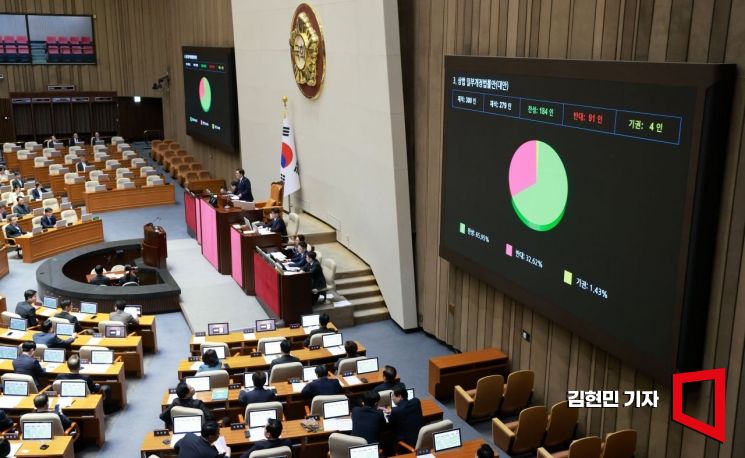 On the 13th, the partial amendment to the Commercial Act was passed at the plenary session of the National Assembly. The amendment expands the duty of directors from the existing "company" to "company and shareholders" and includes provisions mandating the introduction of electronic general meetings of shareholders for listed companies. March 13, 2025 Photo by Kim Hyun-min
KCCI continued, "The issue of minority shareholders being excluded during mergers and acquisitions of listed companies, which was the starting point of the Commercial Act amendment discussions, has already been addressed by a separate improvement bill submitted to the National Assembly," emphasizing, "It is necessary to revisit discussions focusing on this issue to wisely balance the two goals of corporate growth and shareholder protection."
Finally, KCCI urged, "Considering the impact of the Commercial Act amendment on the national economy, we ask the National Assembly to provide another opportunity for careful deliberation."
The Korea Economic Association also claimed in a commentary on the same day, "The passage of the Commercial Act amendment could lead to a surge in indiscriminate lawsuits by shareholders, seriously disrupting management decisions for long-term corporate development such as mergers and acquisitions and large-scale investments."
The association particularly warned, "Activist funds are likely to excessively interfere in management to pursue short-term profits such as dividend increases and management interventions," adding, "It will become virtually impossible for companies to fully concentrate on management."
They further stated, "Ultimately, this amendment will drive our companies to become prey for speculative capital, weakening corporate competitiveness and causing a decline in national economic value," and pointed out, "The expansion of directors' fiduciary duties does not align with our company law system and is likely to violate constitutional principles such as the principle of prohibition of excessive regulation and the principle of clarity."
The association expressed hope that "the business community hopes the president will exercise the right to request reconsideration regarding this Commercial Act amendment, which includes serious side effects and unconstitutional elements."
The Korea Employers Federation also expressed deep regret over the passage of the Commercial Act amendment in the National Assembly.
In a statement on the day, the Federation said, "Despite the earnest appeals of the business community, the Commercial Act amendment passed the National Assembly plenary session," and added, "It is highly concerning as it is likely to cause confusion in the overall management activities of not only large corporations struggling in global competition but also small and medium-sized enterprises vulnerable to lawsuits."
They especially noted, "It is difficult to find legislative examples in major foreign countries that directly stipulate shareholders as the subject of directors' fiduciary duties," calling it "a bill that does not conform to global standards."
The amendment to the Commercial Act broadens the scope of directors' fiduciary duties from 'the company' to 'the company and shareholders' and mandates the introduction of electronic shareholder meetings for listed companies. It is justified by the need to improve governance and protect minority shareholders' rights. It will take effect one year after promulgation.
The business community has repeatedly raised concerns that the bill could hinder corporate investment and innovation and weaken national competitiveness.
The Federation emphasized, "Rather than regulating all companies with broad provisions in the Commercial Act, more rational and effective alternatives should be prepared through the Capital Markets Act," and strongly requested, "We urge the government to exercise the right to request reconsideration of the Commercial Act amendment."
Meanwhile, the Commercial Act amendment, which was put to a vote in the plenary session that afternoon, was passed with 184 votes in favor, 91 against, and 4 abstentions out of 279 members present.
The amendment, proposed as a party bill by the Democratic Party, expands the scope of directors' fiduciary duties from 'the company' to 'the company and shareholders' and mandates the introduction of electronic shareholder meetings for listed companies.
The amendment will take effect one year after promulgation. Members of the People Power Party, who opposed the amendment, voted against or abstained. They plan to recommend that Choi Sang-mok, Acting Prime Minister and Minister of Economy and Finance, exercise the right to request reconsideration of the amendment passed by the plenary session.
© The Asia Business Daily(www.asiae.co.kr). All rights reserved.

















