Cases of government-supported research and development (R&D) outcomes being patented overseas are increasing. The rise in overseas patent applications is seen as encouraging, as it can be linked to securing global competitiveness.
On the 13th, the Korean Intellectual Property Office (KIPO) announced the results of an analysis of government R&D patent outcomes from 2019 to 2023 at the 68th National Science and Technology Advisory Council meeting. The patent performance analysis was conducted to maximize the efficiency of government R&D investment, understand the creation, utilization, and management status of R&D outcomes, and reflect these insights in R&D policy.
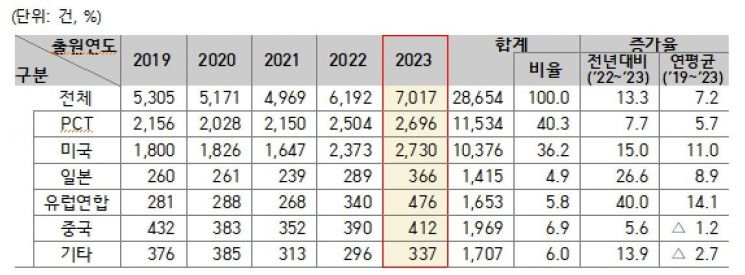 Government R&D Overseas Patent Application Status. Provided by the Korean Intellectual Property Office
According to the analysis, domestic patent applications generated by government R&D in 2023 totaled 37,396, a 0.6% decrease compared to the previous year. In contrast, overseas patent applications reached 7,017 in 2023, marking a 13.3% increase from the previous year. From 2019 to 2023, the number of overseas patent applications grew at an average annual rate of 7.2%.
The proportion of excellent patents (top 3 grades) evaluated using the Patent Analysis and Evaluation System (SMART5) also increased. SMART5, developed by the Korea Invention Promotion Association, evaluates the quantitative and qualitative value of patents based on publicly available patent information. The proportion of excellent patents calculated through this system rose from 4.5% in 2023 to 7.1% last year, an increase of 2.6 percentage points, indicating an improvement in the qualitative level of patents.
Government R&D patents also play a crucial role in promoting startups. Reflecting this, startups based on government R&D patents numbered 768 in 2023, a 4.5-fold increase from 169 in 2019. Notably, the likelihood of startups emerging from R&D projects that generated patents is 3.6 times higher than from projects without patents, highlighting that securing patent rights is becoming a key factor for companies aiming to commercialize R&D outcomes.
The number of technology transfer contracts involving government R&D patents held by universities and public research institutes has steadily increased over the past five years. In 2023 alone, there were 4,676 technology transfer contracts, with an average annual growth rate of 3.9% from 2019 to 2023. However, most technology transfers occurred domestically, with only 21 contracts involving overseas technology transfers.
KIPO also pointed out in its analysis of government R&D patent outcomes that standard patents are emerging as a core element of global technological competitiveness. Securing, maintaining, and managing standard patents require significant costs, but once secured, they are valued as assets that can generate high long-term value.
Given the high costs, the proportion of government R&D in domestic standard patents is also relatively high. Of the 3,541 standard patents filed from 2006 to 2023 (excluding large corporations), government R&D accounted for 46.1%. KIPO explained that this is a clear example of the important role government R&D plays in securing standard patents for universities, public research institutes, and small and medium-sized enterprises.
Kim Wanki, Commissioner of KIPO, stated, “The analysis results of government R&D patent outcomes are utilized in the R&D policy formulation process of research and development ministries. We will strengthen policy support to ensure that government R&D patent outcomes create economic value in actual industries and serve as a driving force for national economic growth.”
© The Asia Business Daily(www.asiae.co.kr). All rights reserved.

















