Cash Boxes to Be Removed from Downtown Routes in April and May, Suburban Routes in June and July
Alternative Payment Methods Such as Bank Transfers and Prepaid Transportation Cards to Be Provided
City and Bus Industry to Cooperate on Promoting G-Pass Usage
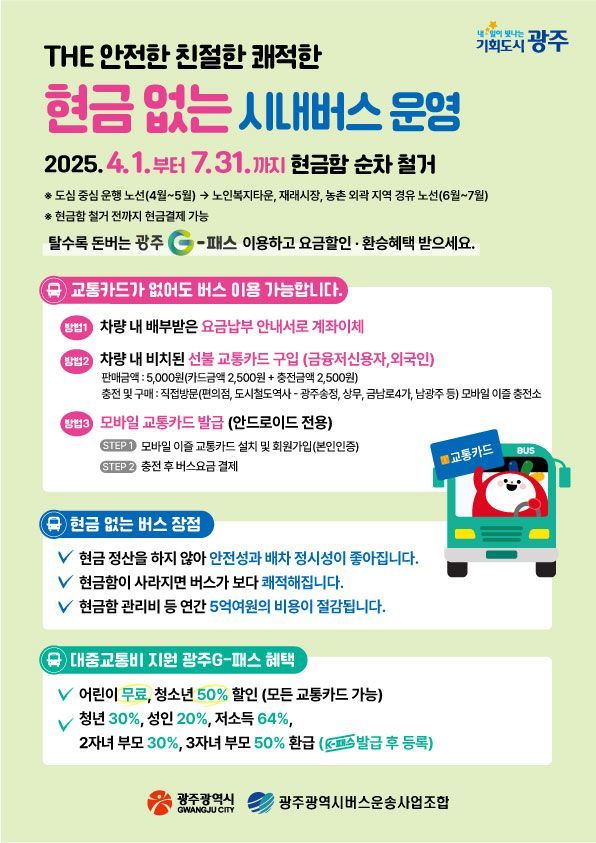
Gwangju City announced on the 13th that it will sequentially introduce 'cashless city buses' from April to July.
Initially, the city plans to remove cash boxes from buses operating on downtown routes between April and May. Then, in June and July, cash boxes will be removed from routes frequently used by the digitally vulnerable, such as seniors, as well as those passing through senior towns, traditional markets, and suburban areas.
Even after the removal of cash boxes, digitally vulnerable groups such as seniors, those with low financial credit, and foreigners will still be able to use city buses by means such as bank transfers, purchasing prepaid transportation cards sold on buses, or issuing mobile transportation cards via QR codes available at bus stops and on buses.
With the introduction of 'cashless city buses', it is expected that the elimination of cash settlement procedures will improve driving conditions for bus drivers and enhance schedule punctuality. In addition, annual costs such as cash box maintenance, estimated at around 500 million KRW, will be saved, leading to more efficient operations.
The widespread use of cards and the annual decrease in cash usage on city buses is also a basis for the introduction of 'cashless city buses'. In fact, after the introduction of the Gwangju G-Pass in January this year, the cash usage rate on city buses dropped to just 1.6%. This is a 0.3 percentage point (15.8%) decrease from last year's average of 1.9%.
Prior to full implementation, the city conducted a pilot operation of 'cashless city buses' starting last December, and the response to the April rollout has been generally positive. In a GwangjuON survey conducted from the 4th to 9th of last month, among about 5,000 participants, 61% supported the introduction of the system and 56% agreed with its implementation in April. Regarding preferred alternatives to cash, participants responded in the order of bank transfers, transportation card sales, and mobile transportation cards issued via QR code.
Accordingly, the city decided to begin implementation in April, applying it sequentially. For routes with a high proportion of senior users, various alternative solutions will be explored, and cooperation with the bus industry will be strengthened to enhance on-site promotion.
'Cashless city buses' are already in operation on all routes in Incheon, Daegu, Daejeon, Jeju, and Sejong, and on some routes in Seoul. Bus drivers have also requested the introduction of this system due to safety concerns associated with handling cash.
Bae Sangyoung, Director of Public Transportation, stated, "To ensure a stable transition of the system, we will do our best to implement cash alternatives for digitally vulnerable groups such as seniors without any issues on site," and added, "We also ask citizens to help their parents prepare transportation cards in advance and show interest and cooperation."
© The Asia Business Daily(www.asiae.co.kr). All rights reserved.
![Clutching a Stolen Dior Bag, Saying "I Hate Being Poor but Real"... The Grotesque Con of a "Human Knockoff" [Slate]](https://cwcontent.asiae.co.kr/asiaresize/183/2026021902243444107_1771435474.jpg)
















