The impeachment motion against Lee Chang-soo, head of the Seoul Central District Prosecutors' Office, and two other prosecutors, who were impeached for allegedly conducting a negligent investigation into the stock manipulation case involving Kim Geon-hee, was unanimously dismissed.
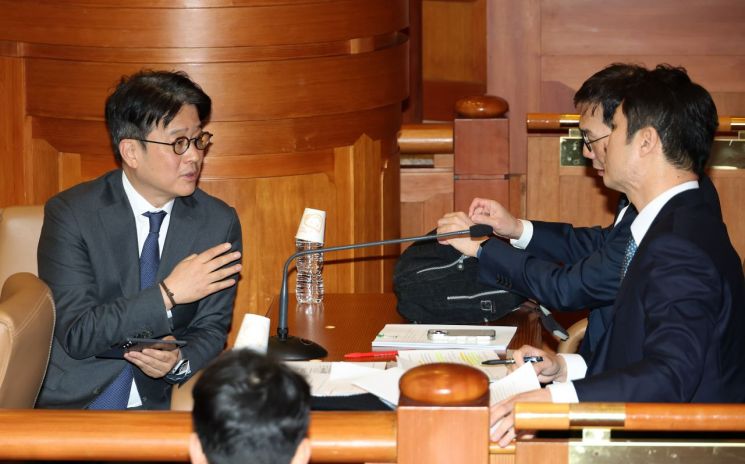 Lee Chang-soo, Chief Prosecutor of the Seoul Central District Prosecutors' Office (from left), Jo Sang-won, 4th Deputy Chief Prosecutor of the Central District Prosecutors' Office, and Choi Jae-hoon, Head of the Anti-Corruption Investigation Division 2 of the Central District Prosecutors' Office, are attending and conversing at the second hearing of the impeachment trial for three prosecutors held at the Constitutional Court in Jongno-gu, Seoul. Photo by Yonhap News.
On the 13th, the Constitutional Court unanimously dismissed the National Assembly's impeachment motion against Prosecutor Lee, Cho Sang-won, the 4th Deputy Chief of the Central District Prosecutors' Office, and Choi Jae-hoon, head of the Anti-Corruption Investigation Division 2 of the Central District Prosecutors' Office. The court stated, "It cannot be seen that Prosecutor Lee, Deputy Chief Cho, or Head Choi violated the Constitution or laws while performing their duties related to the investigation of Mrs. Kim." Following the dismissal of the impeachment, Prosecutor Lee and the others immediately returned to their duties.
The main reason for the impeachment motion against Prosecutor Lee and the two other prosecutors was that they did not properly investigate the Deutsche Motors stock manipulation case involving Kim Geon-hee, wife of President Yoon, and decided not to prosecute. They were impeached on the same day as Choi Jae-hae, head of the Board of Audit and Inspection. The National Assembly also included as grounds for impeachment that they gave explanations inconsistent with the facts during media briefings. Prosecutor Lee, during the impeachment trial hearing held on the 24th of last month, was also accused of providing explanations that differed from the facts. In response, Prosecutor Lee appeared at the hearing on the 24th and said, "Regarding the Kim Geon-hee case, as the head prosecutor, I took full responsibility and thoroughly verified the case, handling it based on evidence and legal principles."
On that day, the Constitutional Court judged that the prosecution's investigation of Mrs. Kim at a third location did not constitute an abuse of discretion. The court stated, "If there are significantly difficult circumstances, it is permissible to consider investigating at another location," adding, "There may be security difficulties in summoning and investigating the spouse of a sitting president, and considering precedents, investigating at a facility affiliated with the Presidential Security Service was not an undue convenience." Furthermore, since the hearing of opinions through the Investigation Review Committee is a discretionary procedure, Prosecutor Lee's decision not to request its convening was not considered an abuse of discretion.
However, the court noted, "It was confirmed through the investigation process and criminal trials of the main perpetrators and accomplices in the Deutsche Motors stock manipulation case that securities accounts under Kim Geon-hee's name were used in the price manipulation crimes," and added, "There is some doubt as to whether the investigation was properly conducted or supervised to collect evidence, such as securing text messages or messenger contents, to verify whether Mrs. Kim had a joint intent or was aware that the principal offenders were engaging in price manipulation."
Nonetheless, the court stated, "Approximately three to four years passed since the investigation began following the complaint, and a considerable amount of time had elapsed since the price manipulation occurred before each respondent became involved in the investigation. They may have judged that additional investigation would unlikely yield further evidence," and "There is insufficient material to determine the necessity of further investigation."
The Constitutional Court also judged that it was difficult to conclude that the prosecutors' statements during media briefings or at the National Assembly audit were false or that they knowingly made false statements. Additionally, the court found that Prosecutor Lee's involvement of a prosecutor who was then the head of the Gongju branch office in the Deutsche Motors stock manipulation investigation at the Seoul Central District Prosecutors' Office did not violate the Constitution or laws.
However, the court did not accept the prosecutors' argument that "the grounds for impeachment by the National Assembly are vague and that the right to impeach was abused, thus the motion should be dismissed." The court stated, "The necessary legal procedures were observed during the National Assembly's resolution of the impeachment motion, and the accused's constitutional or legal violations were sufficiently substantiated," adding, "The main purpose of this impeachment motion should be seen as to uphold the Constitution, and even if political motives or intentions were incidentally involved, it cannot be concluded that the right to impeach was abused." Regarding the grounds for impeachment, the court found that "the respondents were able to exercise their right to defense and the Constitutional Court could specify the subjects of judgment."
© The Asia Business Daily(www.asiae.co.kr). All rights reserved.

















