Wally Schirra Departs After Six Months of Overhaul
Securing 5 to 6 MRO Projects, Now Aiming for Shipbuilding Orders
Hanwha Ocean has opened a new path in the maintenance, repair, and overhaul (MRO) business for U.S. naval vessels. The departure of the U.S. Navy logistics support ship Wally Schirra, which Hanwha Ocean serviced for the first time, is being evaluated as meeting the high technical requirements of the U.S. Navy.
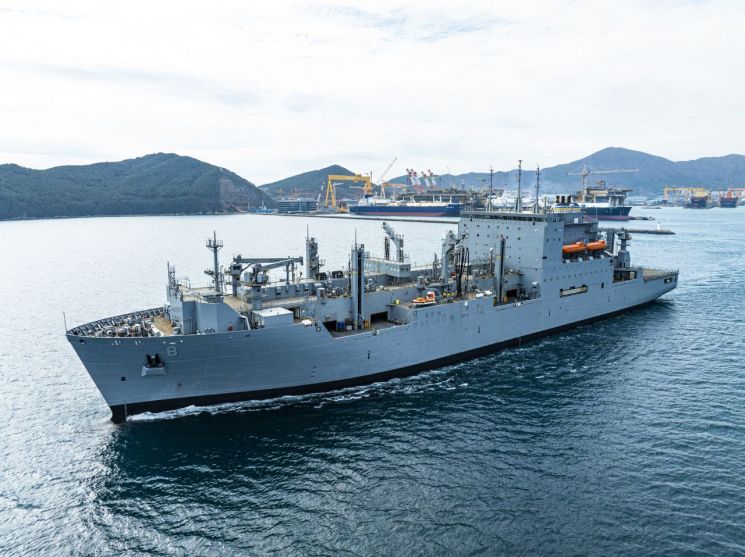 The US Navy logistics support ship, the USS Wally Schirra, is departing after successfully completing ship maintenance. (Photo by Hanwha Ocean)
According to Hanwha Ocean on the 13th, after signing the U.S. Navy ship maintenance agreement (MSRA) in July last year, Hanwha Ocean officially entered the U.S. Navy MRO market by securing the overhaul project for the Wally Schirra ship as its first project. In November of the same year, it also consecutively secured the regular repair project for the USNS YUKON, a replenishment ship belonging to the U.S. Navy 7th Fleet.
Continuous MRO project wins have also increased sales. Last year, Hanwha Ocean achieved an operating profit of 237.9 billion KRW, marking a return to profitability for the first time in four years since 2020. The performance was driven by the merchant ship division's results and the special ship division's operating profit margin. This year, the atmosphere is positive with the expansion of U.S. Navy ship MRO orders and the potential opening of the U.S. military shipbuilding market.
The U.S. MRO Market Alone is Worth 8 Billion USD
The global naval MRO market is continuously growing, with a size of approximately 8 billion USD. Hanwha Ocean aims to secure MRO projects for 5 to 6 U.S. Navy ships this year. In January, then President-elect Donald Trump stated regarding U.S. Navy shipbuilding issues, "We might use allied countries." After winning the presidential election in November last year, Trump praised Korea's shipbuilding capabilities during a call with President Yoon Suk-yeol, saying, "I am well aware of Korea's world-class naval and shipbuilding capabilities."
The U.S. military ship MRO market is a new business opportunity. According to future plans to strengthen naval power, there is a possibility of securing orders worth 1,600 trillion KRW for MRO, combat ships, and logistics support ships. The U.S. ship MRO market is estimated to be worth 20 trillion KRW annually. Submarines and ships have an operational lifespan of up to 40 years and require periodic maintenance, repair, and overhaul. When a submarine is delivered, it generates decades of MRO demand.
Challenging Major Markets Starting from the U.S. Market
Hanwha Ocean may expand its scope starting from the U.S. Navy market. According to market information analysis firm Bizwit, the global ship MRO market size is expected to grow from about 56.6 billion USD in 2020 to 70.5 billion USD by 2030. Additionally, large-scale submarine and ship projects are being promoted in major countries such as Canada (60 trillion KRW), Saudi Arabia, and Poland (100 trillion KRW), indicating further expansion of the global MRO market.
Shipbuilding for U.S. military vessels is also possible. On the 5th of last month, U.S. Senators Mike Lee (Republican, Utah) and John Curtis (Republican, Utah) introduced two bills, including the "Coast Guard Readiness Guarantee Act," to strengthen the readiness of the Navy and Coast Guard. The Trump administration emphasized Korea-U.S. shipbuilding cooperation and proposed allowing allied countries like Korea to build U.S. Navy ships. If this bill passes, shipyards in NATO member countries or Indo-Pacific countries with mutual defense treaties with the U.S. will be able to build naval ships.
Possibility of Securing Shipbuilding Projects Following MRO
The U.S. Navy needs 355 ships to maintain readiness but currently operates only 291. The U.S. must increase naval ship orders to counter China’s expanding maritime dominance. This year, the U.S. Navy is expected to order around 10 ships. The U.S. Congress intervened because increasing the number of ships either requires building them domestically or upgrading old ships, both of which are expensive and time-consuming. Therefore, they want to create options to outsource all or part of shipbuilding to trusted allied shipyards. Experts analyze this as an intention to revive the Trump administration’s plan to secure 355 combat ships for the U.S. Navy.
Acquisition of Philly Shipyard in the U.S. as a Foundation for Orders
Hanwha Ocean acquired the Philly Shipyard in Philadelphia, U.S., in June last year, becoming the first Korean company to do so. Philly Shipyard specializes in building small to medium-sized merchant ships and currently has three years’ worth of backlog in its dock, but it is operating at a loss due to labor costs and other factors. The shipyard’s capacity (CAPA) allows simultaneous construction of 1 to 1.5 ships annually. If production efficiency improves, it is expected to build up to 4 ships per year.
Hanwha Ocean plans to continue stable growth this year through expanding liquefied natural gas (LNG) carrier construction, building three new submarines, expanding MRO business, and starting new offshore projects. A Hanwha Ocean official stated, "By overcoming previous process delays and steadily executing high value-added shipbuilding, leading ultra-competitive and eco-friendly technologies, we will lead the global market based on solid fundamentals."
© The Asia Business Daily(www.asiae.co.kr). All rights reserved.

















