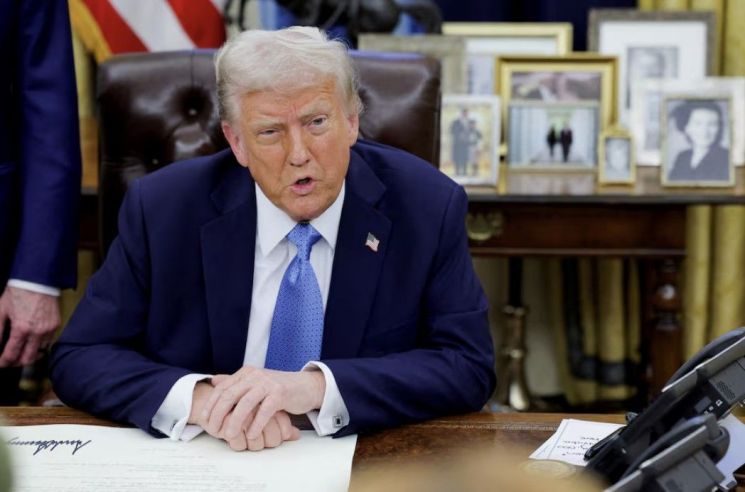
In response to the trade shocks triggered by Trump, the Korean government has expanded and reorganized the Trade Commission, but there are calls to go beyond this and strengthen practical countermeasures. As regulations from the US and EU intensify, increasing the burden on Korea's key industries, additional measures such as applying the PMS (Particular Market Situation) concept and enhancing support for small and medium-sized enterprises (SMEs) are deemed necessary.
According to the Ministry of Trade, Industry and Energy on the 14th, the Korean government confirmed the expansion and reorganization of the Trade Commission at the Cabinet meeting on the 11th, thereby strengthening its trade remedy response capabilities.
With this reorganization, the Trade Commission established the 'Anti-Dumping Investigation Support Division' and the 'Determination Support Division,' expanding from the previous 4 divisions with 43 personnel to 6 divisions with 59 personnel. This is evaluated as enabling more sophisticated operation of anti-dumping investigation and determination procedures.
However, there are criticisms that organizational expansion alone is insufficient. Experts emphasize that "it is now time to focus on the methodology of trade remedy responses" and that policy support to reduce the actual damage to companies must be backed.
A recent commissioned report titled "Research on Korea's Trade Remedy Policy Direction Amidst Strengthening Global Protectionism," prepared by the Korean Trade and Commerce Association, pointed out the urgent need to supplement the circumvention anti-dumping system. As major countries increasingly regulate circumvention involving third-country assembly and completion types, Korea must also prepare legal and administrative measures to respond accordingly.
The report particularly stressed the need to advance the method of calculating dumping margins. Major countries such as the US and EU have recently been actively utilizing the PMS (Particular Market Situation) concept in trade remedy investigations to strengthen investigations by increasing dumping margins. PMS is a system that changes the normal price calculation method when the market does not function normally, such as when prices are distorted due to government subsidies.
In April last year, the US expanded the Department of Commerce's discretionary authority to apply PMS through revised anti-dumping rules. Accordingly, when government subsidies are concentrated in a specific country's industry or production costs are distorted, alternative country prices are actively used instead of the existing normal price calculation method.
For example, in the 2020 anti-dumping investigation on Chinese propane, the US Department of Commerce applied PMS, judging that normal price calculation was impossible due to Chinese government subsidy intervention, imposing high anti-dumping duties ranging from 254.4% to 267.4%. Additionally, in 2022, PMS was applied to polyphenylene ether products, resulting in anti-dumping duties between 17.3% and 48.6%.
The EU also introduced the concept of 'Significant Distortion' through the 2017 amendment of its anti-dumping law, allowing the use of alternative country prices when production costs in a specific country are abnormally low. In particular, the EU Commission designated China and Russia as countries where significant distortion occurs and calculates high dumping margins for exporters from these countries.
With concerns that unfair trade attempts will become more frequent due to the tariff war initiated by Trump, the need for Korea to more actively incorporate the PMS concept into its domestic trade remedy system is growing. It is pointed out that Korea needs to revise its tariff laws within WTO norms to establish a legal basis for PMS application and strengthen discretionary authority to apply it during anti-dumping investigations.
The reality that domestic companies, especially SMEs, have low accessibility to and utilization of the trade remedy system also needs improvement. According to the report, in a survey conducted last year, 54 out of 105 SMEs responded that they considered trade remedy measures, but only 6 companies had actual experience using them. This is analyzed to be due to administrative and cost burdens and insufficient expected benefits.
The difference in utilization of trade remedy systems between large corporations and SMEs is also clearly evident. Large corporations can respond quickly to trade remedy measures through their in-house legal teams, whereas SMEs find it difficult to actively use trade remedy procedures due to a lack of specialized personnel and high administrative costs. Especially, SMEs face difficulties in preparing supporting documents and legal responses when applying for trade remedy measures, highlighting the urgent need for government support.
The report emphasized, "In line with changes in the international trade environment, it is necessary to enhance the effectiveness of the trade remedy system and support companies to actively utilize it," adding, "It is urgent to organize investigation procedures and improve the dumping margin calculation method to align with global standards."
© The Asia Business Daily(www.asiae.co.kr). All rights reserved.
![Clutching a Stolen Dior Bag, Saying "I Hate Being Poor but Real"... The Grotesque Con of a "Human Knockoff" [Slate]](https://cwcontent.asiae.co.kr/asiaresize/183/2026021902243444107_1771435474.jpg)
















