Strengthening Monitoring of Semiconductor Discharge Water
Three national automatic water quality monitoring stations are planned to be installed in the Pyeongtaekho watershed area around Hyeondeok-myeon, Pyeongtaek-si.
According to Pyeongtaek-si on the 13th, the Ministry of Environment is promoting the installation of three national automatic water quality monitoring stations to proactively respond to the stability of water quality in the Pyeongtaekho watershed and the potential water pollution from river discharge during the semiconductor production process.
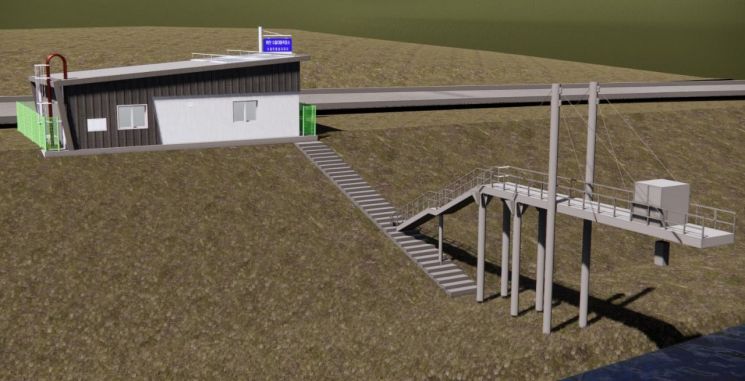 A bird's-eye view of the national automatic water quality monitoring station to be installed in the Pyeongtaekho watershed. Provided by Pyeongtaek City
The city explained that the installation of the monitoring stations was promoted as a result of actively urging the Ministry of Environment on the importance of the water system and the establishment of water safety measures.
The unmanned monitoring stations can measure up to 28 items in real-time, including heavy metals, biological monitoring, and volatile organic compounds, enabling rapid response in case of water pollution accidents.
Currently, Pyeongtaekho supplies about 500 million tons of agricultural and industrial water annually to Pyeongtaek-si and nearby areas, but it is experiencing various water quality pollution problems such as algal blooms due to rapid development in surrounding areas.
In particular, with the establishment of the 'Advanced System Semiconductor Cluster National Industrial Complex' in the areas of Idong and Namsa-eup, Yongin, the city is concerned that from 2040, more than 1.6 million tons of semiconductor discharge water per day will flow into Pyeongtaekho, further increasing the pollution load.
Originally, the cooperative agreement among related organizations for the 'Yongin Advanced System Semiconductor Cluster' had agreed to install two monitoring stations in Pyeongtaekho. However, considering the scale of the Pyeongtaekho watershed, the city is currently consulting with the Ministry of Environment to expand this to three locations and discuss detailed implementation plans.
The Korea Environment Corporation, responsible for installing the monitoring stations, explained, "We will select the optimal sites through collaboration with Pyeongtaek-si and complete the installation of the monitoring stations by the end of 2026."
Jung Jang-seon, mayor of Pyeongtaek-si, said, "We will carefully establish countermeasures against the inflow of semiconductor discharge water to ensure that Pyeongtaekho becomes a place where citizens can feel safe and trust."
© The Asia Business Daily(www.asiae.co.kr). All rights reserved.
![Clutching a Stolen Dior Bag, Saying "I Hate Being Poor but Real"... The Grotesque Con of a "Human Knockoff" [Slate]](https://cwcontent.asiae.co.kr/asiaresize/183/2026021902243444107_1771435474.jpg)















