Private Education Expenses for Elementary, Middle, and High School Students Increase by 2.1 Trillion Won Year-on-Year... Up 7.7%
Participation Rate and Hours Rise Despite Declining Student Numbers
Private Education Participation Rate at 80.0% (Up 1.5%)... Weekly Participation Time at 7.6 Hours (Up 0.3 Hours)
Average Monthly Private Education Expense per Student: 590,000 Won
Elementary: 504,000 Won, Middle: 628,000 Won, High: 772,000 Won
Ministry of Education: "Continuous Implementation of Measures to Alleviate Private Education Burden"
Last year, private education expenses for elementary, middle, and high school students exceeded 29 trillion won, marking a record high for the fourth consecutive year. During this period, the school-age population decreased by 553,000, but spending on private academies increased by 5.8 trillion won. The Ministry of Education announced plans to reduce the burden of private education through nine major education reform tasks.
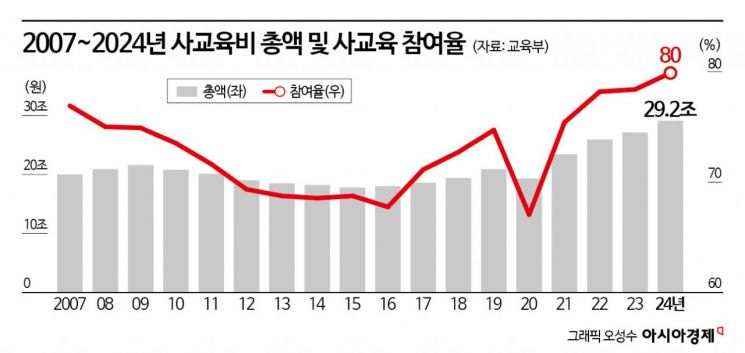
According to the Ministry of Education and Statistics Korea on the 13th, the total private education expenses last year amounted to 29.2 trillion won, an increase of 2.1 trillion won (7.7%) compared to the previous year. By school level, expenses were 13.2 trillion won (6.5%) for elementary schools, 7.8 trillion won (9.5%) for middle schools, and 8.1 trillion won (7.9%) for high schools, showing an upward trend across all groups.
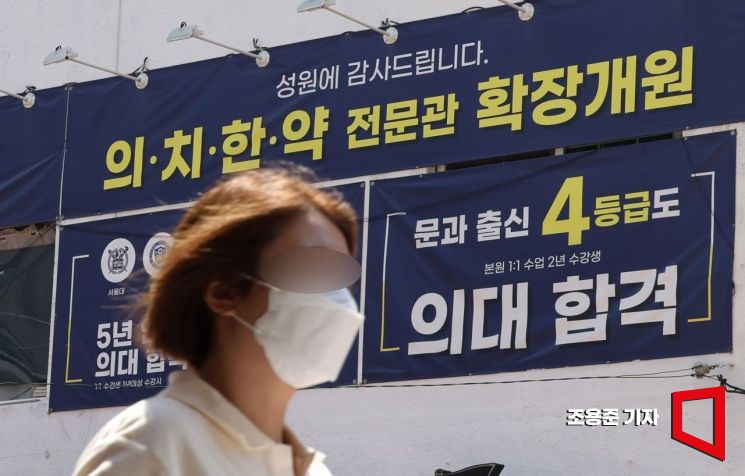 With the confirmation of an increase in medical school admission quotas for the first time in 27 years, the academy district is buzzing with expectations that the threshold for medical school acceptance may be lowered. On the 31st, promotional materials related to medical school admissions were posted on a building of an academy in Gangnam, Seoul. Photo by Jo Yongjun jun21@
◆ Private Education Expenses Hit Record High for Four Consecutive Years
Private education expenses dropped to the 19 trillion won range in 2020 due to the impact of COVID-19-related academy closures, but surged to the 23 trillion won range in 2021 and have set new record highs for four consecutive years (23.4 trillion won → 26 trillion won → 27.1 trillion won → 29.2 trillion won).
During this period, the school-age population decreased from 7.7 million to 7.147 million, a reduction of 553,000. Looking only at the number of elementary, middle, and high school students last year, it was 5.13 million, down 80,000 (1.5%) from the previous year.
The increase in private education expenses despite the decline in student numbers is interpreted as resulting from increased participation rates and participation time in private education.
The private education participation rate was 80.0%, up 1.5 percentage points from the previous year, also a record high. The participation rate was highest in elementary schools at 87.7%, up 1.7 percentage points from the previous year, followed by middle schools at 78.0% (up 2.7 percentage points) and high schools at 67.3% (up 0.9 percentage points). Participation time increased by 0.3 hours, 0.4 hours, and 0.2 hours for elementary, middle, and high schools respectively, reaching 7.8 hours, 7.8 hours, and 6.9 hours.
◆ Average Monthly Private Education Expense per Student: 592,000 Won
The average monthly private education expense per student participating in private education was 592,000 won, a 7.2% increase from the previous year.
By school level, the amounts were 504,000 won for elementary schools, 628,000 won for middle schools, and 772,000 won for high schools, increasing by 9.0%, 5.3%, and 4.4% respectively.
Spending on general subjects such as Korean, English, and Math was 551,000 won, while expenses for arts, physical education, hobbies, and cultural enrichment were 243,000 won. Among general subjects, the subject with the highest average monthly private education expense was 'English.'
The average monthly private education expense per student for English was 264,000 won, higher than Math (249,000 won), Korean (164,000 won), and Social Studies/Science (146,000 won).
By grade, the highest average monthly private education expense was for first-year high school students at 799,000 won. The increase was also notable at 7.9% compared to the previous year, more prominent than other grades (second-year high school 769,000 won, 3.3%; third-year high school 744,000 won, 1.4%). Analysts suggest this may be partly due to baseline effects from changes in college entrance exams for the 2028 academic year and the introduction of the high school credit system.
An official from the Ministry of Education stated, "We estimate that changes in entrance exams have had some influence," but added, "Once the introduction of the 5-grade system for school records is fully established in the field, the demand for private education, which had increased due to this, is expected to decrease."
◆ Neulbom Schools Reduce Private Education for First Graders... "Continuous Promotion of Nine Education Reform Tasks"
The Ministry of Education plans to continuously promote the existing nine education reform tasks to allow people to feel the effects of education reform projects such as Neulbom Schools and Education Development Special Zones.
Notably, the increase in private education participation for first-grade elementary students was the lowest among all grades at 0.2 percentage points, which the Ministry interprets as partly influenced by the expansion of Neulbom Schools.
Looking at private education participation rates by region for elementary students, participation in eup and myeon areas significantly decreased by 9.1 percentage points to 75.2%, contrasting with Seoul's participation rate of 93.8%. A Ministry of Education official said, "We need to see if meaningful results will continue to emerge, but we understand that Neulbom Schools have had an effect in reducing private education in eup and myeon areas."
The Ministry plans to expand support for Neulbom Schools to include up to second-grade elementary students starting this year and provide various high-quality programs such as English programs.
Additionally, the Ministry will support regional education innovation models through Education Development Special Zones and strengthen customized support using the EBS system.
Furthermore, efforts will be actively promoted to alleviate parents' anxiety about private education through special lectures and to establish a response system for private education expenses in cooperation with metropolitan and provincial offices of education.
© The Asia Business Daily(www.asiae.co.kr). All rights reserved.
![Clutching a Stolen Dior Bag, Saying "I Hate Being Poor but Real"... The Grotesque Con of a "Human Knockoff" [Slate]](https://cwcontent.asiae.co.kr/asiaresize/183/2026021902243444107_1771435474.jpg)
















