Even with a $6 Billion Cut in Education, Interest Payments Rise by $10 Billion
"75% of Federal Spending Goes to Social Security"
Elon Musk, head of the U.S. Department of Government Efficiency (DOGE) and CEO of Tesla, has excessively cut the federal government budget and laid off public officials to the extent of triggering anti-Tesla protests. However, last month, U.S. federal spending reached a record high of $603 billion (approximately 875 trillion won). This has led to criticism that the Department of Government Efficiency's activities over the past month have not achieved significant results.
On the 12th (local time), Newsweek and others reported this after analyzing the U.S. Treasury Department's February monthly report.
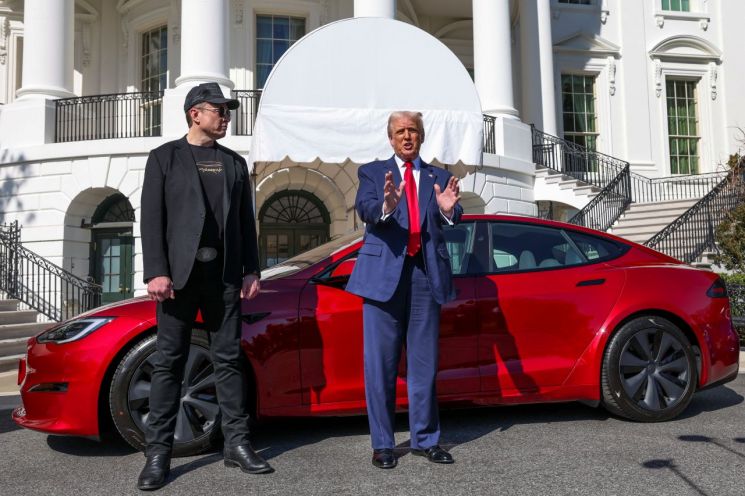 Donald Trump, President of the United States (right), and Elon Musk, CEO of Tesla. Photo by Reuters-Yonhap News
Total spending increased by $40 billion (7%) compared to the same month last year.
CEO Musk plans to reduce the federal budget by $1 trillion annually and stated that the Department of Government Efficiency's activities would cut spending by $4 billion per day. The department's website posted that, as of that day, it had saved $714.29 per taxpayer, totaling $115 billion.
However, foreign media pointed out that the Treasury report shows almost no significant budget cuts in major categories. Despite suspending or firing thousands of public officials and canceling thousands of government subsidies and contracts, the results are minimal.
The only major budget cut was by the Department of Education, which reduced spending by $6 billion. The monthly expenditure of the U.S. Agency for International Development (USAID) dropped to $226 million, down from $547 million in the same month last year, halving the amount.
Although some budget cuts were successful, medical expenses increased by 3% in February, raising government spending by $5 billion. Additionally, if social security spending rises by 6%, an additional $8 billion may be required.
Direct spending by the U.S. Treasury also surged by $29 billion compared to the same month last year. Monthly debt repayments increased by $10 billion to reach $86 billion, and payments related to tax credits rose by $14 billion. Defense spending remained at a similar level of $61.4 billion.
The Trump administration began imposing an additional 10% tariff on Chinese imports from the 4th of last month. Treasury officials stated that the tariff increase did not have a significant impact on government revenue in February and is more likely to appear in March data. On the 4th of this month, President Trump raised the additional tariff on Chinese imports by another 10%, bringing the total to 20%.
Jessica Liddell, senior researcher at the conservative think tank Manhattan Institute, said, "About 75% of federal spending goes to Social Security, Medicaid, Medicare, defense, veterans, and interest, and (the Department of Government Efficiency) has not touched any of those."
Brendan Duke, senior director at the Center on Budget and Policy Priorities (CBPP) and former White House economic advisor under the Biden administration, said about the Department of Government Efficiency's activities, "It is clearly in the early stages, and many layoffs may not yet be reflected in the monthly data."
Meanwhile, on the same day, the U.S. House of Representatives, led by Republicans, narrowly passed a temporary budget bill extending total federal spending to last year's level until the end of September. However, to pass the Senate, support from at least eight Democratic senators is required.
© The Asia Business Daily(www.asiae.co.kr). All rights reserved.
![Clutching a Stolen Dior Bag, Saying "I Hate Being Poor but Real"... The Grotesque Con of a "Human Knockoff" [Slate]](https://cwcontent.asiae.co.kr/asiaresize/183/2026021902243444107_1771435474.jpg)
















