KOSPI Rebounds in a Single Day, Recovering Losses
Individuals Alone Bet on KOSPI's Rise
Samsung Electronics and SK Hynix Also Net Bought... Semiconductors Lead the Rebound
The KOSPI rebounded on the 12th, recovering the losses from the previous day. Only individual investors who net bought leveraged exchange-traded funds (ETFs) betting on the KOSPI's rise were smiling. Individuals also net bought Samsung Electronics and SK Hynix the previous day, and these two stocks led the rebound on that day.
According to the Korea Exchange on the 13th, the KOSPI closed at 2,574.82, up 1.47% from the previous day. It successfully rebounded in just one day, regaining the 2,570 level.
Kim Su-yeon, a researcher at Hanwha Investment & Securities, analyzed, "This year, the KOSPI has outperformed the U.S. S&P 500 by 11.7 percentage points. Although it may seem unfamiliar since such a gap between Korea and the U.S. returns has not occurred since 2005, global economic conditions and supply-demand factors are supporting the KOSPI."
There are forecasts that the domestic stock market's strength relative to the U.S. will continue this year. Kang Dae-seung, a researcher at SK Securities, said, "This year, the Korean stock market is expected to show strength compared to the U.S. Due to the slowdown in U.S. economic growth, it is judged that the U.S. stock market will find it difficult to experience another trend-like rise as before. However, the KOSPI is expected to show relative strength compared to the U.S. thanks to China's economic recovery, Korea's indirect benefits from U.S. tariffs on China, and confirmed semiconductor demand driven by the AI supremacy competition."
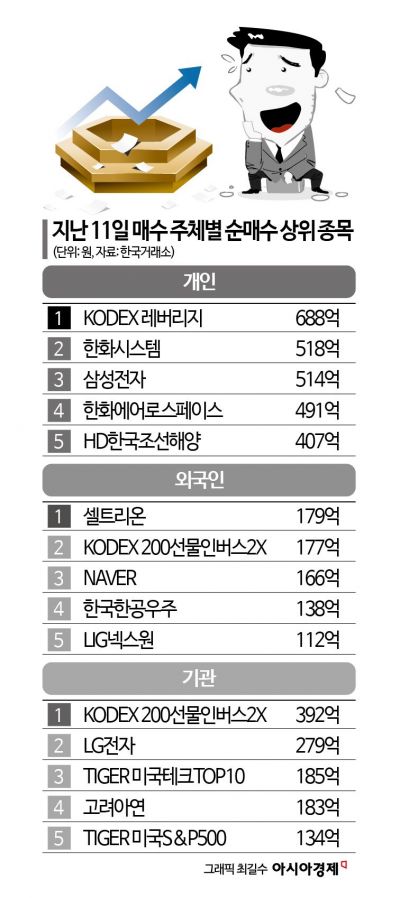
The only ones who benefited from the KOSPI's rebound in one day were individual investors. On the 11th, when the KOSPI fell more than 1% due to concerns about a U.S.-originated economic recession, individuals net bought the KODEX Leverage ETF the most, betting on the KOSPI's rise. Leveraged ETFs can yield twice the returns when the underlying index rises. Individuals net bought 68.8 billion KRW worth of KODEX Leverage. Along with this, individuals also purchased 37.4 billion KRW worth of KODEX KOSDAQ150 Leverage, putting weight on the rebound in both markets.
On the other hand, foreigners and institutions bet on further declines in the KOSPI by buying inverse ETFs on the 11th. Foreigners bought 17.7 billion KRW worth of KODEX 200 Futures Inverse 2X, known as "Gopbus" (a combination of "multiply" and "inverse"), making it the second most held stock after Celltrion, and also net bought 10.1 billion KRW of KODEX Inverse. Institutions net bought 39.2 billion KRW of KODEX 200 Futures Inverse 2X, making it their largest purchase. Conversely, institutions sold 62.1 billion KRW and 39.4 billion KRW of KODEX Leverage and KODEX KOSDAQ150 Leverage, respectively. The KODEX 200 Futures Inverse 2X is a product that inversely tracks twice the KOSPI 200 futures index, allowing investors to earn twice the profit when the KOSPI 200 index falls.
Individuals also net bought Samsung Electronics and SK Hynix, two stocks that rose sharply on the 12th and led the KOSPI's rebound. On the previous day, Samsung Electronics rose 2.43%, and SK Hynix rose 5.91%. On the 11th, individuals net bought 51.4 billion KRW of Samsung Electronics and 25.2 billion KRW of SK Hynix. Conversely, foreigners sold 38.5 billion KRW of SK Hynix and 25.1 billion KRW of Samsung Electronics on the same day. Institutions were the largest sellers of Samsung Electronics, net selling 95.3 billion KRW, while they net bought 5.6 billion KRW of SK Hynix.
Kang Jin-hyuk, a researcher at Shinhan Investment Corp., said, "On the previous day, SK Hynix and Samsung Electronics accounted for 27% and 26% of the KOSPI index's rise contribution, respectively, contributing to more than half of the increase." He added, "This was influenced by expectations of Korea's semiconductor sector benefiting indirectly after reports that the U.S. Trade Representative (USTR) convened a hearing to discuss additional tariffs on Chinese legacy semiconductors." He continued, "Next week, the NVIDIA GTS 2025 event is also scheduled, so it will be necessary to watch whether there will be upward momentum in the semiconductor sector, which had seen deteriorated investor sentiment due to concerns about the Chips Act repeal and tariffs."
© The Asia Business Daily(www.asiae.co.kr). All rights reserved.

















