On-site Meeting to Discuss Support for Export SMEs
Ministry of SMEs and Startups Launches 'Emergency Response Team'
Emergency Management Stabilization Fund for Companies Damaged by Protectionism
"We were preparing to newly export to the United States, but discussions with local companies have been halted due to tariff issues. We were constructing a second factory for this purpose, but a $5 million contract is now at risk of collapse."
Yu Gyeong-yeon, CEO of JJR Aluminum, stated on the 12th regarding the 25% tariff imposed on all steel, aluminum, and derivative products imported by the United States, "The tariff imposition has caused us to lose price competitiveness."
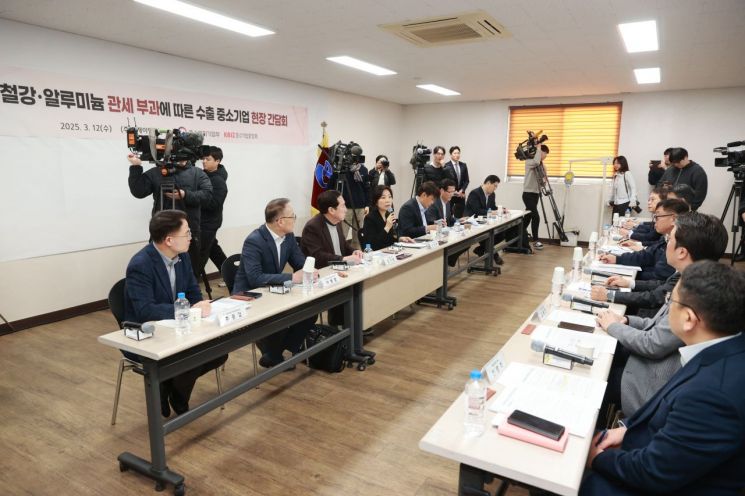 Oh Young-joo, Minister of SMEs and Startups, is delivering a welcoming speech at the "On-site Meeting with Exporting SMEs Regarding U.S. Steel and Aluminum Tariffs" held on the 12th at Gyeonggi-do Hwaseong GJR Aluminum. Photo by Ministry of SMEs and Startups
SMEs complained that they are already experiencing difficulties in export contracts due to the U.S. government's tariff policy. CEO Yu said, "Even if we try to diversify exports to Europe or Southeast Asia due to the U.S. tariff policy, the equipment is basically set up for the U.S., so we have to purchase new equipment," adding, "Support is needed when SMEs expand their facilities during the export process."
The industry emphasized that the government should also work to stabilize raw material prices, which are fluctuating due to the U.S. tariff policy. Jung Han-seong, CEO of Shinjin Fastener Industry, said, "We hope the government manages domestic raw material prices so that they are at least not more expensive than international prices," adding, "Currently, if we do not purchase the cheapest raw materials in the world to maintain competitiveness, we will inevitably fall behind."
There were also calls for support for logistics costs. Oh Won-hyun, CEO of Sein IND, said, "Logistics costs have already more than doubled compared to before COVID-19, and if we use Chinese ships to enter the U.S., additional fees are charged, so logistics costs effectively increase by 100%," emphasizing the need to urgently raise the support limit for logistics costs within the export voucher program.
In addition, the SME industry urged the government to strengthen education for SMEs, respond to stricter rules of origin, and prepare cooperation plans with large corporations.
The Ministry of SMEs and Startups plans to actively respond to the U.S. tariff measures by operating an 'Emergency Response Team' to establish a rapid support system for tariff-affected companies. Led by the Director of the SME Policy Office, the team consists of four groups: the Complaint Center, Fund Support Team, Information Provision Team, and Export Support Team. They plan to hold weekly meetings to identify and review policy improvement tasks. Fifteen complaint centers nationwide will receive damage reports and provide consultation for export SMEs, as well as offer tariff-related information.
To quickly support SMEs experiencing management difficulties due to tariff measures, 'protectionism damage' will be added as a reason for management difficulties in the Emergency Management Stabilization Fund, providing funds for business normalization. For affected companies, the application documents for the Emergency Management Stabilization Guarantee will also be simplified. In the second announcement of the export voucher program scheduled for May, a separate support quota will be allocated for tariff-affected companies to provide consulting for export strategy development.
Minister Oh emphasized, "Regarding the U.S. tariff policy, the government is strengthening cooperation among related ministries, but if damages become a reality, we must promptly supplement countermeasures through public-private cooperation," adding, "We will prepare comprehensive support measures considering the entire value chain."
© The Asia Business Daily(www.asiae.co.kr). All rights reserved.
![Clutching a Stolen Dior Bag, Saying "I Hate Being Poor but Real"... The Grotesque Con of a "Human Knockoff" [Slate]](https://cwcontent.asiae.co.kr/asiaresize/183/2026021902243444107_1771435474.jpg)















