Korean, Chinese, and Japanese Steel Products Seeking New Export Destinations
80% of India's Imports... Potential for Additional Inflows
India Aims to Grow Its Domestic Steel Industry... Concerns Over Setbacks
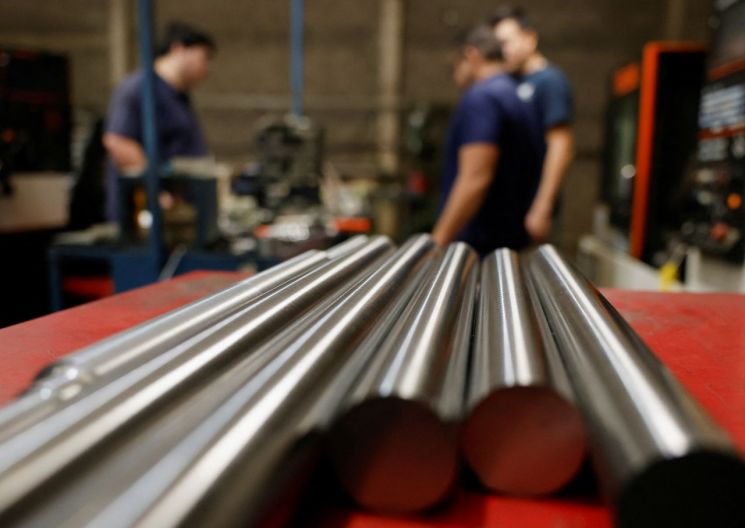 Workers at a metal machinery factory in Apodaca, Mexico, stand next to a pile of steel rods on the 11th (local time). The United States implemented a policy imposing a uniform 25% tariff on imported steel and aluminum starting at midnight on the 12th. / Reuters and Yonhap News Agency
As the United States decided to impose a uniform 25% tariff on imported steel and aluminum, there is growing speculation that steel from South Korea, China, and Japan seeking 'alternatives' could additionally flow into India. In India, concerns have been raised that the domestic steel industry might be hit hard and that the Modi government's production expansion policies could face setbacks.
According to the Economic Times of India on the 12th (local time), Amit Varghava, KPMG India's metals and mining lead, said, "With India's steel imports increasing, the tariff war is causing imported products to enter the market at lower prices," adding, "Steel prices within India are falling, which could negatively impact the government's steel production capacity expansion policies."
The steel industry is considered one of India's key industries. Currently, India's steel production reaches 180 million tons annually, ranking it as the world's second-largest steel producer after China. This is thanks to Prime Minister Narendra Modi's 'Make in India' policy, which aims to make India a major global production hub. With steel consumption increasing by more than 10% annually and demand surging, the Indian government established the 'National Steel Policy' in 2017, which includes plans to expand steel production to 300 million tons by 2030.
However, due to the very high domestic steel demand, imports have also been steadily increasing. India's steel imports for the fiscal year 2024?2025 (April 2024 to March 2025) are estimated at 10 million tons, with steel products from China, South Korea, and Japan accounting for about 80% of total imports. In this situation, if the U.S. raises the tariff rate on steel products uniformly to 25%, steel products from China, Japan, and South Korea, unable to find export destinations, are likely to enter India at reduced prices.
In this case, Indian steel products would also have to lower their prices, potentially shrinking the steel industry and making it difficult to achieve the goals of the national steel policy. The Indian steel industry estimates that an investment of $120 billion (approximately 174.3 trillion KRW) will be needed over the next five years to meet government targets.
Ritabrata Ghosh, Vice President of Indian credit rating agency ICRA, explained, "Many steel companies are concerned that their market share will decline due to increased imports, so they are not announcing new investment plans," adding that existing investment plans are also being readjusted.
© The Asia Business Daily(www.asiae.co.kr). All rights reserved.
![Clutching a Stolen Dior Bag, Saying "I Hate Being Poor but Real"... The Grotesque Con of a "Human Knockoff" [Slate]](https://cwcontent.asiae.co.kr/asiaresize/183/2026021902243444107_1771435474.jpg)















