[Corporate Research Lab] ③ Spotify Rises to the Top Despite Apple's Interference
User-Friendly 'Personalized Curation' as a Key to Success
Eradicating the Illegal Download Market... Coexistence with Music Copyright Holders
A call came from the CEO of a famous American company to a startup headquartered in Sweden.
"I don't understand why you want to provide music for free."
The company that Steve Jobs, the legendary co-founder of Apple, tried to keep in check was none other than Spotify. This small startup, which began in Sweden in 2006, launched its first service in 2008 and has since grown into the world's largest audio streaming platform, with over 675 million listeners across more than 180 countries. It boasts 263 million subscribers and a catalog of over 100 million tracks and more than 6 million podcasts.
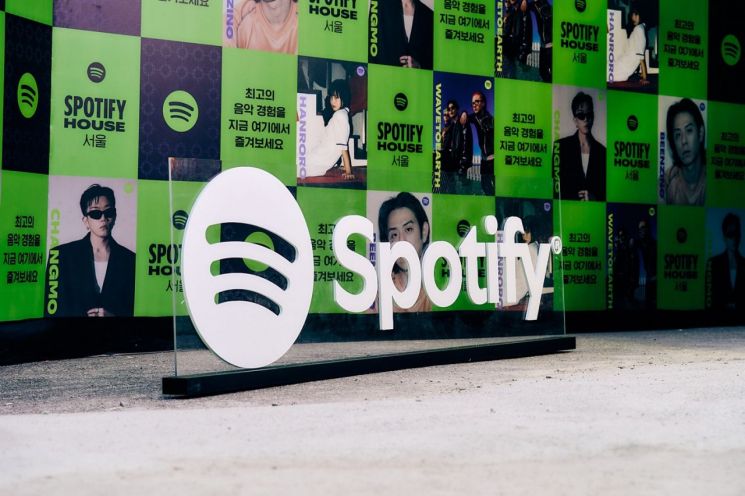
Jobs reacted unfavorably when Spotify attempted to enter the U.S. market. He was concerned that Spotify might impact Apple's iTunes business, which relied on individual music purchases. Spotify developed a streaming-based service where consumers could listen to music for free by watching ads or purchasing subscriptions through contracts with record labels and copyright holders. Even after Spotify entered the U.S. in 2011, Apple hindered its progress by delaying app store update approvals and obstructing other record labels from signing copyright agreements with Spotify.
Spotify, often called the ‘Netflix of the music industry,’ was born out of the global downturn in the music industry. In the early 2000s, the music market was plagued by illegal copying and copyright infringement. Revenue from the music market dropped sharply from $25 billion (36.2 trillion KRW) in 1999 to $14 billion (20.3 trillion KRW) in 2014, and streaming revenue was minimal at around $300 million (430 billion KRW) due to a lack of listeners. Daniel Ek, the founder and CEO of Spotify, created a model that reduced users' cost burden by offering free streaming supported by ads and subscriptions while ensuring revenue distribution to music copyright holders to address this complex situation.
Spotify’s rapid success is attributed to its user-friendly approach. True to the phrase ‘knows you better than you know yourself,’ Spotify provides personalized services from the moment users start using it. The service is sophisticated, utilizing artificial intelligence (AI) algorithms and machine learning technology. It customizes not only music recommendations but also application features to suit the listener. Personalized service is not determined by just a few songs listened to but is achieved through advanced technology and long-term accumulated data analysis.
This technological prowess is backed by massive R&D investment. Known as the ‘R&D center of the audio music industry,’ Spotify’s annual R&D expenditure exceeds 1 trillion KRW. It was recorded at 837 million euros (1.16 trillion KRW) in 2020, 912 million euros (1.26 trillion KRW) in 2021, and 1.387 billion euros (1.87 trillion KRW) in 2022. Major research areas include Audio Intelligence, human-computer interaction, language technology, user modeling, and various technologies linked to the music industry.

There were times when Spotify’s R&D investment was viewed negatively. Due to its scalability, Spotify recorded losses for a while as revenue lagged behind. However, Spotify dispelled concerns by turning profitable last year, driven by an increase in subscribers. Total revenue last year was 4.2 billion euros (6.64 trillion KRW), a 16% increase from the previous year. Operating profit reached 477 million euros (750 billion KRW). Monthly active users rose 12% year-on-year to 675 million, and premium subscribers increased 11% to 263 million during the same period.
Spotify’s growth was not achieved alone. Another key innovation was coexistence. As Spotify’s user base grew, music copyright holders also earned higher revenues. According to the International Federation of the Phonographic Industry, total revenue in the music industry was $20 billion (28.9 trillion KRW) in 2019, with over half?$11.4 billion (16.5 trillion KRW)?generated through streaming.
Spotify has contributed to spreading music from various countries worldwide. One of the biggest beneficiaries is South Korea. Thanks to Spotify, K-pop has gained more fans. BTS, which has secured fanbases in many countries, spread its music faster through Spotify channels. Last year, BTS recorded 3.9 billion streams overseas, excluding South Korea, making them the most streamed K-pop artist abroad.

Access to K-pop has also become easier. If you have listened to K-pop even once on Spotify, you are more likely to receive recommendations for BTS songs. If you have listened to songs by K-pop artists such as NewJeans, LE SSERAFIM, BLACKPINK, or Stray Kids, you would have been recommended BTS’s music. Spotify offers an ‘Algotorical’ playlist, which combines algorithm-based playlists based on music recommendation technology and editorial playlists prepared by Spotify’s music experts.
Along with music tracks, various podcasts are also a competitive advantage for Spotify. Users can continuously receive new podcast content daily through personalized categories such as business, technology, music, sports, comedy, education, arts, and politics. This is why unsubscribing is difficult.
Spotify is often mistaken for an American company because it was listed on the U.S. stock market in 2017. Spotify’s market capitalization reaches $107.6 billion (156.2 trillion KRW). With operating profit turning positive last year, its stock price continues to rise.
© The Asia Business Daily(www.asiae.co.kr). All rights reserved.
![Clutching a Stolen Dior Bag, Saying "I Hate Being Poor but Real"... The Grotesque Con of a "Human Knockoff" [Slate]](https://cwcontent.asiae.co.kr/asiaresize/183/2026021902243444107_1771435474.jpg)

















