Specifying FAR Incentives for Three-Dimensional Parks,
Upzoning Quasi-Residential Zones Near Stations,
and Introducing Pre-Deliberation and Processing Deadline Systems for Redevelopment
Seoul City will reflect the redevelopment and reconstruction deregulation plan announced earlier this year to revitalize the construction industry and housing market in its higher-level plans. Measures such as easing the public contribution ratio for urban regulatory area maintenance projects and relaxing floor area ratio (FAR) restrictions when creating three-dimensional parks will be included in the '2030 Seoul Urban and Residential Environment Maintenance Basic Plan.'
On the 12th, Seoul City announced that it will hold a public inspection and announcement of the amendment to the '2030 Seoul Metropolitan City Urban and Residential Environment Maintenance Basic Plan (Residential Environment Maintenance Project Section)' from the 13th to the 27th. Afterwards, it plans to complete the amendment notification within the first half of this year after following procedures such as hearing opinions from the Seoul Metropolitan Council and deliberation by the Urban Planning Committee.
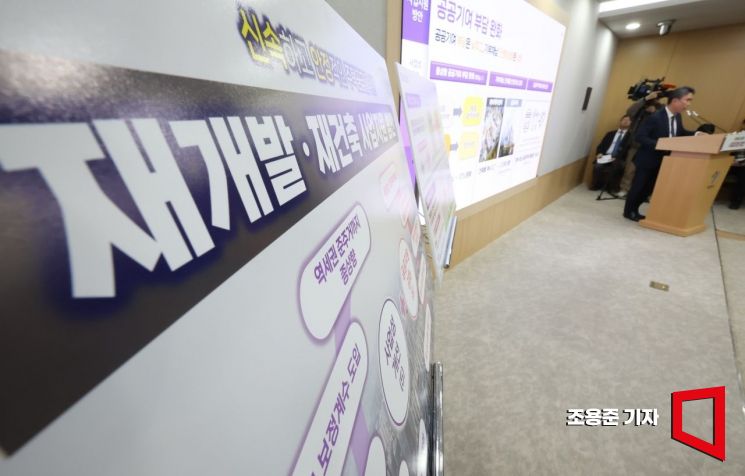 Yoo Chang-soo, Deputy Mayor for Administration of Seoul, is holding a press briefing on the 'Support Measures for Redevelopment and Reconstruction Projects' for rapid and stable housing supply on the 27th at the Seoul City Hall briefing room in Jung-gu, Seoul. Photo by Jo Yong-jun jun21@
Over the past two months, Seoul City announced deregulation plans including △additional easing of the public contribution ratio for maintenance projects in urban regulatory areas (No. 3) △relaxation of FAR when creating three-dimensional parks in maintenance projects (No. 6) △specific criteria for upgrading quasi-residential zones in low-profit areas near station districts (No. 35). Additionally, the 'pre-deliberation system' will be implemented, changing the timing for securing resident consent rates during maintenance plan initiation from before the deliberation application to before the notification request.
The 2030 Basic Plan is the highest-level statutory plan for maintenance projects targeting residential areas, presenting the basic directions for △housing maintenance-type redevelopment △reconstruction △residential environment improvement projects. It was comprehensively revised last September to include major deregulation measures such as business feasibility correction factors and current FAR, and this time, additional deregulation plans are being incorporated.
Specifying Height Regulation Areas and Easing Public Contributions
If the deregulation No. 3 'Easing Public Contributions When Upzoning Height-Regulated Areas' is applied, it is expected that the areas eligible for redevelopment will expand. The 2030 Basic Plan newly defines height regulation areas and includes a measure to apply a ratio proportional to the actually additionally secured FAR rather than a uniform 10% public contribution ratio when upzoning land use zones.
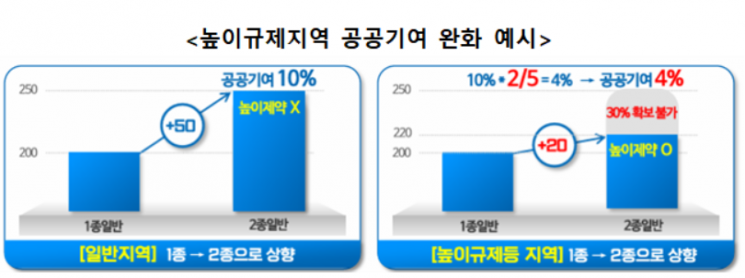
The city specified that 'height regulation areas' include areas where the maximum building height is restricted by laws and regulations such as height and landscape districts, areas around national heritage sites, hilly terrain, and adjacent urban natural parks that are effectively subject to height planning restrictions. Since height regulation areas have limitations on securing FAR even when upzoned, public contributions should be made only in proportion to the actually additionally secured FAR.
For example, even if the land use zone is upgraded from Type 1 (200%) to Type 2 (250%), if only 220% is secured due to height restrictions, the public contribution burden is 4%, not 10%.
Introducing Three-Dimensional Parks to Increase the Number of Saleable Houses
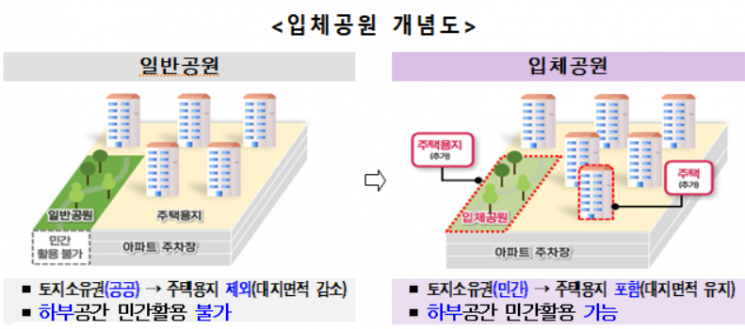
The deregulation No. 6 'Introduction of Three-Dimensional Park System,' which recognizes parks created on private land or building rooftops instead of conventional flat parks as public contributions, is also included. According to the new planning, when the project implementer creates and provides a three-dimensional park, the main content is to relax the FAR considering the facility construction costs and land use restrictions for residents due to the establishment of separate surface rights.
Three-dimensional parks are recognized as park area counted as site area, increasing the total number of houses that the project implementer can sell, thereby enhancing business feasibility and enabling efficient land use.
Upzoning Quasi-Residential Zones Near Stations Expected to Improve Business Feasibility in Northern Districts
Specific guidelines related to 'actively promoting upzoning of quasi-residential zones in low-profit station-area maintenance districts' have also been prepared. Although the current 2030 Basic Plan states that upzoning to quasi-residential zones is possible for station-area maintenance districts, there were difficulties in actual system operation due to the lack of specific details on the scope of upzoning and area selection.
The draft guidelines include the principle that upzoning to quasi-residential zones applies to maintenance projects where the average official land price of the district is below the average official land price of Seoul's redevelopment and reconstruction projects, and only the portion (area) within 250 meters from the subway station boundary within the district is upzoned. It also includes that since business conditions vary by maintenance district, the application and scope of quasi-residential upzoning can be partially adjusted considering regional characteristics.
It is expected that the development potential FAR will expand in relatively low-profit northern districts near stations, facilitating maintenance project promotion. Public contribution facilities resulting from upzoning will prioritize the introduction of facilities for socially vulnerable groups such as public housing and welfare facilities.
Introduction of Pre-Deliberation and Processing Deadline Systems for Redevelopment
The 'pre-deliberation system' and 'processing deadline system' to shorten redevelopment project periods will also be introduced. Starting this year, the redevelopment pre-deliberation system changes the timing for submitting consent forms (over 50% of landowners) during maintenance plan initiation from before the urban planning committee deliberation application to before the notification request, allowing resident consent and deliberation to proceed simultaneously.
The redevelopment processing deadline system will be implemented immediately to shorten administrative procedure periods. With the implementation of the redevelopment pre-deliberation and processing deadline systems, it is expected that the period required for designating maintenance districts can be shortened by more than six months.
Detailed information on the '2030 Basic Plan Amendment (Draft)' can be found in the Seoul City Bulletin, on the Seoul City website (notices and announcements), and on the Maintenance Project Information Portal.
Choi Jin-seok, Director of the Seoul City Housing Office, said, "Seoul City's efforts to deregulate to support redevelopment and reconstruction projects are actively ongoing," adding, "We will promptly complete the amendment of the statutory basic plan to ensure that the deregulation plans are not just announced but quickly applied on-site, so that the housing market can receive business momentum even amid difficult economic conditions."
© The Asia Business Daily(www.asiae.co.kr). All rights reserved.



















