428 Cases Involving 77 Marine Animal Species... Analysis of Damage Cases
Serious Threats to Marine Ecosystems, Actual Damage Likely Higher
The Korea Institute of Ocean Science and Technology (KIOST) has confirmed that marine debris poses a serious threat to biodiversity and ecosystems in both the coastal land areas and seabeds of South Korea, and has published these findings in an international academic journal.
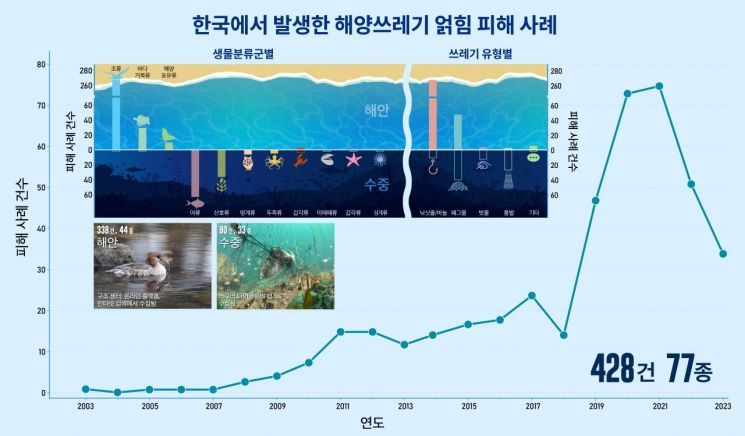
KIOST analyzed 20 years of data on marine animal entanglement with marine debris collected over the past three years (2021-2023).
The findings by KIOST researchers Noh Heejin, Hong Sanghee, and Shim Wonjun, published in the Marine Pollution Bulletin (February 2025, online), are titled "Unseen threats along the coast and in underwater ecosystems of South Korea: The severity of marine debris entanglement." The paper analyzes the impact of marine plastic debris entanglement on marine life.
This study was conducted by a joint research team from KIOST and the East Asian Sea Community OCEAN (led by Hong Sunwook), based on data collected from wildlife rescue and treatment centers across the Korean coast, media reports, records submitted by citizens on online platforms, and direct observation records from scuba divers (Team Booster, Aquaknights, cloud.oceanknighits.net).
The research team identified 428 cases of entanglement involving 77 species of marine animals?including seabirds, sea turtles, fish, and marine mammals?caused by fishing lines, hooks, and abandoned fishing gear over a 20-year period (2003-2023). The types and materials of debris were systematically classified, and the patterns of impact were analyzed according to biological taxonomy, habitat, and feeding strategy.
Additionally, statistical analysis was used to identify long-term trends and assess the risks to endangered species listed by the International Union for Conservation of Nature (IUCN) and marine protected species in Korea.
The analysis showed that the number of entanglement cases caused by marine debris has been increasing annually. Seabirds such as the black-tailed gull, which feed along the coast or in shallow waters, were frequently affected by fishing lines and hooks, while species such as sea turtles and dolphins, which feed underwater, were more often entangled in abandoned fishing gear.
Furthermore, the study found that 13% (10 species, 44 cases) of the affected marine animals?including the green sea turtle (Chelonia mydas) and black-legged kittiwake (Rissa tridactyla)?are listed as threatened species on the IUCN Red List and are internationally protected.
Threatened species are those assessed as being at risk of extinction on the IUCN Red List, which categorizes species worldwide into nine groups: extinct, extinct in the wild, critically endangered, endangered, vulnerable, near threatened, least concern, data deficient, and not evaluated. The categories of critically endangered, endangered, and vulnerable are collectively referred to as threatened.
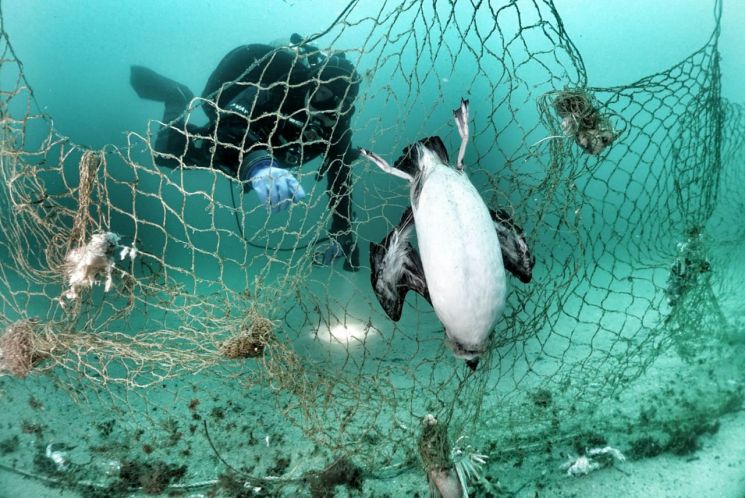
This study is particularly significant as it provides a comprehensive long-term assessment of the impact of marine debris entanglement on marine life in both coastal land and seabed ecosystems, and is expected to raise public awareness of the marine debris issue.
Noh Heejin, head of the Ecological Risk Research Division at KIOST, and Hong Sunwook, head of the East Asian Sea Community OCEAN, who led the research, stated, "This study demonstrates the real threats that marine debris poses to biodiversity and marine ecosystems. The data provided by wildlife rescue centers and civic groups have been invaluable."
Lee Heeseung, President of KIOST, said, "Marine debris is a global environmental issue that requires closer international cooperation to solve. In particular, we expect these research findings to play an important role in policy-making for marine environmental conservation and in raising public awareness."
© The Asia Business Daily(www.asiae.co.kr). All rights reserved.
![Clutching a Stolen Dior Bag, Saying "I Hate Being Poor but Real"... The Grotesque Con of a "Human Knockoff" [Slate]](https://cwcontent.asiae.co.kr/asiaresize/183/2026021902243444107_1771435474.jpg)

















