U.S. Navy Faces Production Capacity Shortfall
Shipbuilding Costs Rising Faster Than Inflation
"Need to Respond to China's Civil-Military Fusion Strategy"
Voices are continuing to call for the United States to cooperate with allies such as South Korea to counter China's naval power.
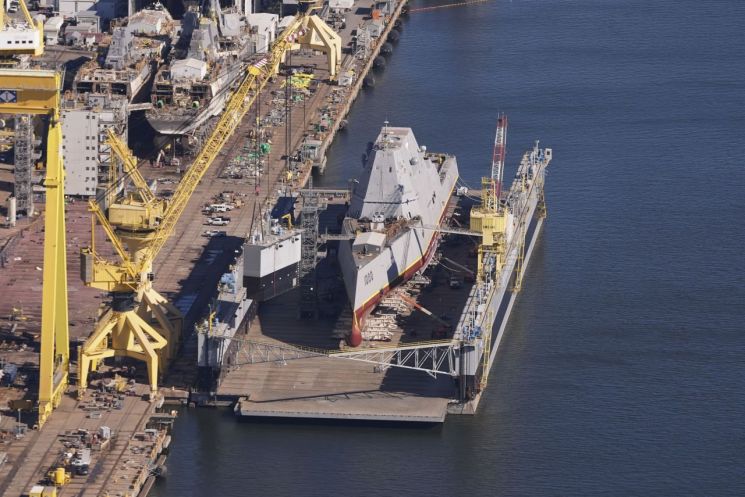
On the 11th (local time), Brett Sydel, Acting Assistant Secretary of the U.S. Navy for Research, Development, and Acquisition, stated at a House Armed Services Committee Navy Subcommittee hearing that "the U.S. shipbuilding industry is struggling to produce ships at the pace necessary to permanently enhance combat power."
He noted, "U.S. shipbuilders continue to produce the world's highest quality and safest state-of-the-art warships," but also pointed out that "ship deliveries are delayed by approximately 1 to 3 years, and costs are rising faster than overall inflation."
The U.S. Navy set a goal in 2016 to operate 355 warships and determined in 2023 that 381 ships would be needed to meet future battlefield demands. However, as of last year, only 295 ships were in operation. The U.S. Department of Defense stated in its 2024 China Military Power Report published last year that the Chinese navy possesses over 370 ships and submarines, making it the largest in the world, with the number expected to increase to 395 by 2025 and 435 by 2030.
As the arms race between the U.S. and China intensifies and international tensions rise, calls for the U.S. to urgently strengthen its naval power continue. Experts generally agree that U.S. shipbuilders, who have neglected investment since the Cold War and relied on government budgets, have lost competitiveness and regressed in their shipbuilding and repair capabilities.
Ronald O'Rourke, a naval expert at the Congressional Research Service (CRS), suggested in a report submitted to the subcommittee that the U.S. shipbuilding industry should adopt productivity improvement practices and techniques, such as developing ship designs that reduce labor input like South Korea.
He also pointed out that while there is an option to build naval vessels at shipyards of allied countries such as Japan, South Korea, and Europe, U.S. law prohibits this, and there are concerns about technology leakage. Title 10, Section 8679 of the U.S. Code forbids building warships at foreign shipyards unless the President grants an exception for national security reasons, and the annual Department of Defense appropriations bills passed by Congress include provisions that prohibit using funds to build warships at foreign shipyards.
Researchers at the U.S. think tank Center for Strategic and International Studies (CSIS) also called in a report published that day for countering Chinese shipbuilding in response to the Chinese government's civil-military fusion strategy. They recommended that the U.S. government impose fees on shipping companies that allow Chinese-made vessels to enter ports and restrict the transportation of major U.S. cargo on Chinese ships.
They also advised that the government use diplomatic efforts to sever transactions between U.S. companies and capital and Chinese shipyards that contribute to China's naval buildup, and encourage like-minded countries to take similar measures. Furthermore, they urged long-term investment in the U.S. shipbuilding industry and attracting foreign capital, stating, "In particular, key countries such as South Korea and Japan should be encouraged and incentivized to invest in U.S. shipyards."
The researchers emphasized that merely expanding the U.S. shipbuilding industry has limitations in countering China's dominance and stressed the need to promote friendshoring?restructuring supply chains centered on friendly countries?by strengthening shipbuilding capabilities in Japan, South Korea, and Europe through coordinated investment and policy incentives.
© The Asia Business Daily(www.asiae.co.kr). All rights reserved.
![Clutching a Stolen Dior Bag, Saying "I Hate Being Poor but Real"... The Grotesque Con of a "Human Knockoff" [Slate]](https://cwcontent.asiae.co.kr/asiaresize/183/2026021902243444107_1771435474.jpg)















