NYT: Trump Administration Begins Discussing Changes to Subsidy Projects
The semiconductor industry has fallen into panic due to U.S. President Donald Trump's remarks about repealing the "terrible" CHIPS Act, reported the U.S. daily The New York Times (NYT) on the 10th (local time).
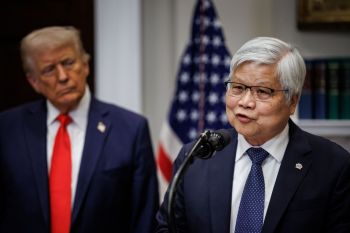 TSMC Chairman Wei Zhaojia (right) is giving a speech on the 3rd (local time) in the Roosevelt Room in Washington D.C., USA, after U.S. President Donald Trump announced that TSMC will invest $100 billion (approximately 145 trillion won) in the United States. Photo by UPI Yonhap News
In his first joint session speech to Congress on the 4th, President Trump criticized the CHIPS Act as "terrible." He added, "The CHIPS Act and everything left should all be eliminated," emphasizing, "The money should be used to reduce debt or for any other reason as desired."
The CHIPS Act is a bipartisan bill passed by the U.S. Congress in 2022 during the previous Joe Biden administration, which provides a total of $52.7 billion (approximately 77 trillion KRW) in subsidies to companies building semiconductor manufacturing facilities in the United States.
NYT cited eight anonymous sources reporting that semiconductor industry executives, fearing the withdrawal of allocated subsidies, have been consulting lawyers to inquire whether the U.S. Department of Commerce has grounds to terminate contracts.
The Trump administration has already begun to shake the subsidy program. Michael Grimes, formerly of Morgan Stanley, conducted brief interviews with employees of the 'CHIPS Program Office' under the Department of Commerce at the end of last month, and last week the Department of Commerce laid off 40 employees, amounting to one-third of the office's entire staff.
Sources said the Trump administration has started discussing changes to projects that received subsidies. The previous Biden administration gave preferential treatment to subsidy recipients who hired unionized construction workers and supported employee childcare. These guidelines are reportedly subject to change.
The Semiconductor Industry Association held a conference call with its members the day after President Trump's speech, and sources said some participants attributed Trump's dissatisfaction with the CHIPS Act to personal animosity toward former President Biden.
NYT also reported that President Trump claimed that due to U.S. tariff threats, Taiwan's TSMC decided to increase its U.S. investment to $100 billion (approximately 145 trillion KRW) and double the number of factories under construction in Arizona to six. However, sources said it is unclear whether TSMC's investment expansion was actually driven by tariffs.
According to sources, TSMC had already purchased land and drafted plans to expand investment when it secured customers necessary to operate the three additional factories it announced it would build.
It is said that customers including Apple and Nvidia promised to purchase more chips in the U.S., which simply accelerated the investment timeline compared to previous plans.
Lawyers and industry executives pointed out that tariffs on semiconductors themselves are not very effective because the U.S. imports almost no semiconductors directly. Semiconductors are generally sent directly to electronics factories in Asia, where they are embedded in laptops, mobile phones, and home appliances before being imported into the U.S.
Some in the semiconductor industry are reportedly preparing plans to persuade President Trump, including at the industry's annual meeting scheduled for November.
Deirdre Hanford, CEO of the National Semiconductor Technology Center established under the CHIPS Act to oversee semiconductor technology development, said, "Our colleagues in Washington need to remember this, accept it, and continue investing in our amazing industry."
Among some industry executives, there are complaints that the previous Biden administration started subsidy payments too late.
The law was enacted in August 2022, but the Biden administration spent several months reviewing individual projects, so final agreements on most major subsidy projects were only completed after the presidential election.
© The Asia Business Daily(www.asiae.co.kr). All rights reserved.

















