334 Cold-Related Illness Cases and 8 Estimated Deaths in the 2024-25 Season
88% of Fatalities Were Aged 65 or Older, Cause of Death Mainly Hypothermia
Last winter, the number of cold days in South Korea increased by 1.1 days compared to the same period last year, but the number of cold-related illness patients decreased by 16.5%, and deaths also dropped by 33.0%.
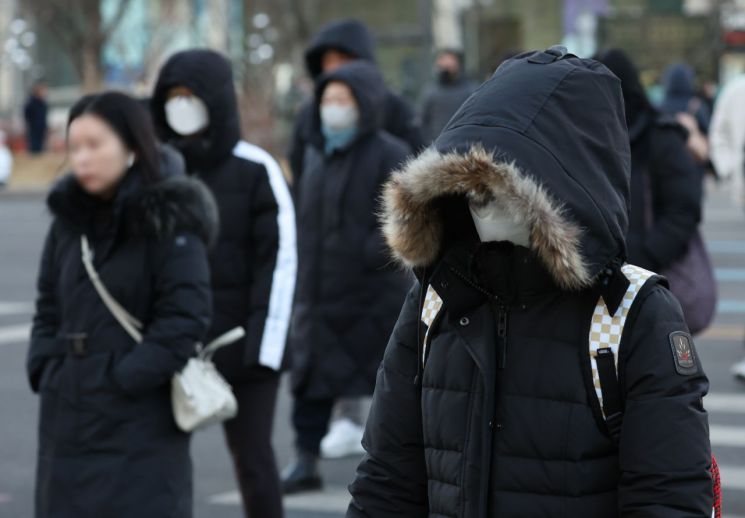
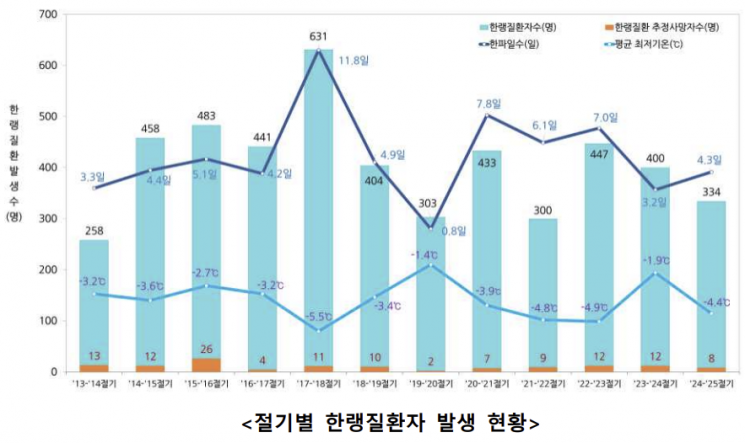
According to the results of the "2024-2025 Cold-Related Illness Emergency Room Surveillance System" announced by the Korea Disease Control and Prevention Agency on the 11th, a total of 334 cold-related illness patients were reported nationwide through about 500 emergency medical institutions and local governments from December 1 last year to February 28 this year. Among them, 8 deaths were recorded. Compared to the same period last year, the number of cold-related illness patients (400) decreased by 16.5%, and deaths (12) decreased by 33.0%.
Cold-related illnesses are diseases caused directly by cold that can harm the human body, with hypothermia, frostbite, and chilblains being representative examples. According to the Korea Meteorological Administration, the number of cold days last season in South Korea was 4.3 days, an increase from 3.2 days the previous year, and the average daily minimum temperature dropped from -1.9℃ to -4.4℃.
In the 2017-2018 season (December 2017 to February 2018), when the highest number of cold-related illness cases occurred (631 cases), the number of cold days was as high as 11.8 days, and the lowest minimum temperature was -5.5℃. Although the occurrence of cold-related illnesses has been notably correlated with the number of cold days and minimum temperatures, the Korea Disease Control and Prevention Agency explains that the trend of cold-related illness cases over the past five years does not show a clear correlation with weather changes.
The main symptom among cold-related illness patients in this surveillance was hypothermia (80.2%, 268 patients), and most of the estimated deaths (8) were also due to hypothermia (87.5%, 7 patients).
The incidence of cold-related illnesses was about 2.3 times higher in men (69.8%, 233 patients) than in women (30.2%, 101 patients). By age group, the highest incidence was among those aged 65 and older (54.8%, 183 patients), and most of the estimated deaths were also in this age group (87.5%, 7 patients). Notably, among the elderly aged 80 and above, 30.8% (103 patients) of cases occurred, with 75.0% (6 patients) of estimated deaths, confirming that the risk of cold-related illnesses increases with age.
The locations where cold-related illnesses occurred were roadside (25.4%, 85 patients), home (18.3%, 61 patients), and around residences (14.1%, 47 patients), with outdoor occurrences (74.0%, 247 patients) being about 2.9 times higher than indoor occurrences (26.0%, 87 patients). Additionally, the times when cold-related illnesses mainly occurred were between 6-9 AM (20.1%, 67 patients) and 9 AM-12 PM (16.8%, 56 patients), suggesting that the temperature drop overnight may influence cold-related illnesses.
By region, the Gyeonggi area had the highest number of cold-related illness patients (19.5%, 65 patients), and the incidence per 100,000 population was highest in Gangwon (2.8), Gyeongbuk (1.5), Chungbuk (1.4), and Jeonbuk (1.3), in that order.
© The Asia Business Daily(www.asiae.co.kr). All rights reserved.
![Clutching a Stolen Dior Bag, Saying "I Hate Being Poor but Real"... The Grotesque Con of a "Human Knockoff" [Slate]](https://cwcontent.asiae.co.kr/asiaresize/183/2026021902243444107_1771435474.jpg)
















