A high-performance catalyst capable of synthesizing ammonia without energy loss at low temperature and low pressure has been developed. Hydrogen production using renewable energy is a key technology for eco-friendly energy and chemical production, and research on hydrogen storage in the form of ammonia is being widely conducted worldwide. Considering this, the recent research achievement is expected to contribute to ammonia production and utilization suitable for future eco-friendly hydrogen economy systems.
KAIST announced on the 11th that Professor Min-ki Choi's research team from the Department of Bio and Chemical Engineering has developed a catalyst system that can increase ammonia productivity while reducing energy consumption and carbon dioxide emissions.
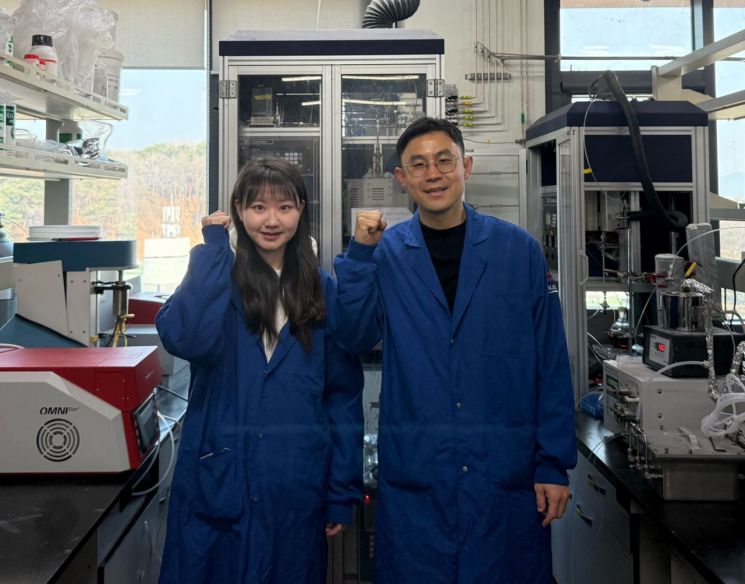 (From left) Baek Ye-jun, PhD candidate in the Department of Bio and Chemical Engineering, Professor Choi Min-ki. Provided by KAIST
The process of producing ammonia has relied on the iron (Fe)-based catalyst 'Haber-Bosch process' technology for over 100 years. However, this method requires high temperatures above 500 degrees Celsius and high pressures above 100 atmospheres, consuming enormous amounts of energy and generating large amounts of carbon dioxide during production. Additionally, ammonia produced by this method is manufactured in large-scale factories, resulting in significant distribution costs.
As an alternative to these problems, there is growing interest in an eco-friendly process that synthesizes ammonia at low temperature and low pressure (300 degrees Celsius, 10 atmospheres) using green hydrogen produced by water electrolysis. However, to implement this process, developing a catalyst that can secure high ammonia productivity even under low temperature and pressure is essential, but current technology shows limitations with reduced ammonia productivity under the same conditions.
In response, the research team developed a novel catalyst that operates like a 'chemical capacitor' by introducing ruthenium (Ru) catalysts and strongly basic barium oxide (BaO) particles onto a highly conductive carbon surface. A capacitor is a device that stores electrical energy by separating it into positive (+) and negative (-) charges.
The catalyst developed by the research team decomposes hydrogen molecules (H2) into hydrogen atoms (H) on the ruthenium catalyst during the ammonia synthesis reaction, and these hydrogen atoms are further split into proton (H+) and electron (e-) pairs. At this time, the acidic protons are stored in the strongly basic barium oxide, while the remaining electrons are separately stored in ruthenium and carbon.
Furthermore, due to the unique chemical capacitor phenomenon, the electron-rich ruthenium catalyst promotes the cleavage of nitrogen (N2) molecules, which is the key step in ammonia synthesis, dramatically enhancing catalytic activity, the research team explained.
In particular, the research team demonstrated that by controlling the nanostructure of carbon, the electron density of ruthenium can be maximized, thereby enhancing catalytic activity. As a result, this catalyst exhibited ammonia synthesis performance more than seven times higher than the previous best catalysts under mild conditions of 300 degrees Celsius and 10 atmospheres.
Professor Min-ki Choi of KAIST said, "This research has attracted academic attention by confirming that controlling electron movement inside catalysts during conventional thermochemical catalytic reactions, rather than electrochemical ones, can significantly improve catalytic activity. It was confirmed that efficient ammonia synthesis is possible even under low temperature and low pressure conditions using the catalyst developed by the research team, which is expected to enable more flexible ammonia production and utilization suitable for eco-friendly hydrogen economy systems."
Meanwhile, this research was conducted with support from the Korea Institute of Energy Research and the National Research Foundation of Korea. Professor Min-ki Choi of the Department of Bio and Chemical Engineering served as the corresponding author, and doctoral student Ye-jun Baek participated as the first author. The study was introduced on the 24th of last month in the international journal in the field of catalytic chemistry, Nature Catalysis.
© The Asia Business Daily(www.asiae.co.kr). All rights reserved.

















