Implementation of Pregnancy and Childbirth Coverage Products and Improvements to Triplet Fetal Insurance
Remaining Tasks to Be Further Institutionalized Through Standing Meetings
Separate Communication Opportunities to Be Provided for Major Field-Interest Issues
The Insurance Reform Council, which has been ongoing since May last year to improve the structural problems of the insurance industry, will conclude after its 7th meeting. The financial authorities plan to transition the major insurance industry issues discussed at the Insurance Reform Council from regular meetings to standing meetings to monitor implementation and other matters.
On the 11th, the Financial Services Commission held the 7th Insurance Reform Council meeting. This meeting was conducted as a large forum with over 130 participants, including practitioners who had participated in the Insurance Reform Council, insurance company CEOs, academia and experts, as well as associations from life insurance, non-life insurance, and corporate insurance agencies. They discussed supplementary reform tasks in four areas: ▲ Comprehensive insurance reform measures for restoring trust and innovation ▲ Advanced capital regulation plans for the insurance sector ▲ Future preparedness tasks for the insurance industry ▲ Future preparedness strategies for insurance companies.
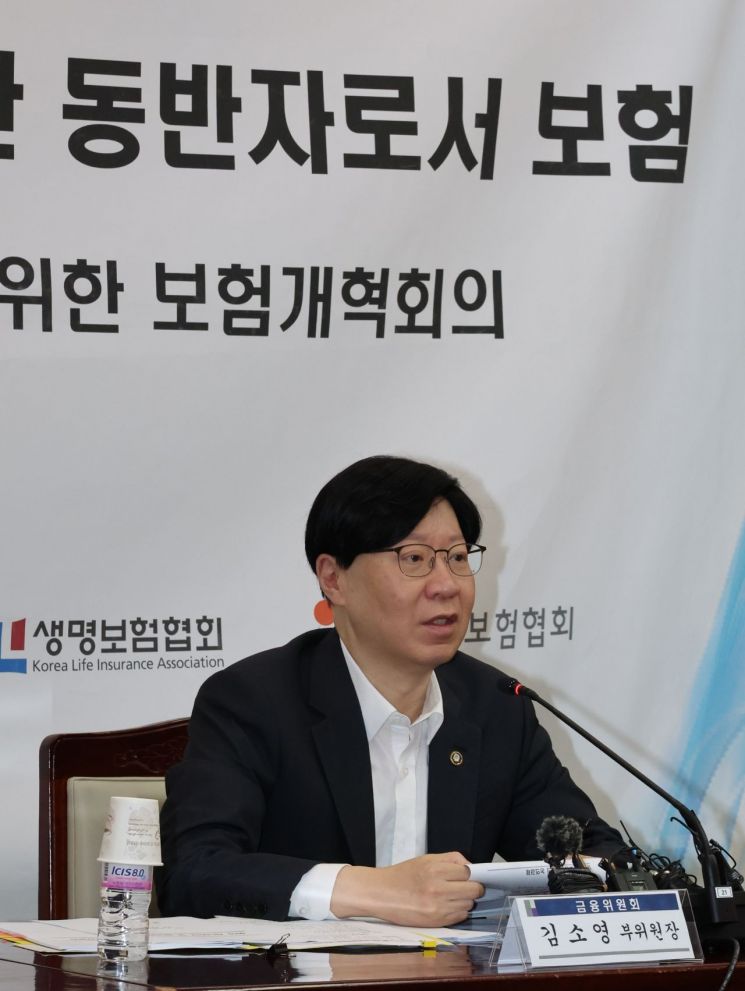 Kim So-young, Vice Chairman of the Financial Services Commission, speaking at the Insurance Reform Meeting held last year. Photo by Yonhap News
So far, the financial authorities and the insurance industry have selected 74 tasks as part of the comprehensive insurance reform measures through the Insurance Reform Council. Among these, 23 tasks have been institutionalized and are already in effect. Representative examples include pregnancy and childbirth coverage products, improvements to triplet fetal insurance, and no-accident refund systems for non-life insurance. The financial authorities plan to focus on further institutionalization and market stabilization of the remaining tasks.
Regarding insurance product improvement measures, preparations for the reorganization of internal product committees within insurance companies were shared. Various opinions were also expressed on strengthening the standardization of electronic claims for actual expense insurance, expanding limits on providing special benefits, and expanding pregnancy and childbirth support products. There was also an expectation that if insurance companies launch various products linked not only to pregnancy and childbirth but also to postpartum care and childcare, it would greatly help overcome low birth rates.
Regarding sales channel improvements, discussions were held on the reorganization of financial institution insurance agencies, the operational risk evaluation system for corporate insurance agencies (GA), and directions for sales commission reform. Concerning the reorganization of financial institution insurance agencies, which includes improvements to the so-called 'Bancassurance 25% rule' regulation, there was a request to establish communication channels to convey the possibility of abuse of dominant positions by other sectors and opinions from the insurance industry field, as this regulation is being improved for the first time in about 20 years. Regarding the recent major issue in the GA industry, sales commission reform, it was suggested that additional opinion gathering such as explanatory meetings is necessary before finalizing the system, as the GA industry is somewhat unaware of the reform direction.
Regarding the revision of International Financial Reporting Standards (IFRS17), opinions were exchanged on expanding information sharing about liability discount rates, the possibility of reduced public understanding and administrative burden when improving disclosure-related systems, and strengthening communication when improving actuarial assumption calculation systems. There was also a suggestion that when improving actuarial assumption calculation systems such as lapse rates, the industry and authorities should communicate openly about specific operational directions and future schedules.
For future preparedness tasks, opinions were raised that products attracting youth interest, such as youth-only insurance, subscription-type insurance, and do-it-yourself (DIY) insurance, should be developed. There was also an opinion that securitization of death benefits would be an effective support measure for the elderly. Suggestions were made that non-life insurance products should also allow securitization of insurance benefits or insurance claim trusts. There was an opinion that combining trust and insurance services to evolve the insurance industry into a platform providing services throughout life requires policy support from the authorities.
The financial authorities plan to provide separate communication opportunities for major tasks with high interest in the field among the opinions presented by sector. They plan to operate a working-level consultative body to discover additional tasks for future preparedness. For tasks not yet finalized beyond the 74 comprehensive insurance reform tasks, such as the introduction of sales specialist companies, activation of data utilization for customized product development, activation of small-amount short-term insurance companies, and review of special benefit regulation improvements, follow-up measures such as short-term research projects and consultations with related agencies will be carried out.
Kim So-young, Vice Chairman of the Financial Services Commission, said, “Thanks to the efforts of the insurance industry, a foundation has been laid for the insurance industry to take off again as a trusted partner of the people.” She added, “We will not forget the determination at the launch of the Insurance Reform Council to change long-standing practices and perceptions and reform everything, and will work together to become an industry trusted by the public.”
© The Asia Business Daily(www.asiae.co.kr). All rights reserved.
![Clutching a Stolen Dior Bag, Saying "I Hate Being Poor but Real"... The Grotesque Con of a "Human Knockoff" [Slate]](https://cwcontent.asiae.co.kr/asiaresize/183/2026021902243444107_1771435474.jpg)
















