Trump: "There Is a Transition Period in Bringing Wealth Back to America"
Determined to Push Ahead with Tariffs Even Amid Recession Concerns
February CPI and PPI to Be Released This Week
The three major indices of the U.S. New York Stock Exchange plunged sharply in early trading on the 10th (local time). Concerns over tariff policy uncertainty are growing, and remarks by U.S. President Donald Trump, who did not rule out the possibility of an economic recession, are dragging down stock prices. As demand for safe-haven assets expands, government bond yields are declining.
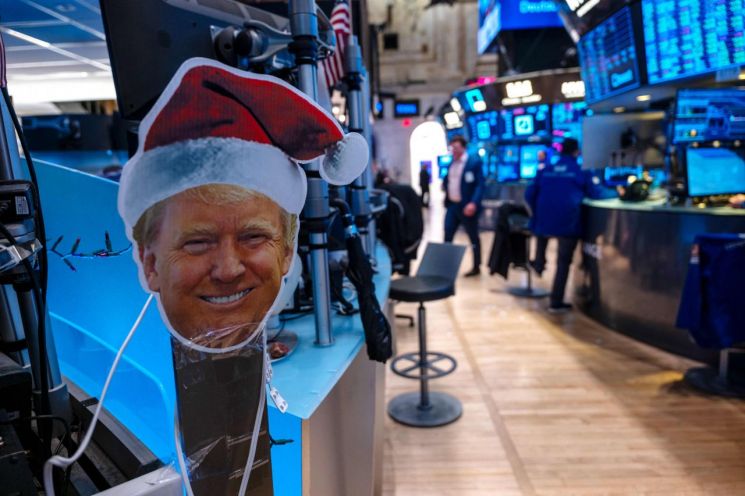
As of 10:17 a.m. in the New York stock market on the day, the Dow Jones Industrial Average (Dow), which focuses on blue-chip stocks, was trading at 42,458.04, down 343.67 points (0.8%) from the previous trading day. The S&P 500, centered on large-cap stocks, fell 101.05 points (1.75%) to 5,669.14, and the Nasdaq, focused on technology stocks, dropped 518.51 points (2.85%) to 17,677.71.
By stock, technology shares are plunging. Nvidia, the leader in artificial intelligence (AI) stocks, is down 3.27%. Alphabet, Google's parent company, is down 4.08%, and U.S. electric vehicle maker Tesla is plunging 8.71%. Defensive consumer goods stocks are rising, with Unilever up 2.67%.
President Trump expressed his determination to push ahead with tariff policies even if it means enduring a temporary economic recession. In an interview with Fox News aired on the 9th, when asked about the possibility of a recession this year, he said, "I don't want to predict such a thing," but added, "We are doing something very big, and there is a transition period in such matters." He continued, "We are doing something big to bring wealth back to America," and said, "These things always take some time, but I think it will be better for us." President Trump also reaffirmed his intention to implement reciprocal tariffs on the 2nd of next month. On the same day, U.S. Commerce Secretary Wilbur Ross announced that a 25% tariff on all steel and aluminum products entering the U.S. would be imposed as scheduled on the 12th.
Concerns are growing that the White House's aggressive tariff measures could lead to an economic recession, further dampening investor sentiment.
Chris Larkin, Managing Director of Investments at Morgan Stanley eTrade, said, "There are always multiple forces at play in the market, but right now most are being overshadowed by tariffs," adding, "Traders and investors should expect continued volatility until trade policies become clearer."
Lori Calvasina, Head of U.S. Equity Strategy at RBC Capital Markets, said, "The risk of a bear market has increased," and added, "We had expected the market to decline 5-10% by year-end, but now we think the decline could be in the 14-20% range."
This week, inflation indicators that could influence the timing of the Federal Reserve's resumption of interest rate cuts will be released one after another. On the 12th, the Consumer Price Index (CPI), a retail price indicator, will be released, followed by the Producer Price Index (PPI), a wholesale price indicator, on the 13th. The February CPI is expected to have risen 2.9% year-on-year, a slowdown from the previous month's 3%. The PPI for the same month is forecast to have increased 0.3% month-on-month, also below the previous month's 0.4%. With growing concerns that high inflation may become entrenched, these inflation indicators, released just before the March Federal Open Market Committee (FOMC) meeting scheduled for the 18th-19th, are attracting particular attention.
As uncertainty over tariff policies drives demand for safe-haven assets, government bond prices are rising and bond yields are falling. The yield on the 10-year U.S. Treasury note, a global benchmark for bond yields, fell 9 basis points (1 bp = 0.01 percentage points) from the previous trading day to 4.22%, while the yield on the 2-year U.S. Treasury note, which is sensitive to monetary policy, moved down 7 basis points to 3.92%. Expectations that the Fed may accelerate monetary easing due to a recession are also pushing down Treasury yields.
© The Asia Business Daily(www.asiae.co.kr). All rights reserved.
![Clutching a Stolen Dior Bag, Saying "I Hate Being Poor but Real"... The Grotesque Con of a "Human Knockoff" [Slate]](https://cwcontent.asiae.co.kr/asiaresize/183/2026021902243444107_1771435474.jpg)















