Establishing a Support System to Prevent Solitary Deaths Among High-Risk and Socially Isolated Households
Customized Support by Service Type: Wellness Checks, Lifestyle Improvement, Social Network Formation, and Post-Management
63 Billion KRW Invested in 29 Projects, Including New Initiatives Such as Essential Goods Support to Encourage Outings
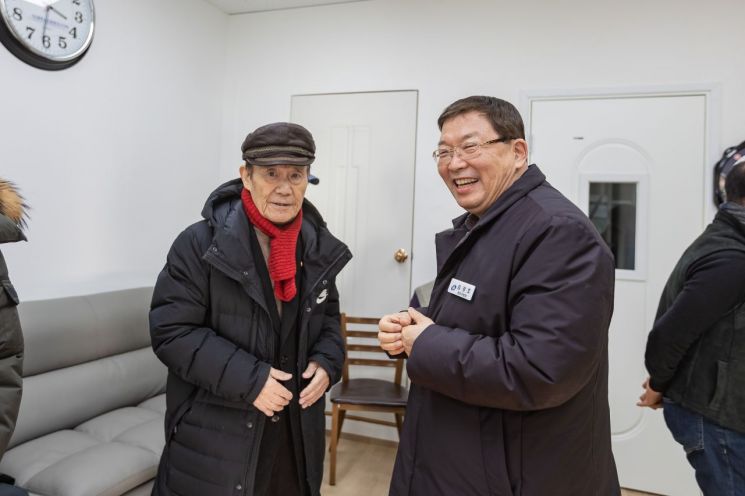 Kim Kyung-ho, head of Gwangjin District Office, is visiting a senior center and having a conversation with the elderly.
“The incident that happened last year in Jayang-dong is still vivid in my memory. I hurriedly went to the home of an elderly person who did not answer the wellness check call, and their health condition looked very poor. I immediately reported it to 119 and helped transfer them to the hospital. If we had been even a little late, it could have led to a tragic accident. It was a heart-stopping moment. I want to express my gratitude once again to the staff who accompanied me.”
This is what Yu 00, an administrative officer working in Gwangjin-gu, said as they recalled the memory.
Gwangjin-gu (Mayor Kim Kyung-ho) is taking the lead in preventing solitary deaths. To address the issues of social isolation and solitary death, the district has established the “2025 Solitary Death Prevention Implementation Plan” and set up a support system.
Solitary death refers to dying alone while being cut off from people around you. It occurs in single-person households. In the past, it was mostly elderly living alone, but the number of solitary deaths among young and middle-aged adults is gradually increasing.
According to the district, as of the end of last year, there were 85,851 single-person households in Gwangjin-gu, accounting for more than half of all households. This is a 3.6 percentage point increase compared to 78,614 households in 2020. Among them, 53% were young adults aged 19 to 39, 29% were middle-aged adults aged 40 to 64, and 17% were elderly aged 65 and above. Among the 25 autonomous districts in Seoul, Gwangjin-gu ranks sixth in the proportion of single-person households.
Accordingly, the district provides customized solitary death prevention services. They monitor high-risk groups for solitary death and socially isolated households within the community by dividing services into four types: wellness checks, lifestyle improvement, social network formation, and post-management.
First, they strengthen the wellness check service. This service checks mobile phone records and automatically sends an answering machine call if there are no call records or if the phone is turned off. Non-responders are immediately reported to the responsible staff for prompt crisis response. This year, they introduced IoT technology using door opening sensors to diversify monitoring methods. About 3,000 households at risk of solitary death will benefit.
A new isolated daily life improvement project is also launched. This project encourages outings for 40 high-risk individuals. Once a month, they visit community centers and local welfare institutions to receive blood pressure checks and health and welfare counseling. Only those who verify their outdoor activities receive essential goods worth about 200,000 KRW annually. This project aims to promote sociality by encouraging outdoor activities.
Efforts are also made in social network formation and post-management. Regular group programs such as self-help meetings, sports activities, and cultural activities are operated to alleviate anxiety and loneliness among socially isolated households. These are piloted at the neighborhood level to promote exchanges. For low-income unclaimed deceased suspected of solitary death, up to 1 million KRW is provided for belongings cleanup and special cleaning costs.
A 6.3 billion KRW budget implementation plan has also been prepared. It includes 29 projects under four key tasks: ▲identifying high-risk solitary death groups and assessing risk levels ▲strengthening connections to resolve social isolation ▲linking services by life cycle ▲establishing a foundation for solitary death prevention management. Unique projects in Gwangjin-gu include crisis information utilization surveys, group program operations, free health checkups for single-person households, beverage delivery and wellness check services for low-income elderly living alone, public funerals for unclaimed and solitary death deceased, and moving support services for single-person households. The district aims to achieve zero solitary deaths for the second consecutive year.
Kim Kyung-ho, Mayor of Gwangjin-gu, said, “The issue of solitary death is not just an individual problem but a challenge that society as a whole must consider and solve together. We ask for the warm interest of local residents,” and added, “We will continue to work closely with the community to prevent solitary deaths and build a dense social safety net.”
© The Asia Business Daily(www.asiae.co.kr). All rights reserved.
![Clutching a Stolen Dior Bag, Saying "I Hate Being Poor but Real"... The Grotesque Con of a "Human Knockoff" [Slate]](https://cwcontent.asiae.co.kr/asiaresize/183/2026021902243444107_1771435474.jpg)















