'Pyeongan Gamsa Dogwa Geupjeja Hwanyeongdo' Unveiled Again After 31 Years
Depicts a Banquet Scene in Pyongyang from 200 Years Ago
Conserved Over 1 Year and 4 Months
Joseon-Era Women's Wedding Garment 'Hwalot' Also Revealed
The Overseas Korean Cultural Heritage Foundation announced on the 10th that, together with the Samsung Foundation of Culture, it will newly unveil the eight-panel folding screen titled 'Pyeongan Gamsa Dogwa Geupjeja Hwanyeongdo' (平安監司道科及第者歡迎圖) held by the Peabody Essex Museum in the United States. This is the first public display after about one year and four months of conservation treatment at the Leeum Museum of Art's Conservation Research Lab.
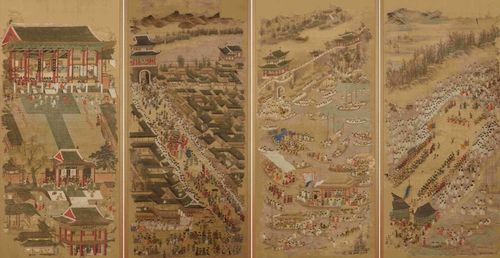 Partial section of the folding screen "Pyeongan Gamsa Dogwa Geupje Ja Hwanyeongdo." Provided by the Overseas Korean Cultural Heritage Foundation.
According to the Overseas Korean Cultural Heritage Foundation, the revealed folding screen underwent a long process of historical verification, during which the order of the panels and some damaged parts were restored. When the folding screen was first exhibited at the National Museum of Korea in Seoul in 1994, the panels were separated and in a severely damaged state. The displayed folding screen has been conserved, marking the first case of a private museum in Korea preserving and presenting overseas cultural heritage.
Correcting the Title of ‘Pyeongan Gamsa Dogwa Geupjeja Hwanyeongdo’
During the verification process, the artifact's title was changed from the previous 'Pyeongan Gamsa Hyangyeondo' (平安監司饗宴圖) to 'Pyeongan Gamsa Dogwa Geupjeja Hwanyeongdo'.
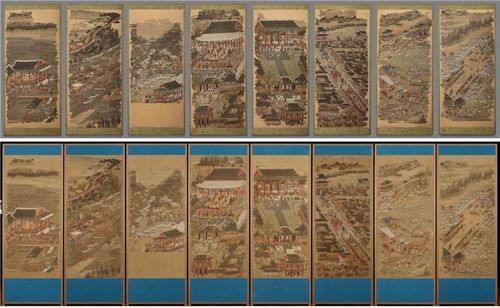 Before (above) and after (below) the preservation treatment of 'Pyeongan Gamsa Dogeup Jeja Hwanyeongdo'. Provided by the Overseas Korean Cultural Heritage Foundation
While the 'Pyeongan Gamsa Hyangyeondo' held by the National Museum of Korea depicts a boat party scene of the Pyeongyang magistrate's entourage, the painting in this work shows the celebration of two prospective officials who passed the top of the provincial civil service examination (Dogwa) in Pyeongan Province in 1826. A museum official explained, "This is currently the only known work depicting the celebration of officials who passed the Pyeongan Dogwa."
Regarded as a Treasure-Level Material of High Historical Value
The museum estimates that the work has very high historical value. Regarding traces of paper containing rice flour found on the folding screen, a museum official said, "Adding thickness to the paper improves color development. The effort put into this suggests its high value," and added, "It is a very large and well-painted work, likely created by a court painter or someone of equivalent skill."
Wedding Garment ‘Hwalot’ Also Unveiled
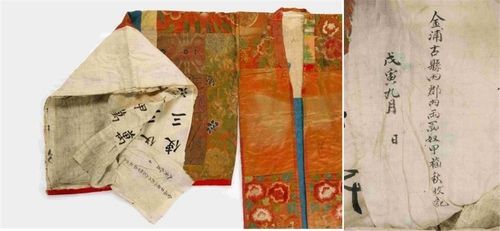
The Hwalot held by the Peabody Essex Museum was also unveiled. The Hwalot, a traditional wedding garment for women during the Joseon Dynasty, is characterized by various embroidered patterns such as phoenixes and flowers on red silk, decorated with gold leaf. Originally royal ceremonial attire, it later became widely used among commoners. It is known that about 50 pieces remain worldwide, including around 30 in Korea.
The production date of the unveiled Hwalot is estimated to be from the 18th to 19th century. During the conservation process, part of a Chusugi (秋收記), a harvest record document bearing the name 'Gapbok' (甲福), presumed to be a slave from the Gimpo region, was found inside the sleeve. Chusugi is a document recording the harvest status of cultivated land. A representative from the Seokjuseon Memorial Museum at Dankook University, responsible for the conservation, explained, "The Chusugi includes the phrase 'Muin 9wol' (戊寅九月), and the Muin year is estimated to be one of 1818, 1878, or 1938." Additionally, in the Gwageot (official robe), several layers of hanji (traditional Korean paper) were found lining the garment, including a Nakbokji (落幅紙), which is an answer sheet of a failed candidate in the civil service examination.
The 'Pyeongan Gamsa Dogwa Geupjeja Hwanyeongdo' folding screen and the Hwalot will be on display from the 11th until April 6th on the second floor of M1, the permanent exhibition hall for antiques at the Leeum Museum of Art. Afterwards, they are scheduled to be exhibited in the Korean Gallery of the Peabody Essex Museum in May.
© The Asia Business Daily(www.asiae.co.kr). All rights reserved.
![Clutching a Stolen Dior Bag, Saying "I Hate Being Poor but Real"... The Grotesque Con of a "Human Knockoff" [Slate]](https://cwcontent.asiae.co.kr/asiaresize/183/2026021902243444107_1771435474.jpg)


















