Swedish Think Tank Releases "Trends in International Arms Transfers" Report
South Korea Ranks Among Top 10 Exporters... Main Destinations: Poland, the Philippines, and India
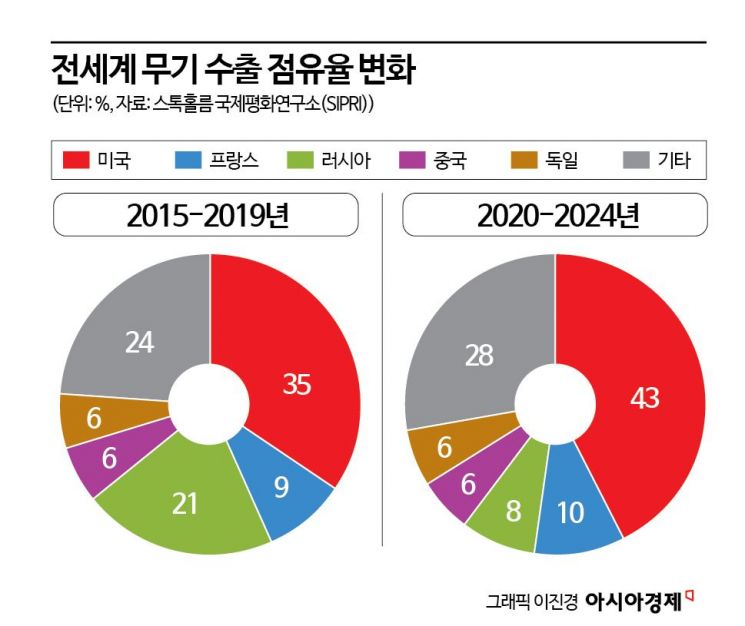
A Swedish think tank has revealed that the United States accounts for 43% of global arms exports. Since the outbreak of the Russia-Ukraine war in 2022, Russia's arms exports have declined due to increased domestic demand, while European demand has risen, leading to an increase in the U.S. share. South Korea also ranked among the top 10 arms exporters.
The Stockholm International Peace Research Institute (SIPRI), a non-profit think tank based in Sweden, reported on the 10th (local time) in its "Trends in International Arms Transfers, 2024" report that over the past five years (2020?2024), the U.S. share of global arms exports rose to 43%, up 8 percentage points from 35% in the previous five years (2015?2019). This is more than four times the share of the second-ranked France (10%). During the same period, Russia's arms exports sharply declined to about 8% (third place).
The region with the highest exports of U.S.-made weapons was Europe (35%), which the report noted surpassed the Middle East (33%) for the first time in 20 years. However, by individual country, Saudi Arabia (12%) was the largest U.S. "customer," followed by Ukraine (9.3%) and Japan (8.8%).
The largest arms importer was Ukraine. Ukraine's arms imports increased nearly 100-fold compared to the previous five years, making it the world's top importer. This accounts for 8.8% of global arms imports. Notably, since Russia's invasion in 2022 triggered the Ukraine war, at least 35 countries have supplied weapons to Ukraine. Among the arms supplied to Ukraine from 2020 to 2024, 45% were U.S.-made, followed by Germany (12%) and Poland (11%).
Peter Wezeman, a senior researcher at SIPRI, analyzed that the decline in Russia's arms exports is due to increased domestic demand caused by the Ukraine war and Western trade sanctions making Russian production and sales more difficult. He added that although NATO member countries in Europe have taken measures to strengthen European industry amid growing Russian threats and strained relations with the U.S. during Donald Trump's first administration, "the arms supply relationship between the U.S. and Europe has deep roots, and (European) imports of U.S.-made weapons have actually increased."
The Washington Post (WP) in the U.S. noted that these statistics emerged amid the Trump administration's pressure on Ukraine for a ceasefire. President Donald Trump repeatedly argued that the U.S. should be compensated for military aid provided to Ukraine. He also emphasized the necessity of mineral agreements to allow the U.S. access to Ukraine's critical minerals.
In response, Ukrainian President Volodymyr Zelenskyy countered Trump's claims about U.S. military aid, stating that "a significant portion of the $174 billion in U.S. funds approved by Congress for responding to the Ukraine war actually flowed to U.S. defense contractors."
Meanwhile, South Korea ranked 10th globally in arms exports over the past five years. Its share of global exports increased slightly from 2.1% to 2.2%. South Korea's top three arms export destinations were Poland (46%), the Philippines (14%), and India (7%).
During the same period, South Korea's arms imports fell by 24% compared to the previous five years, reducing its share of global arms imports from 3.4% to 2.6%. It ranked 12th worldwide, dropping three places from 9th last year. However, the report noted that "due to tensions with China and North Korea, Japan and South Korea are expanding their military capabilities," and "the U.S. was the main arms supplier for both countries, accounting for 97% of Japan's arms imports and 86% of South Korea's."
© The Asia Business Daily(www.asiae.co.kr). All rights reserved.
![Clutching a Stolen Dior Bag, Saying "I Hate Being Poor but Real"... The Grotesque Con of a "Human Knockoff" [Slate]](https://cwcontent.asiae.co.kr/asiaresize/183/2026021902243444107_1771435474.jpg)
















